Algebraic modelling: completing a model from the context

What this lesson covers
- A model is completed by substituting known facts from the context into its given form.
- Every answer from a model has to be checked against the context it came from.
Completing a model
- The exam often gives the shape of the model.
- Your job: find the missing constant.
- Then use the model to answer the question.
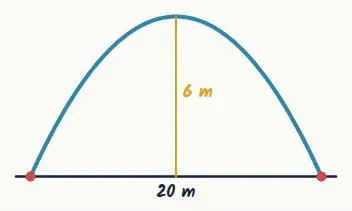
A bridge arch: 20 m wide, 6 m high
- Put the origin at one foot of the arch.
- It is zero at 0 and 20: y = kx(20 − x).
- The top is at x = 10, height 6.
Finding k
- Substitute the top point.
- Then solve for k.
- y = kx(20 − x)zero at 0 and 20
- 6 = k × 10 × (20 − 10)top: x = 10, y = 6
- 6 = 100k
- k = 6 ÷ 100 = 0.06÷ 100
- y = 0.06x(20 − x)
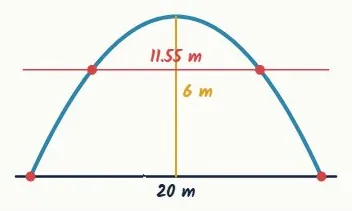
How wide is the arch 4 m up?
- Set the height to 4 and solve.
- x = 4.23 m and x = 15.77 m.
- The width at 4 m is 11.55 m.
Height 4 m: rearrange to zero
- Expand the bracket.
- Clear the decimals.
- 0.06x(20 − x) = 4height 4 m
- 1.2x − 0.06x² = 4expand
- 0.06x² − 1.2x + 4 = 0rearrange to zero
- 3x² − 60x + 200 = 0× 50
The quadratic formula
- Two roots: one each side.
- Width: their difference.
- 3x² − 60x + 200 = 0
- a = 3, b = −60, c = 200
- x = (60 ± √(3600 − 2400))/6formula
- = (60 ± √1200)/6
- = 10 ± 5.774
- x = 4.226 or x = 15.774
- width = 15.774 − 4.226difference
- ≈ 11.55 m
A thrown ball: vertex form
- Top known: vertex form.
- One more point finds a.
- y = a(x − 5)² + 8top at (5, 8)
- 3 = a(0 − 5)² + 8through (0, 3)
- 3 = 25a + 8
- 25a = −5subtract 8
- a = −0.2÷ 25
- y = −0.2(x − 5)² + 8
Where does the ball land?
- It lands where y = 0.
- Reject the negative root.
- y = −0.2(x − 5)² + 8
- −0.2(x − 5)² + 8 = 0lands: y = 0
- −0.2(x − 5)² = −8subtract 8
- (x − 5)² = 40÷ −0.2
- x − 5 = ±√40 = ±6.325square root
- x = 5 − 6.325 = −1.325behind the thrower
- x = 5 + 6.325 = 11.325
- It lands 11.3 m away.
Which form to use
- Know where it crosses zero? Use the roots.
- Know the top or bottom? Use vertex form.
- Then one more point finds the constant.
A model from Pythagoras
- Legs x and x + 7.
- Hypotenuse 13.
- A quadratic follows.
- x² + (x + 7)² = 13²Pythagoras
- x² + x² + 14x + 49 = 169expand
- 2x² + 14x − 120 = 0subtract 169
- x² + 7x − 60 = 0÷ 2
- (x + 12)(x − 5) = 0factorise
- x = −12a length is positive
- x = 5: legs 5 and 12
- area = ½ × 5 × 12 = 30 units²
Check every answer against the context
- x = −12 fits the equation, not the triangle.
- The ball does not land behind the thrower.
- Say why each rejected answer fails.
Where the marks are
- Merit: complete the model and use it.
- Excellence: model the situation yourself.
- Both: an answer in context, with units.
What to take away
- Finish the model from the facts, then use it.
| Given a form | substitute known facts to finish it |
| Zeros known | y = kx(w − x) |
| Top known | y = a(x − h)² + k |
| Shapes | Pythagoras, area and volume formulae |
| Solve | then reject what cannot happen |
| Answer | a sentence with units |
Your turn: four questions
- Pause here and answer each one.
- Sketch the situation first.
- Answers with units.
| Question | |
|---|---|
| 1 | Arch: 12 m wide, 9 m high, y = kx(12 − x). Find k. |
| 2 | How high is that arch 2 m from one end? |
| 3 | Legs x and x + 2, hypotenuse 10. Find the legs. |
| 4 | Q3 gives x = 6 or −8. Which do you keep, and why? |
Show answer
1. At x = 6: 9 = 36k, so k = 0.25. 2. y = 0.25 × 2 × 10 = 5 m. 3. x² + (x + 2)² = 100 gives x² + 2x − 48 = 0, so x = 6: legs 6 and 8. 4. Keep 6: a length cannot be negative.
The answers: questions 1 and 2
- 1. top at x = 6, y = 9halfway across
- 9 = k × 6 × (12 − 6)substitute
- 9 = 36k
- k = 9 ÷ 36 = 0.25
- 2. y = 0.25 × 2 × (12 − 2)x = 2
- = 0.25 × 2 × 10
- = 5 m high
The answers: questions 3 and 4
- 3. x² + (x + 2)² = 10²Pythagoras
- x² + x² + 4x + 4 = 100expand
- 2x² + 4x − 96 = 0subtract 100
- x² + 2x − 48 = 0÷ 2
- (x + 8)(x − 6) = 0factorise
- x = 6 or x = −8
- legs 6 and 6 + 2 = 8check: 36 + 64 = 100
- 4. x = −8 is negativenot a length
- keep x = 6
Is your child on track?
Take the free placement test