The derivative: what the gradient function means
What this lesson covers
- The derivative gives the gradient of the curve at every point.
- The gradient at a point is the gradient of the tangent there, which the chord gradients approach.
How steep is a curve?
- A straight line has one gradient everywhere.
- A curve gets steeper or flatter as you go.
- The derivative gives its gradient at every point.
The gradient of y = x² at x = 3
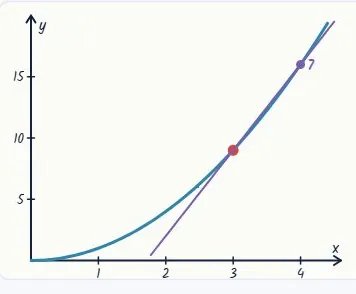
- Mark the point (3, 9) on the curve.
- A chord joins it to a second point.
- Chord to x = 4: gradient 7.
Move the second point closer
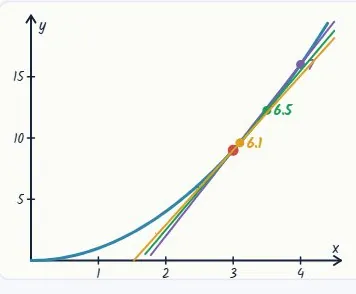
- To x = 3.5: gradient 6.5.
- To x = 3.1: gradient 6.1.
- The chords are closing in on one line.
The limit is the tangent
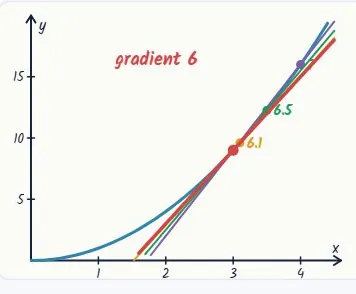
- As the gap shrinks, the gradient heads to 6.
- That line just touches the curve: the tangent.
- Gradient at x = 3 is 6, which is 2 × 3.
The numbers behind the drawing
- Rise ÷ run, each chord.
- The run shrinks to 0.
- Gradients close in on 6.
- gradient = rise ÷ run
- x = 4: (16 − 9) ÷ 1 = 7
- x = 3.5: (12.25 − 9) ÷ 0.5 = 6.5
- x = 3.1: (9.61 − 9) ÷ 0.1 = 6.1
- x = 3.01: (9.0601 − 9) ÷ 0.01
- = 0.0601 ÷ 0.01 = 6.01
- gradients → 6 as run → 0
A gradient for every x
- Repeat at any point on y = x²: the gradient is 2x.
- dy/dx = 2x is the gradient function.
- It is a new function, not the curve.
| y = x² | the curve: heights |
| dy/dx = 2x | the gradient at every x |
| at x = 3 | height 9, gradient 6 |
| at x = −1 | height 1, gradient −2 |
The rule for xⁿ
- Bring the power down in front.
- Then reduce the power by one.
- A constant term has gradient 0.
| y | dy/dx |
|---|---|
| x² | 2x |
| x³ | 3x² |
| x⁵ | 5x⁴ |
| 5x | 5 |
| 7 (a constant) | 0 |
Using it at a point
- Differentiate first.
- Brackets around −2.
- Positive: the curve rises.
- y = x³
- dy/dx = 3x²power down, one less
- x = −2: 3 × (−2)²into dy/dx
- = 3 × 4 = 12
- x = 1: 3 × 1² = 3
The most common gradient mistake
- Substituting into y gives a height, not a gradient.
- For a gradient, substitute into dy/dx.
- Write which one you are using.
| Asked | the gradient of y = x³ at x = 2 |
| Wrong | substitute into y: 8 |
| Right | dy/dx = 3x², so 3 × 4 = 12 |
A gradient is a rate of change
- Units of y per unit of x.
- Metres per second, dollars per item.
- Say the rate in context, with units.
What to take away
- The derivative is the gradient, everywhere at once.
| Derivative | the gradient at every point |
| Tangent | the limit of the chords |
| Rule | xⁿ becomes nxⁿ⁻¹ |
| Constant | differentiates to 0 |
| Gradient at a point | substitute into dy/dx |
| Height at a point | substitute into y |
Your turn: four questions
- Pause here and answer each one.
- Question 3 is a chord, not a derivative.
- Question 4: set the gradient equal to 10.
| Question | |
|---|---|
| 1 | Differentiate y = x⁴. |
| 2 | Find the gradient of y = x³ at x = −2. |
| 3 | Gradient of the chord (1, 1) to (1.1, 1.21) on y = x²? |
| 4 | Where does y = x² have a gradient of 10? |
Show answer
1. dy/dx = 4x³. 2. dy/dx = 3x², so 3 × (−2)² = 12. 3. (1.21 − 1) ÷ (1.1 − 1) = 0.21 ÷ 0.1 = 2.1, close to the tangent gradient 2. 4. 2x = 10, so x = 5, at the point (5, 25).
The answers
- 1. y = x⁴, dy/dx = 4x³power down, one less
- 2. dy/dx = 3x²
- x = −2: 3 × (−2)² = 3 × 4 = 12
- 3. (1.21 − 1) ÷ (1.1 − 1)rise ÷ run
- = 0.21 ÷ 0.1 = 2.1
- close to dy/dx = 2(1) = 2the tangent
- 4. dy/dx = 2x = 10
- x = 5, y = 5² = 25
- the point (5, 25)
Is your child on track?
Take the free placement test