Probability: when to add and when to multiply
What this lesson covers
- Probabilities are multiplied for "and" along a path, and added for "or" across outcomes that cannot happen together.
- A probability is always between 0 and 1, which is a check on every answer.
Add or multiply?
- The examiner's first reason for Not Achieved.
- Mixing up adding and multiplying.
- One picture sorts it out.
The words decide
- "And" usually means multiply.
- "Or" usually means add.
- "Not" and "at least one" use 1 minus.
| Event | Do | When |
|---|---|---|
| A and B | multiply | if independent |
| A or B | add | if they cannot both happen |
| Not A | 1 − P(A) | the complement |
| At least one | 1 − P(none) |
Probability as area
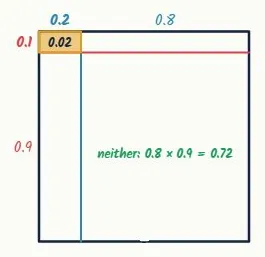
- Bus late: 0.2 of the width.
- Train late: 0.1 of the height.
- Both late: the corner, 0.2 × 0.1 = 0.02.
"Exactly one": add two separate cells
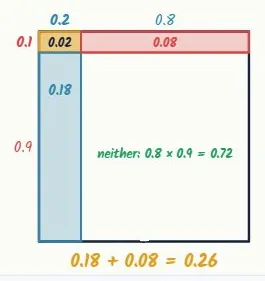
- Bus late, train on time: 0.2 × 0.9 = 0.18.
- Bus on time, train late: 0.8 × 0.1 = 0.08.
- Separate cells, so add: 0.26.
All the working
- Not: 1 minus.
- And: multiply. Or: add.
- bus on time: 1 − 0.2 = 0.8not late
- train on time: 1 − 0.1 = 0.9not late
- both: 0.2 × 0.1 = 0.02and: multiply
- neither: 0.8 × 0.9 = 0.72and: multiply
- at least one: 1 − 0.72 = 0.28
- exactly one: 0.2 × 0.9 + 0.8 × 0.1
- = 0.18 + 0.08 = 0.26or: add
- check: 0.02 + 0.26 + 0.72 = 1
Independent and mutually exclusive
- Independent: one does not affect the other.
- Mutually exclusive: they cannot both happen.
- Different ideas, different operations.
| Word | Means | So |
|---|---|---|
| Independent | no effect on each other | multiply |
| Mutually exclusive | cannot happen together | add |
The "at least one" shortcut
- Three cells, or one.
- Use the complement.
- long way: 0.02 + 0.18 + 0.08three cells
- = 0.28
- short way: 1 − 0.72one cell: neither
- = 0.28the same
Every answer between 0 and 1
- Adding when you should multiply can pass 1.
- A probability above 1 is always wrong.
- The examiner lists this for Not Achieved.
Keep four decimal places
- Rounding early spreads error through a question.
- Keep at least four decimal places in working.
- Round only the final answer.
Where the marks are
- Achieved: know when to multiply and when to add.
- Merit: several steps, like exactly one.
- Every answer in context.
What to take away
- And multiplies, or adds, not subtracts from 1.
| And | multiply (independent events) |
| Or | add (separate outcomes) |
| Not | 1 minus |
| At least one | 1 − P(none) |
| Check | 0 ≤ p ≤ 1, and totals add to 1 |
| Accuracy | 4 decimal places in working |
Your turn: four questions
- Pause here and answer each one.
- Draw the square if it helps.
- Check your answers add to 1.
| Question | |
|---|---|
| 1 | P(rain) = 0.3 each day, independent. P(rain on both days)? |
| 2 | P(no rain on either day)? |
| 3 | P(rain on at least one day)? |
| 4 | P(rain on exactly one day)? |
Show answer
1. 0.3 × 0.3 = 0.09. 2. 0.7 × 0.7 = 0.49. 3. 1 − 0.49 = 0.51. 4. 0.3 × 0.7 + 0.7 × 0.3 = 0.42. Check: 0.09 + 0.42 + 0.49 = 1.
The answers: questions 1 and 2
- 1. P(rain and rain) = 0.3 × 0.3and: multiply
- = 0.09
- 2. P(dry) = 1 − 0.3 = 0.7complement
- P(dry and dry) = 0.7 × 0.7and: multiply
- = 0.49
The answers: questions 3 and 4
- 3. P(at least one) = 1 − P(none)
- = 1 − 0.49
- = 0.51
- 4. rain, dry or dry, raintwo separate ways
- 0.3 × 0.7 + 0.7 × 0.3
- = 0.21 + 0.21 = 0.42or: add
- check: 0.09 + 0.42 + 0.49 = 1
Is your child on track?
Take the free placement test