Kinematics: displacement, velocity and acceleration
What this lesson covers
- Velocity is the derivative of displacement and acceleration is the derivative of velocity.
- Going back up the chain needs anti-differentiation, and the starting values fix each constant.
One chain, three quantities
- Displacement s: where it is.
- Velocity v: how fast s changes.
- Acceleration a: how fast v changes.
| Symbol | Meaning | Units |
|---|---|---|
| s | displacement | metres |
| v = ds/dt | velocity | m/s |
| a = dv/dt | acceleration | m/s² |
Down the chain: differentiate
- Differentiate to go down.
- Factorise v for later.
- s = t³ − 6t² + 9t
- v = ds/dt = 3t² − 12t + 9differentiate
- = 3(t² − 4t + 3)take out 3
- = 3(t − 1)(t − 3)factorise
- a = dv/dt = 6t − 12differentiate again
Try it: s, v and a together
When is it at rest?
- At rest: v = 0.
- Substitute into s and a.
- v = 3(t − 1)(t − 3)
- 3(t − 1)(t − 3) = 0at rest: v = 0
- t = 1 s or t = 3 s
- s(1) = 1 − 6 + 9 = 4 m
- a(1) = 6 − 12 = −6 m/s²
- s(3) = 27 − 54 + 27 = 0 mback at the start
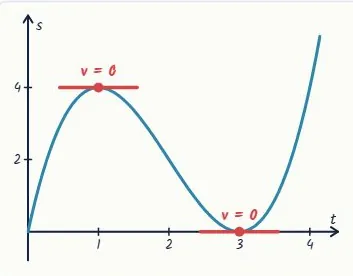
Velocity is the gradient of s
- Rising graph: moving forward.
- Flat at t = 1 and t = 3: at rest.
- Falling in between: moving back.
Up the chain: anti-differentiate
- Each step up needs + c.
- The start value fixes it.
- a = 6 − 2t
- v = 6t − 2t²/2 + canti-differentiate
- = 6t − t² + c
- v(0) = 0 − 0 + c = 5starts at 5 m/s
- c = 5
- v = 6t − t² + 5
Try it: back up the chain
Up again: a new constant
- A new constant, k.
- It starts at s = 0.
- v = 6t − t² + 5
- s = 6t²/2 − t³/3 + 5t + kanti-differentiate
- = 3t² − t³/3 + 5t + k
- s(0) = 0 − 0 + 0 + k = 0starts at s = 0
- k = 0
- s = 3t² − t³/3 + 5t
- check: ds/dt = 6t − t² + 5
Show how you found c
- Write + c, then substitute t = 0.
- Say what the starting value was.
- The examiner wants this line for Merit.
The maximum velocity
- Max velocity: a = 0.
- Then substitute t = 3.
- a = 6 − 2t = 0max v: a = 0
- t = 3 s
- da/dt = −2 < 0a maximum
- v(3) = 6(3) − 3² + 5
- = 18 − 9 + 5 = 14 m/s
- s(3) = 3(3²) − 3³/3 + 5(3)
- = 27 − 9 + 15 = 33 m
Read the question words
- "At rest": v = 0.
- "Starts from rest": v = 0 when t = 0.
- "Constant speed": a = 0.
Starting from rest at the origin
- From rest: v(0) = 0.
- At the origin: s(0) = 0.
- a = 6t
- v = 6t²/2 + c = 3t² + canti-differentiate
- v(0) = 0 + c = 0, c = 0from rest
- s = 3t³/3 + k = t³ + kanti-differentiate
- s(0) = 0: k = 0, s = t³at the origin
- v(2) = 3 × 2² = 12 m/s
- s(2) = 2³ = 8 m
Try it: read the motion
Where the marks are
- Achieved: differentiate or anti-differentiate once.
- Merit: find the constants, with working.
- Excellence: a full chain, answered in context.
What to take away
- Down by differentiating, up with + c.
| Down the chain | differentiate: s to v to a |
| Up the chain | anti-differentiate, with + c |
| Starting values | fix each constant |
| At rest | v = 0 |
| Max or min v | a = 0 |
| Units | m, m/s, m/s² |
Common mistakes
- a = 6 − 2t, so v = 6t − t²Going up the chain needs + c: v = 6t − t² + c, and v(0) = 5 gives c = 5. Show the line where you find c.
- The object is at rest when a = 0.At rest means the velocity is zero: solve v = 3(t − 1)(t − 3) = 0, giving t = 1 s or t = 3 s.
- For the maximum velocity, set v = 0.Velocity is greatest where its own gradient is zero, so set a = 6 − 2t = 0, giving t = 3 s and v = 14 m/s.
- "Starts from rest" means s = 0 when t = 0.From rest means v(0) = 0. It is "at the origin" that tells you s(0) = 0.
Your turn: four questions
- Questions 3 and 4 need + c.
- Give units.
s = 2t³ − 3t². Find v and a.
When is that object at rest?
a = 4 m/s² and v = 2 m/s at t = 0. Find v.
It starts at s = 0. How far has it gone after 3 s?
Show answer
1. v = 6t² − 6t, a = 12t − 6. 2. 6t(t − 1) = 0, so t = 0 and t = 1 second. 3. v = 4t + c; v(0) = 2, so v = 4t + 2. 4. s = 2t² + 2t + k, k = 0, so s(3) = 18 + 6 = 24 m.
The answers: questions 1 and 2
- 1. s = 2t³ − 3t²
- v = ds/dt = 6t² − 6tdifferentiate
- a = dv/dt = 12t − 6differentiate again
- 2. 6t² − 6t = 0at rest: v = 0
- 6t(t − 1) = 0take out 6t
- t = 0 s or t = 1 s
The answers: questions 3 and 4
- 3. v = 4t + canti-differentiate a = 4
- v(0) = 0 + c = 2, so c = 22 m/s at the start
- v = 4t + 2
- 4. s = 4t²/2 + 2t + kanti-differentiate v
- = 2t² + 2t + k
- s(0) = 0 + 0 + k = 0, so k = 0starts at s = 0
- s(3) = 2 × 3² + 2 × 3
- = 18 + 6 = 24 m
Sample question: Achieved
A particle moves along a straight line so that its displacement from a fixed point O after t seconds is s = t³ − 6t² + 9t metres. Find its velocity and acceleration at t = 4.
Hint
Differentiate s to get v, then differentiate v to get a. Substitute t = 4 into each.
Answer
v = 9 m per s and a = 12 m per s² at t = 4
Step by step
- Recall the chain: velocity is the derivative of displacement, and acceleration is the derivative of velocity.
- Differentiate s term by term: v = 3t² − 12t + 9.
- Differentiate again: a = 6t − 12.
- At t = 4: v = 3 × 16 − 48 + 9 = 48 − 48 + 9 = 9 m per s.
- At t = 4: a = 24 − 12 = 12 m per s².
- Classic mistake: substituting t = 4 into s and calling it the velocity. s(4) = 64 − 96 + 36 = 4 m is where the particle is, not how fast it is going.
- Both are positive, so at t = 4 the particle is moving in the positive direction and speeding up.
- Check the units: displacement in metres, velocity in m per s, acceleration in m per s².
Full working
- v = dsdt = 3t² − 12t + 9
- a = dvdt = 6t − 12
- v(4) = 48 − 48 + 9 = 9 m per s
- a(4) = 24 − 12 = 12 m per s²
- v = 9 m per s, a = 12 m per s²
Sample questions: Merit
A particle's displacement from O after t seconds is s = 2t³ − 15t² + 24t + 5 metres, for t ≥ 0. Find when the particle is at rest and where it is at those times. Describe its motion between those times.
Hint
At rest means the velocity is zero. Find v, solve v = 0, then put those times into s, not v.
Answer
At rest at t = 1 s (s = 16 m) and t = 4 s (s = −11 m); between them it moves in the negative direction
Step by step
- At rest means not moving at that instant, so the velocity is zero.
- Differentiate: v = 6t² − 30t + 24.
- Set v = 0 and take out the common factor 6: 6(t² − 5t + 4) = 0.
- Factorise: 6(t − 1)(t − 4) = 0, so t = 1 or t = 4 seconds.
- Where is it? Use the displacement, not the velocity. s(1) = 2 − 15 + 24 + 5 = 16 m.
- s(4) = 128 − 240 + 96 + 5 = −11 m, so it is 11 m on the negative side of O.
- Classic mistake: putting t = 1 and t = 4 back into v. That just gives 0, which you already knew.
- Between t = 1 and t = 4, test t = 2: v = 24 − 60 + 24 = −12. Negative, so it moves in the negative direction, from 16 m back to −11 m.
- So it travels 27 m back towards and past O between the two stops.
Full working
- v = 6t² − 30t + 24v = dsdt
- 6(t − 1)(t − 4) = 0, so t = 1 or 4at rest: v = 0
- s(1) = 16 m, s(4) = −11 muse s for the position
- v(2) = −12 < 0moving in the negative direction between
- t = 1 s at 16 m; t = 4 s at −11 m
A particle starts at the origin with velocity 3 m per s. Its acceleration after t seconds is a = 6t − 4 m per s². Find its velocity and displacement at t = 2.
Hint
Anti-differentiate a to get v, and use v = 3 at t = 0 for the first constant. Then anti-differentiate v and use s = 0 at t = 0 for the second.
Answer
v = 7 m per s and s = 6 m at t = 2
Step by step
- Going up the chain from acceleration to velocity to displacement needs anti-differentiation, and each step brings a new constant.
- Anti-differentiate a: v = 3t² − 4t + c.
- At t = 0 the velocity is 3, so 3 = 0 − 0 + c and c = 3. So v = 3t² − 4t + 3.
- Anti-differentiate v: s = t³ − 2t² + 3t + k. Use a new letter, k, because it is a different constant.
- It starts at the origin, so s = 0 at t = 0. That gives k = 0, so s = t³ − 2t² + 3t.
- Classic mistake: using the same c for both steps, or forgetting the first one. The starting velocity 3 must appear in v.
- At t = 2: v = 12 − 8 + 3 = 7 m per s.
- At t = 2: s = 8 − 8 + 6 = 6 m.
- Check by differentiating back: s gives 3t² − 4t + 3 = v, and v gives 6t − 4 = a. Correct.
Full working
- v = 3t² − 4t + c; c = 3v = 3 at t = 0
- s = t³ − 2t² + 3t + k; k = 0s = 0 at t = 0
- v(2) = 12 − 8 + 3 = 7 m per s
- s(2) = 8 − 8 + 6 = 6 m
- v = 7 m per s, s = 6 m
Sample questions: Excellence
A car is travelling at 20 m per s when the driver brakes. t seconds after the brakes go on, the acceleration is a = −2t m per s². A hazard is 60 m ahead of the car at the moment the brakes go on. Does the car stop before reaching it? Find the stopping distance exactly, and give one limitation of the model.
Hint
Anti-differentiate twice, using v = 20 and s = 0 at t = 0. The car stops when v = 0; put that time into s.
Answer
The car stops after 2√5 ≈ 4.47 s, having travelled 80√53 ≈ 59.63 m, so it stops about 0.37 m before the hazard
Step by step
- Take s = 0 where the brakes go on, and t = 0 at that moment.
- Anti-differentiate a = −2t: v = −t² + c. At t = 0, v = 20, so c = 20 and v = 20 − t².
- The car stops when v = 0: t² = 20, so t = √20 = 2√5 ≈ 4.47 s. Take the positive root, as time after braking is positive.
- Anti-differentiate v: s = 20t − t³3 + k. At t = 0, s = 0, so k = 0.
- Stopping distance: s at t = 2√5. Note t³ = t² × t = 20 × 2√5 = 40√5.
- s = 20 × 2√5 − 40√53 = 40√5 − 40√53 = 80√53.
- 80√53 ≈ 59.63 m, which is less than 60 m.
- So the car stops about 60 − 59.63 = 0.37 m short of the hazard. That is very close.
- Classic mistake: using a constant-acceleration formula like v² = u² + 2as. The acceleration here changes with time, so you must use calculus.
- Limitation: the model starts when the brakes go on. A real driver takes time to react; even 0.5 s at 20 m per s adds 10 m, and the car would hit the hazard.
- Check: s′ = 20 − t² = v and v′ = −2t = a, and v(2√5) = 20 − 20 = 0. Correct.
Full working
- v = 20 − t²anti-differentiate; v = 20 at t = 0
- v = 0 when t = √20 = 2√5 ≈ 4.47 s
- s = 20t − t³3s = 0 at t = 0
- s(2√5) = 40√5 − 40√53 = 80√53t³ = 40√5
- 80√53 ≈ 59.63 m < 60 m
- Yes: it stops after 80√53 ≈ 59.63 m, about 0.37 m short
A particle moves in a straight line with velocity v = t² − 6t + 8 m per s, and starts at s = 0. Find its displacement after 5 seconds and the total distance it travels in those 5 seconds. Explain why the two answers are different.
Hint
The particle turns around whenever v = 0. Find those times, find s at each, and add up the lengths of the separate stretches.
Answer
Displacement 203 ≈ 6.67 m; total distance 283 ≈ 9.33 m
Step by step
- Anti-differentiate v: s = t³3 − 3t² + 8t + c. It starts at s = 0, so c = 0.
- Displacement after 5 s: s(5) = 1253 − 75 + 40 = 1253 − 35 = 203 ≈ 6.67 m.
- Distance is different: it counts every metre moved, in either direction. So find where the particle turns around.
- It turns where v = 0: t² − 6t + 8 = (t − 2)(t − 4) = 0, so t = 2 and t = 4.
- Check the direction on each stretch: v(1) = 3 > 0 (forwards), v(3) = −1 < 0 (backwards), v(4.5) = 1.25 > 0 (forwards).
- Positions at the turning times: s(2) = 83 − 12 + 16 = 203 and s(4) = 643 − 48 + 32 = 163.
- Stretch 1, from t = 0 to 2: forwards from 0 to 203, which is 203 m.
- Stretch 2, from t = 2 to 4: backwards from 203 to 163, which is 43 m.
- Stretch 3, from t = 4 to 5: forwards from 163 to 203, which is 43 m.
- Total distance = 203 + 43 + 43 = 283 ≈ 9.33 m.
- Classic mistake: giving s(5) = 203 as the distance. The 43 m backwards and the 43 m forwards cancel in the displacement but both count in the distance.
- So the displacement says where it ends up (6.67 m from the start), while the distance says how far it went (9.33 m).
Full working
- s = t³3 − 3t² + 8ts = 0 at t = 0
- s(5) = 1253 − 35 = 203 mdisplacement
- v = (t − 2)(t − 4) = 0 at t = 2 and t = 4it turns around
- s(2) = 203, s(4) = 163
- distance = 203 + 43 + 43 = 283add each stretch
- Displacement 203 ≈ 6.67 m; distance 283 ≈ 9.33 m
Where science uses this
Practise this
Report a mistake
More in AS 91262
 The derivative: what the gradient function means6 min
 Differentiating polynomials, fractions and all7 min
 Equation of a tangent to a curve, step by step8 min
 Turning points: finding and proving max or min8 min
 Sketching the gradient graph of a function7 min
 Optimisation with calculus: the biggest box8 min
 Anti-differentiation and why you need + c7 minKinematics: displacement, velocity and acceleration8 min
 The derivative: 7 exam questions solved step by step11 min
 Differentiating: 7 exam questions solved step by step11 min
 Tangents: 7 exam questions solved step by step11 min
 Turning points: 7 exam questions solved step by step12 min
 Gradient graphs: 7 exam questions solved step by step12 min
 Optimisation: 7 exam questions solved step by step11 min
 Anti-differentiation: 7 exam questions solved step by step11 min
 Kinematics: 7 exam questions solved step by step11 min
Is your child on track?
Take the free placement test