Wave behaviour: reflection, refraction, diffraction and interference
What this lesson covers
- Waves carry energy without carrying matter; transverse and longitudinal waves; mechanical and electromagnetic waves.
- Amplitude, wavelength, frequency and period, with v = fλ and f = 1/T.
- Reflection of waves and of pulses on ropes, including when a pulse is inverted.
- Refraction of water waves: the frequency stays the same while the speed, wavelength and direction change.
- Diffraction through a gap, superposition of pulses, and two-source interference explained with path difference.
What a wave is
- A wave transfers energy from one place to another without moving the material along with it: a cork on a pond bobs up and down while the ripples move past.
- In a transverse wave the particles move at right angles to the direction the wave travels (a rope, water ripples, light); in a longitudinal wave they move back and forth along it, in compressions and rarefactions (sound).
- Mechanical waves need a material to travel through; electromagnetic waves (radio, Wi-Fi, light, X-rays) are transverse and can cross a vacuum.
- All electromagnetic waves travel through a vacuum at c = 3.00 × 10⁸ m s⁻¹, and at nearly that speed in air.
| Mechanical waves | Electromagnetic waves | |
|---|---|---|
| Examples | sound, water waves, waves on a rope | radio, Wi-Fi, light |
| Needs a material? | yes | no, they cross a vacuum |
| Type | transverse or longitudinal | always transverse |
| Speed | depends on the material (sound about 340 m s⁻¹ in air) | 3.00 × 10⁸ m s⁻¹ in a vacuum |
Describing a wave: v = fλ
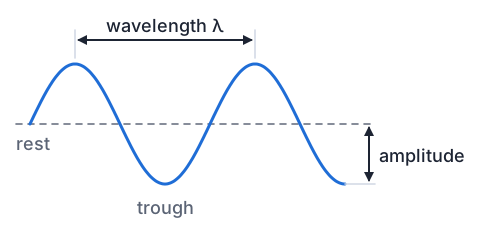
- Amplitude is the largest distance from the rest position, a measure of the energy the wave carries.
- Wavelength λ is the length of one complete wave, for example crest to crest, in metres.
- Frequency f is the number of waves per second, in hertz (Hz); the period T is the time for one wave, so f = 1/T.
- The wave moves one wavelength in one period, so v = λ ÷ T = fλ; any wave also obeys v = d ÷ t.
- The source sets the frequency; the material sets the speed; the wavelength follows from λ = v ÷ f.
Example: ripples and radio
- 1. In a ripple tank a dipper makes 12 waves in 4.0 s, and the waves are 2.5 cm apart. Find the frequency, the period and the speed.
- 2. A 100 MHz FM radio signal is sent from a tower. Find its wavelength, and how many waves leave the tower in one minute.
- f = 12 ÷ 4.0 s = 3.0 Hzwaves per second
- T = 1/f = 1 ÷ 3.0 = 0.33 s
- v = fλ = 3.0 × 0.025 = 0.075 m s⁻¹change 2.5 cm to 0.025 m first
- λ = c ÷ f = 3.00 × 10⁸ ÷ 1.00 × 10⁸ = 3.00 m100 MHz = 1.00 × 10⁸ Hz
- number of waves = f × t = 1.00 × 10⁸ × 60 = 6.0 × 10⁹frequency is waves per second
Reflection, and pulses at a boundary
- Water waves hitting a straight barrier reflect with the angle of reflection equal to the angle of incidence; the speed, frequency and wavelength do not change because the wave stays in the same water.
- A pulse on a rope tied to a wall (a fixed end) reflects inverted; at a free end, such as a loop on a smooth pole, it reflects upright.
- Where a light rope joins a heavier rope, part of the pulse goes on (transmitted, upright, slower) and part comes back (reflected, inverted), and both are smaller than the original.
- Going from the heavy rope to the light rope, the reflected pulse comes back upright, and the transmitted pulse is upright and faster.
- In the same time, the faster pulse travels further: from light to heavy, the reflected pulse ends up further from the join than the transmitted one.
Refraction of water waves
- Water waves travel more slowly in shallow water than in deep water.
- The frequency cannot change at the boundary, because each wave that arrives must carry on, so with v = fλ a slower wave has a shorter wavelength.
- If the waves meet the boundary at an angle, one end of each wavefront slows first, so the wavefronts swing round and the direction changes towards the normal.
- The same relationship as for light applies: sin θ₁ ÷ sin θ₂ = v₁ ÷ v₂ = λ₁ ÷ λ₂.
- That is why swell lines up with a beach: the parts of each wave in shallower water slow down, so the crests turn to run nearly parallel to the shore, and the waves also grow taller as the water gets shallow.
Example: waves crossing into shallow water
- A dipper makes 10 waves in 4.0 s. In deep water the wavelength is 3.0 cm; in shallow water it is 1.8 cm. The waves meet the boundary at 40° to the normal.
- Find the speed in each part and the new direction.
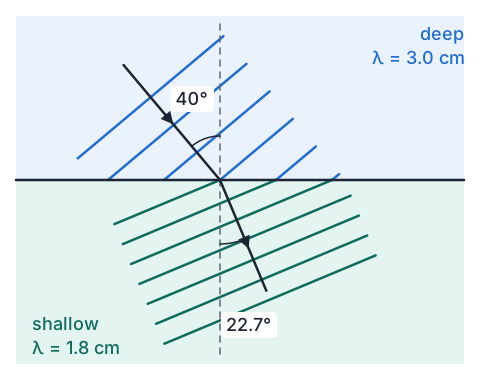
- f = 10 ÷ 4.0 = 2.5 Hzthe same in both depths
- v deep = fλ = 2.5 × 0.030 = 0.075 m s⁻¹
- v shallow = 2.5 × 0.018 = 0.045 m s⁻¹
- sin θ₂ = sin θ₁ × λ₂ ÷ λ₁ = sin 40° × 1.8 ÷ 3.0 = 0.6428 × 0.6 = 0.3857sin θ₁ ÷ sin θ₂ = λ₁ ÷ λ₂
- θ₂ = 22.7°
- slower, shorter wavelength, same frequency, bent towards the normal
Diffraction through a gap
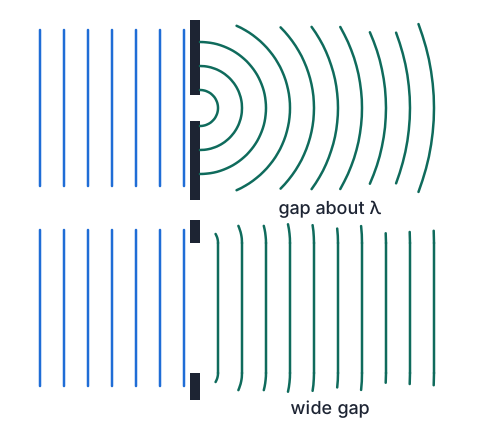
- Diffraction is the spreading of a wave as it passes through a gap or around the edge of an obstacle.
- The spreading is greatest when the gap is about the same size as the wavelength, or smaller; through a gap many wavelengths wide, the waves carry on mostly straight with only their edges curving.
- So for a fixed gap, longer wavelengths (lower frequencies) diffract more.
- Diffraction does not change the speed, frequency or wavelength, because the wave stays in the same material; the amplitude beyond the gap is smaller as the energy spreads out.
- Everyday examples: you hear people round a corner because sound wavelengths (around a metre) are similar to a doorway, and long ocean swell spreads into a harbour behind a narrow entrance.
Superposition of pulses
- When two pulses meet, the displacement at each point is the sum of the two displacements: the principle of superposition.
- Two upward pulses meeting make a bigger pulse for an instant (constructive interference); an upward and a downward pulse of the same size cancel for an instant (destructive interference).
- After meeting, each pulse carries on with its own shape, size and speed, as if the other were never there.
- To draw the result at a given time, first work out where each pulse would be on its own (distance = speed × time), then add the displacements point by point.
Two-source interference
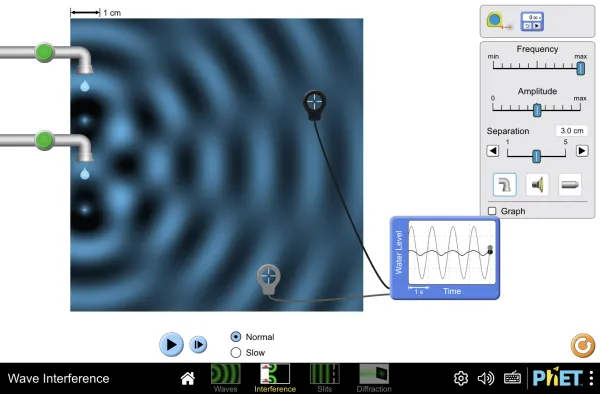
- Two sources with the same frequency, in phase, send out overlapping circular waves.
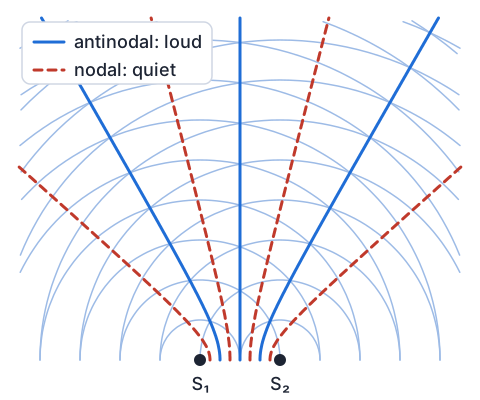
- Where a crest meets a crest (and a trough meets a trough) the waves add to a large amplitude: constructive interference, along antinodal lines.
- Where a crest meets a trough they cancel: destructive interference, along nodal lines, where the water stays nearly still or the sound is quiet.
- Path difference decides which: if the distances from the two sources differ by a whole number of wavelengths (0, λ, 2λ) the point is antinodal; if they differ by an odd number of half wavelengths (½λ, 1½λ) it is nodal.
- Raising the frequency (shorter λ) or moving the sources further apart gives more nodal lines, closer together.
Example: loud and quiet spots from two speakers
- Two speakers play the same 680 Hz note in phase. Sound travels at 340 m s⁻¹.
- Point P is 3.0 m from one speaker and 4.25 m from the other. Point Q is 3.5 m from one and 4.5 m from the other. Is each point loud or quiet?
- λ = v ÷ f = 340 ÷ 680 = 0.50 m
- P: path difference = 4.25 − 3.0 = 1.25 m = 1.25 ÷ 0.50 = 2.5λan odd number of half wavelengths
- P is on a nodal line: crest meets trough, quiet
- Q: path difference = 4.5 − 3.5 = 1.0 m = 2λa whole number of wavelengths
- Q is on an antinodal line: crest meets crest, loud
What Achieved, Merit and Excellence look like
- Achieved names the effect; Merit links it to constructive and destructive interference; Excellence explains both with path difference, in the context of the question.
- A labelled diagram with a nodal and an antinodal line can carry some of the explanation.
| Grade | A model answer |
|---|---|
| Achieved | The waves interfere, so some places get big waves and some get small waves. |
| Merit | Where a crest from one dipper meets a crest from the other there is constructive interference and the water moves a lot; where a crest meets a trough there is destructive interference and the water stays almost still. |
| Excellence | The dippers have the same frequency and are in phase. At a point whose distances to the two dippers differ by a whole number of wavelengths, crests arrive together, so the amplitudes add (an antinodal line, large movement). Where the distances differ by an odd number of half wavelengths, a crest from one always arrives with a trough from the other, so they cancel (a nodal line, almost no movement). |
Common mistakes
- The waves slow down in shallow water, so their frequency goes down.The source sets the frequency, so it stays the same; the speed falls, so by v = fλ the wavelength gets shorter.
- Diffraction through the gap makes the wavelength longer.Diffraction only spreads the wave; its speed, frequency and wavelength are unchanged because it stays in the same material.
- A nodal line is where the crests from both sources meet.Crest meets crest on antinodal lines; nodal lines are where crest meets trough, a path difference of an odd number of half wavelengths.
- 12 waves in 4.0 s, 2.5 cm apart: v = 3.0 × 2.5 = 7.5 m s⁻¹.Change cm to m first: v = 3.0 × 0.025 = 0.075 m s⁻¹.
A ripple tank in a baking dish
You need: a large glass or white baking dish, water, a ruler, two bars of soap or two small plastic containers, a saucer or flat plate, a phone torch
- Pour about 1 cm of water into the dish on a table and let it settle; shine the phone torch from above at an angle so the ripples show up.
- Tap the water gently with the long edge of the ruler to send straight waves across the dish.
- Set the two soaps across the middle with a 1 cm gap between them, send waves at the gap, then widen the gap to about 6 cm and repeat.
- Take the soaps out, place the upside-down saucer under the water near one end so the water above it is shallow, and send waves over it.
- Look for: the waves fan out much more through the narrow gap than the wide one, and over the saucer they move more slowly and bunch closer together.
Safety: Keep the phone and any charging cable well away from the water, and wipe up spills straight away so the floor is not slippery.
Your turn
A wave has a frequency of 4.0 Hz and a wavelength of 0.60 m. Find its speed.
Find the period of that wave.
Find the wavelength of a 2.4 GHz Wi-Fi signal.
Water waves travel at 0.30 m s⁻¹ in deep water and 0.20 m s⁻¹ in shallow water. They meet the boundary at 30° to the normal. Find the angle in the shallow water.
Two dippers in phase make waves with λ = 2.0 cm. A point is 9.0 cm from one dipper and 12.0 cm from the other. Is it on a nodal or an antinodal line?
Show answer
1. v = fλ = 4.0 × 0.60 = 2.4 m s⁻¹. 2. T = 1/f = 1 ÷ 4.0 = 0.25 s. 3. λ = c ÷ f = 3.00 × 10⁸ ÷ 2.4 × 10⁹ = 0.125 m (12.5 cm). 4. sin θ₂ = sin 30° × 0.20 ÷ 0.30 = 0.5 × 0.667 = 0.333, so θ₂ = 19.5°. 5. Path difference = 12.0 − 9.0 = 3.0 cm = 1.5λ, an odd number of half wavelengths, so it is on a nodal line.
Exam-style question: swell at a marina
- Ocean swell with a period of 8.0 s and a wavelength of 100 m rolls towards a marina. The breakwater has a 12 m wide entrance, and the water inside gets shallower towards the boat ramp.
Calculate the speed of the swell.
Describe what happens to the waves as they pass through the entrance, and why.
Inside, the water gets shallower. Explain what happens to the speed, frequency, wavelength and amplitude of the waves.
A second entrance is opened further along the breakwater. Explain why boats at some moorings now rock a lot while boats at others hardly move.
Show answer
1. v = λ ÷ T = 100 ÷ 8.0 = 12.5 m s⁻¹ (Achieved). 2. They diffract: the wavelength (100 m) is much bigger than the 12 m gap, so the waves spread out into the marina as curved wavefronts, reaching boats that are not in line with the entrance; the wavelength, frequency and speed do not change (Merit with the reason). 3. In shallower water the waves slow down; the frequency stays the same because it is set by the source (each wave arriving must pass on), so by v = fλ the wavelength gets shorter, and the amplitude grows as the energy is squeezed into slower, shorter waves (Excellence for all four, each with a reason). 4. The two entrances act as two sources with the same frequency, in phase, so the waves interfere. At moorings where the distances to the two entrances differ by a whole number of wavelengths, crest meets crest (constructive, antinodal), so boats rock a lot; where they differ by an odd number of half wavelengths, crest meets trough (destructive, nodal), so boats hardly move (Excellence needs path difference).
Wave Interference
Full screen · PhET Interactive Simulations, University of Colorado Boulder, CC BY 4.0
Recap
- v = fλ and f = 1/T; the source sets f, the material sets v.
- Reflection: angles equal; a pulse inverts when it reflects off something heavier or fixed.
- Refraction: slower means shorter wavelength and bending towards the normal, with the frequency unchanged.
- Diffraction: most spreading when the gap is about one wavelength; nothing else about the wave changes.
- Interference: path difference nλ gives antinodal (loud, large), (n − ½)λ gives nodal (quiet, still).
| Behaviour | Speed | Frequency | Wavelength | Direction |
|---|---|---|---|---|
| Reflection | same | same | same | changes |
| Refraction (into slower) | decreases | same | decreases | towards the normal |
| Diffraction | same | same | same | spreads out |
How is NCEA Level 2 maths going?
See the NCEA Level 2 maths guide