De Moivre's theorem: powers and roots of complex numbers

What this lesson covers
- Raising r cis θ to the power n raises the modulus to n and multiplies the argument by n.
- The n roots of a complex number are equally spaced around a circle, so one wrong starting argument makes every root wrong.
De Moivre's theorem
- (r cis θ)ⁿ = rⁿ cis(nθ).
- Raise the modulus, multiply the argument.
- It is in the formula booklet.
(1 + √3i)⁵
- Polar form first.
- Raise r, multiply θ.
- Bring θ into range.
- 1 + √3i: x > 0, y > 0first quadrant
- r = √(1 + 3) = 2modulus
- θ = tan⁻¹(√3/1) = π/3argument
- (2 cis(π/3))⁵ = 2⁵ cis(5π/3)
- = 32 cis(5π/3)
- 5π/3 − 2π = −π/3more than π
- = 32 cis(−π/3)
Back to a + bi
- Exact cos and sin.
- Check the modulus.
- (1 + √3i)⁵ = 32 cis(−π/3)
- cos(−π/3) = 1/2
- sin(−π/3) = −√3/2below the axis
- 32(1/2) + 32(−√3/2)i
- = 16 − 16√3i
- 16² + (16√3)² = 256 + 768check
- √1024 = 32
Solving zⁿ = r cis θ
- Let z = s cis α.
- s is the positive nth root of r.
- nα = θ + 2πk: n roots, 2π/n apart.
z³ = 8i
- Polar form of 8i.
- Modulus: the cube root.
- Arguments 2π/3 apart.
- 8i = 8 cis(π/2)positive Im axis
- s³ = 8, so s = ∛8 = 2modulus
- 3α = π/2 + 2πk
- α = π/6 + 2πk/3divide by 3
- k = 0: α = π/6
- k = 1: π/6 + 2π/3 = 5π/6
- k = 2: π/6 + 4π/3 = 3π/2
- 3π/2 − 2π = −π/2more than π
- 2cis(π/6), 2cis(5π/6), 2cis(−π/2)
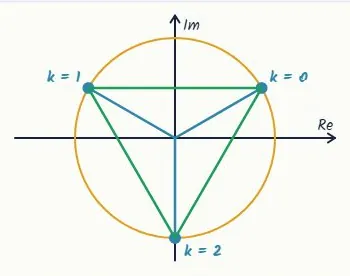
The cube roots of 8i
- All on the circle of radius 2.
- A third of a turn apart.
- Equally spaced: a triangle.
The 2025 error: the starting argument
- Sketch: second quadrant.
- Calculator: −π/3, wrong.
- π − π/3 = 2π/3.
- −8 + 8√3i: x < 0, y > 0second quadrant
- r = √((−8)² + (8√3)²)modulus
- = √(64 + 192) = √256 = 16
- tan⁻¹(−√3) = −π/3fourth quadrant
- reference: tan⁻¹(√3) = π/3
- θ = π − π/3 = 2π/3second quadrant
- z⁴ = 16 cis(2π/3)
The four roots
- Modulus: ⁴√16 = 2.
- A quarter turn apart.
- Keep each one in range.
- z⁴ = 16 cis(2π/3)
- s⁴ = 16, so s = ⁴√16 = 2modulus
- 4α = 2π/3 + 2πk, α = π/6 + πk/2
- k = 0: α = π/6
- k = 1: π/6 + π/2 = 2π/3
- k = 2: π/6 + π = 7π/6
- 7π/6 − 2π = −5π/6more than π
- k = 3: π/6 + 3π/2 = 5π/3
- 5π/3 − 2π = −π/3more than π
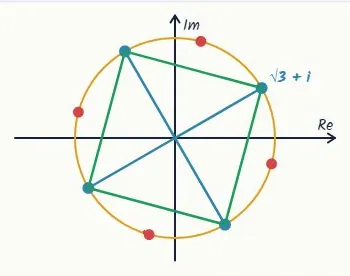
Check on the Argand diagram
- Four roots on the circle of radius 2.
- A quarter turn apart: a square.
- A wrong start turns the whole square.
The roots in rectangular form
- Exact cos and sin.
- Answer in the form asked.
- 2 cis(π/6) = 2(√3/2 + i/2)
- = √3 + i
- 2 cis(2π/3) = 2(−1/2 + (√3/2)i)
- = −1 + √3i
- 2 cis(−5π/6) = 2(−√3/2 − i/2)
- = −√3 − i
- 2 cis(−π/3) = 2(1/2 − (√3/2)i)
- = 1 − √3i
Check: a root to the fourth
- Square, then square again.
- It gives back the number.
- z⁴ = −8 + 8√3i
- (√3 + i)² = 3 + 2√3i + i²expand
- = 2 + 2√3ii² = −1
- (√3 + i)⁴ = (2 + 2√3i)²square again
- = 4 + 8√3i + 12i²expand
- = 4 + 8√3i − 12i² = −1
- = −8 + 8√3i
Setting out a roots question
- Sketch, then write it in polar form.
- nth root of the modulus.
- Argument with k; keep each in range.
Where the marks are
- Achieved: de Moivre for a power.
- Merit: all the roots of zⁿ = a + bi.
- Excellence: roots inside longer problems.
What to take away
- Sketch first, get the starting argument right, then add 2π/n.
| Power | rⁿ cis(nθ) |
| Sketch first | the right argument |
| Root modulus | positive nth root |
| Arguments | (θ + 2πk)/n |
| n roots | spaced 2π/n |
| Answer | in the form asked |
Your turn: four questions
- Pause here and answer each one.
- Sketch the number in 3 and 4 first.
- Give every root.
| Given | Find | |
|---|---|---|
| 1 | (−1 + i)⁶ | a + bi |
| 2 | (2 cis(π/8))⁴ | a + bi |
| 3 | z³ = −27 | all roots, polar |
| 4 | z² = −2 − 2√3i | both roots, a + bi |
Show answer
1. −1 + i = √2 cis(3π/4), so the power is 8 cis(9π/2) = 8 cis(π/2) = 8i. 2. 16 cis(π/2) = 16i. 3. −27 = 27 cis π: 3 cis(π/3), 3 cis π and 3 cis(−π/3). 4. −2 − 2√3i = 4 cis(−2π/3): 1 − √3i and −1 + √3i.
The answers: questions 1 and 2
- 1. −1 + i: second quadrant
- r = √2, θ = π − π/4 = 3π/4
- (√2)⁶ cis(18π/4) = 8 cis(9π/2)de Moivre
- 9π/2 − 4π = π/2into range
- 8 cis(π/2) = 8(0 + i) = 8i
- 2. 2⁴ cis(4π/8) = 16 cis(π/2)de Moivre
- = 16(0 + i) = 16i
The answers: question 3
- 3. −27 = 27 cis πnegative real axis
- s³ = 27, so s = 3modulus
- 3α = π + 2πk, α = π/3 + 2πk/3
- k = 0, 1, −1: π/3, π, −π/3all in range
- 3 cis(π/3), 3 cis π, 3 cis(−π/3)
- 3 cis π = −3
The answers: question 4
- 4. −2 − 2√3i: third quadrant
- r = √(4 + 12) = 4modulus
- reference: tan⁻¹(2√3/2) = π/3
- θ = −(π − π/3) = −2π/3below the axis
- s² = 4, s = 2; 2α = −2π/3 + 2πk
- α = −π/3 + πk: −π/3, 2π/3k = 0, 1
- 2 cis(−π/3) = 1 − √3i
- 2 cis(2π/3) = −1 + √3i
Is your child on track?
Take the free placement test