Polar form by hand: modulus, argument and quadrants

What this lesson covers
- Modulus is a distance, so it is never negative; argument is an angle measured from the positive real axis.
- The quadrant decides the argument, so a sketch comes before the calculator.
Polar form: a distance and a direction
- x + iy is the point (x, y).
- Modulus r: the distance from the origin.
- Argument θ: the angle from the real axis.
The Argand diagram
- z = 1 + √3i: first quadrant.
- w = −2 + 2i: second quadrant.
- u = 1 − i: fourth quadrant.
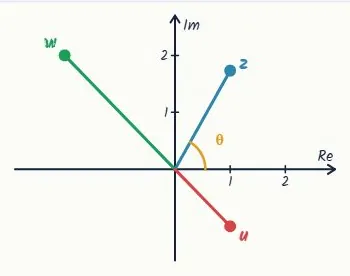
z = 1 + √3i
- Sketch: name the quadrant.
- Modulus, then argument.
- Check by converting back.
- z = 1 + √3i: x > 0, y > 0first quadrant
- r = √(1² + (√3)²)modulus
- = √(1 + 3) = √4 = 2
- θ = tan⁻¹(√3/1) = π/3argument
- first quadrant: keep π/3
- z = 2 cis(π/3)
- 2(1/2) + 2(√3/2)i = 1 + √3i
w = −2 + 2i
- Sketch: second quadrant.
- Calculator says −π/4.
- Then π − reference angle.
- w = −2 + 2i: x < 0, y > 0second quadrant
- r = √((−2)² + 2²)modulus
- = √(4 + 4) = √8 = 2√2
- calculator: tan⁻¹(−1) = −π/4fourth quadrant
- reference: tan⁻¹(2/2) = π/4
- θ = π − π/4 = 3π/4second quadrant
- w = 2√2 cis(3π/4)
- 2√2(−√2/2) = −2, 2√2(√2/2) = 2
The 2025 error: the lost minus sign
- Below the axis: θ < 0.
- Measured clockwise.
- Range: −π < θ ≤ π.
- u = 1 − i: x > 0, y < 0fourth quadrant
- r = √(1² + (−1)²) = √2modulus
- reference: tan⁻¹(1/1) = π/4
- θ = π/4sign lost
- θ = −π/4below the real axis
- u = √2 cis(−π/4)
- −π < θ ≤ πthe usual range
The modulus, written right
- Square b, not bi.
- A modulus: never negative.
- |3 + 4i| = √(3² + 4²)no i
- = √(9 + 16) = √25 = 5
- √(3² + (4i)²) = √(9 − 16)squared the i
- = √(−7)not a distance
- |z| ≥ 0never negative
Exact values, no calculator
- Converting by hand needs exact values.
- π/6, π/4 and π/3 cover most questions.
| θ | cos θ | sin θ |
|---|---|---|
| π/6 | √3/2 | 1/2 |
| π/4 | √2/2 | √2/2 |
| π/3 | 1/2 | √3/2 |
4 cis(−2π/3) in rectangular form
- x = r cos θ, y = r sin θ.
- Exact values only.
- x = r cos θ, y = r sin θ
- −2π/3: third quadrantreference π/3
- cos(−2π/3) = −1/2
- sin(−2π/3) = −√3/2
- x = 4(−1/2) = −2
- y = 4(−√3/2) = −2√3
- 4 cis(−2π/3) = −2 − 2√3i
- √(4 + 12) = √16 = 4modulus
Multiplying in polar form
- Multiply the moduli.
- Add the arguments.
- Bring it into range.
- z = 2 cis(π/3), v = 3 cis(5π/6)
- |zv| = 2 × 3 = 6multiply moduli
- arg = π/3 + 5π/6add arguments
- = 2π/6 + 5π/6 = 7π/6
- 7π/6 > πout of range
- 7π/6 − 12π/6 = −5π/6subtract 2π
- zv = 6 cis(−5π/6)
Dividing, and the answer form
- Divide the moduli.
- Subtract the arguments.
- Then give the form asked.
- |z/v| = 2 ÷ 3 = 2/3divide moduli
- arg = π/3 − 5π/6subtract arguments
- = 2π/6 − 5π/6 = −3π/6
- = −π/2in range
- z/v = (2/3) cis(−π/2)
- cos(−π/2) = 0, sin(−π/2) = −1
- (2/3)(0 − i) = −(2/3)ithe form asked
Sketch before the calculator
- Sketch the point, name the quadrant.
- Reference angle from the sizes of x and y.
- Adjust for the quadrant, check the sign.
Where the marks are
- Achieved: modulus, argument, converting.
- Merit: use that a modulus is positive.
- Excellence: quotients, argument and parts.
What to take away
- Sketch first: the quadrant decides the argument.
| Sketch first | which quadrant? |
| Modulus | √(x² + y²), positive |
| Argument | from positive real axis |
| Below the axis | negative argument |
| Multiply | × moduli, + arguments |
| Divide | ÷ moduli, − arguments |
Your turn: four questions
- Pause here and answer each one.
- No calculator: sketch every point first.
- Give question 3 exactly.
| Given | Find | |
|---|---|---|
| 1 | −√3 + i | modulus, argument |
| 2 | −3 − 3i | polar form |
| 3 | 6 cis(−π/3) | a + bi, exactly |
| 4 | 2cis(3π/4) × 3cis(π/2) | polar form |
Show answer
1. Second quadrant: modulus 2, argument π − π/6 = 5π/6. 2. Third quadrant: 3√2 cis(−3π/4), not 3π/4 or π/4. 3. 6(1/2) + 6(−√3/2)i = 3 − 3√3i. 4. 6 cis(5π/4), brought into range as 6 cis(−3π/4).
The answers: questions 1 and 2
- 1. −√3 + i: second quadrant
- r = √(3 + 1) = √4 = 2
- reference: tan⁻¹(1/√3) = π/6
- θ = π − π/6 = 5π/6
- 2. −3 − 3i: third quadrant
- r = √(9 + 9) = √18 = 3√2
- reference: tan⁻¹(3/3) = π/4
- θ = −(π − π/4) = −3π/4below the axis
- −3 − 3i = 3√2 cis(−3π/4)
The answers: questions 3 and 4
- 3. x = 6 cos(−π/3) = 6(1/2) = 3
- y = 6 sin(−π/3) = 6(−√3/2) = −3√3
- 6 cis(−π/3) = 3 − 3√3i
- 4. modulus 2 × 3 = 6multiply moduli
- argument 3π/4 + π/2 = 5π/4add arguments
- 5π/4 − 2π = −3π/4more than π
- 6 cis(−3π/4)
Is your child on track?
Take the free placement test