Limits, continuity and differentiability from a graph
What this lesson covers
- A function is continuous where its graph has no break, and differentiable where it also has no sharp corner.
- Reading these from a piecewise graph is Achieved-level work that is often left blank.
Three questions about a point
- Does the limit exist?
- Is the function continuous there?
- Is it differentiable there?
A graph in three pieces
- A curve, maximum at (−1, 3).
- Open dot at (1, −1), closed dot at (1, 2).
- Up to (3, 4), then down to (5, 0).
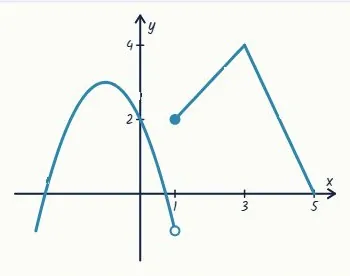
Open and closed dots
- Open: not on the graph.
- Closed: on the graph.
- F(1) = 2, not −1.
| Open dot | not on the graph |
| Closed dot | the value |
| (1, −1) | open, not included |
| f(1) | 2, the closed dot |
The limit as x tends to 1
- From the left: heading to −1.
- From the right: heading to 2.
- They disagree: no limit at x = 1.
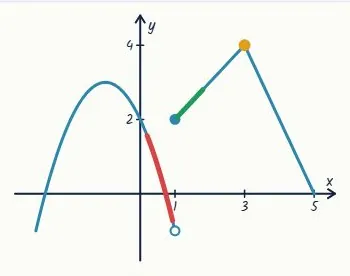
Try it: approach from both sides
Writing the limits
- Left −1, right 2: no limit.
- Where it heads, not f(1).
- from the left: f(x) → −1as x → 1
- from the right: f(x) → 2as x → 1
- −1 ≠ 2the sides disagree
- lim(x→1) f(x) does not exist
- x → 3, both sides: f(x) → 4
- lim(x→3) f(x) = 4
Continuous: no break
- Draw through it without lifting the pen.
- The limit exists and equals the value.
- X = 1: a jump, not continuous.
- X = 3: continuous, with a corner.
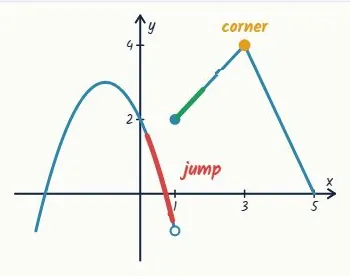
Graphing calculator
Differentiable: one clear gradient
- Continuous first.
- Then one gradient.
- A corner has two.
- x = 1: a jump, not continuous
- not differentiable at x = 1
- x = 3: lim f(x) = 4 = f(3)continuous
- left: (4 − 2)/(3 − 1) = 1rise over run
- right: (0 − 4)/(5 − 3) = −2rise over run
- 1 ≠ −2: a cornergradients differ
- not differentiable at x = 3
Try it: a corner
Easy marks to lose
- The open dot is not the value.
- A jump has no limit.
- Not differentiable: the jump too.
| Misread | Right | |
|---|---|---|
| f(1) | −1 | 2, closed dot |
| Limit at 1 | 2 | does not exist |
| Differentiable at 3 | yes, no gap | no, a corner |
| Not differentiable | x = 3 only | x = 1 and x = 3 |
The sign of the gradient
- Rising: positive. Falling: negative.
- Zero at the maximum, x = −1.
- The curve is concave down.
| f'(x) | |
|---|---|
| −3 < x < −1 | positive |
| x = −1 | zero, maximum |
| −1 < x < 1 | negative |
| 1 < x < 3 | positive, 1 |
| 3 < x < 5 | negative, −2 |
Unknown constants
- Pieces meet at x = 1.
- Gradients match at x = 1.
- f(x) = ax² + b (x < 1), 4x (x ≥ 1)
- a(1)² + b = 4(1)pieces meet
- a + b = 4
- f'(x): 2ax (x < 1), 4 (x > 1)
- 2a(1) = 4, so a = 2gradients match
- b = 4 − 2 = 2substitute back
- a = 2, b = 2
- 2(1)² + 2 = 4 = 4(1)
Where the marks are
- Achieved: read them from a graph.
- Merit: explain each, with the reason.
- Excellence: combined with other calculus.
What to take away
- Read the dots, then check both sides, then look for jumps and corners.
| Open dot | not on the graph |
| Closed dot | the value |
| Limit | both sides agree |
| Continuous | limit equals value |
| Differentiable | no break, corner, cusp |
| Gradient sign | rising or falling |
Common mistakes
- There is a dot at (1, −1), so f(1) = −1.That dot is open, so it is not on the graph; the closed dot gives f(1) = 2.
- f(1) = 2, so the limit as x tends to 1 is 2.The limit is where f heads from each side: −1 from the left and 2 from the right disagree, so the limit does not exist.
- The graph joins up at x = 3, so it is differentiable there.It is continuous, but the gradient is 1 on the left and −2 on the right: a corner, so not differentiable.
- The pieces meet at x = 1, a + b = 4, so f is differentiable there.Meeting gives continuity only; the gradients must match too (2a = 4), which gives a = 2 and b = 2.
Your turn: four questions
- Question 3: the absolute value of x − 3.
- Give a reason with every answer.
| Function | Find | |
|---|---|---|
| 1 | x+2 (x<1), 5−x (x≥1) | continuous at 1? |
| 2 | x² (x<2), 4x−4 (x≥2) | differentiable at 2? |
| 3 | |x − 3| | not differentiable at |
| 4 | kx+1 (x<2), x² (x≥2) | k for continuity |
Show answer
1. Left limit 3, right limit 4: a jump, so not continuous at x = 1. 2. Both pieces give 4 and both gradients are 4: differentiable at x = 2. 3. x = 3: a corner, gradient −1 on the left and 1 on the right. 4. 2k + 1 = 4, so k = 3/2.
The answers: questions 1 and 2
- 1. left: 1 + 2 = 3x + 2 as x → 1
- right: f(1) = 5 − 1 = 45 − x at x = 1
- 3 ≠ 4: a jump, not continuous
- 2. 2² = 4 and 4(2) − 4 = 4pieces meet
- gradients: 2x = 2(2) = 4, and 4
- they match: differentiable at 2
The answers: questions 3 and 4
- 3. |x − 3| = 3 − x for x < 3
- |x − 3| = x − 3 for x ≥ 3
- gradients −1 and 1 at x = 3
- a corner: not differentiable
- 4. k(2) + 1 = 2²pieces meet at x = 2
- 2k + 1 = 4, so 2k = 3
- k = 3/2
Sample question: Achieved
F(x) = 2x − 1 for x < 3, and f(x) = x² − 4 for x ≥ 3. Find the limit of f(x) as x tends to 3, and f(3). Is f continuous at x = 3?
Hint
Find where each piece heads as x gets close to 3. If both sides agree and match f(3), the function is continuous.
Answer
The limit is 5 and f(3) = 5, so f is continuous at x = 3.
Step by step
- A limit asks where f(x) is heading as x gets close to 3, from both sides.
- From the left, x < 3, so use 2x − 1. It heads to 2(3) − 1 = 5.
- From the right, x ≥ 3, so use x² − 4. It heads to 9 − 4 = 5.
- Both sides agree, so the limit exists and equals 5.
- f(3) uses the piece with x ≥ 3: f(3) = 9 − 4 = 5.
- Continuous means the limit exists and equals the value. 5 = 5, so f is continuous at x = 3: the two pieces join with no gap.
Full working
- left: 2(3) − 1 = 5x < 3 piece
- right: 3² − 4 = 5x ≥ 3 piece
- lim f(x) = 5both sides agree
- f(3) = 5
- limit 5 = f(3), so f is continuous at x = 3
Sample questions: Merit
f(x) = x² for x ≤ 2, and f(x) = 3x − 2 for x > 2. Is f continuous at x = 2? Is it differentiable at x = 2? Give a reason for each answer.
Hint
Continuity: compare where the two pieces go at x = 2. Differentiability: also compare the gradients of the two pieces at x = 2.
Answer
Continuous, because both pieces give 4 and f(2) = 4. Not differentiable, because the gradient is 4 from the left and 3 from the right: a corner.
Step by step
- There are two separate questions. Continuity is about values; differentiability is about gradients.
- Values at x = 2: the left piece gives 2² = 4, so f(2) = 4. The right piece heads to 3(2) − 2 = 4.
- Both sides head to 4 and f(2) = 4, so there is no jump. f is continuous at x = 2.
- Gradients: the left piece x² has derivative 2x, which is 4 at x = 2. The right piece 3x − 2 has gradient 3.
- A function is differentiable at a point only if it is continuous there and has one gradient there.
- 4 ≠ 3, so the graph changes direction sharply at (2, 4). That is a corner.
- So f is continuous but not differentiable at x = 2.
- The classic mistake is to say no gap means differentiable. A corner has no gap but still fails.
Full working
- left: 2² = 4, right: 3(2) − 2 = 4, f(2) = 4values agree
- continuous at x = 2
- left gradient: 2x = 4derivative of x²
- right gradient: 3derivative of 3x − 2
- 4 ≠ 3, a corner
- continuous but not differentiable at x = 2
f(x) = x² − 9x − 3 for x ≠ 3, and f(3) = 5. Find the limit of f(x) as x tends to 3. Is f continuous at x = 3? What value of f(3) would make it continuous?
Hint
Factorise the top. For x ≠ 3 you can cancel x − 3, and the limit only uses values near 3, never at 3.
Answer
The limit is 6. f is not continuous at x = 3, because 6 ≠ 5. Setting f(3) = 6 would make it continuous.
Step by step
- Putting x = 3 into the fraction gives 00, which tells us nothing. So simplify first.
- Factorise the top as a difference of two squares: x² − 9 = (x − 3)(x + 3).
- For x ≠ 3, the factor x − 3 is not zero, so it cancels: f(x) = x + 3.
- A limit only looks at x close to 3, never at 3 itself. So the limit is 3 + 3 = 6.
- The graph is the line y = x + 3 with a hole at (3, 6), and a single dot at (3, 5).
- Continuous needs the limit to equal the value. 6 ≠ 5, so f is not continuous at x = 3.
- If f(3) were 6, the dot would fill the hole, and f would be continuous.
- Check near 3: f(3.01) = 9.0601 − 90.01 = 6.01, which is close to 6.
Full working
- x² − 9 = (x − 3)(x + 3)difference of two squares
- f(x) = x + 3 for x ≠ 3cancel x − 3
- lim f(x) = 3 + 3 = 6
- 6 ≠ f(3) = 5, so not continuous
- limit 6; not continuous; f(3) = 6 would make it continuous
Sample questions: Excellence
f(x) = ae^(x − 1) for x < 1, and f(x) = bx² + 1 for x ≥ 1, where a and b are constants. Find a and b so that f is differentiable at x = 1. Then decide whether the second derivative from each side also agrees at x = 1.
Hint
Differentiable needs two things: the pieces meet (continuity), and the gradients match. That gives two equations in a and b.
Answer
a = 2 and b = 1. The second derivatives agree: both are 2 at x = 1.
Step by step
- To be differentiable, f must first be continuous at x = 1, and then the two gradients must match.
- Continuity: the left piece heads to ae⁰ = a, and the right piece gives b + 1. So a = b + 1.
- Gradients: the left piece ae^(x − 1) has derivative ae^(x − 1), which is a at x = 1.
- The right piece bx² + 1 has derivative 2bx, which is 2b at x = 1. So a = 2b.
- Solve the pair: 2b = b + 1, so b = 1 and a = 2.
- Second derivatives: the left piece gives 2e^(x − 1) again, which is 2 at x = 1.
- The right piece x² + 1 has second derivative 2.
- Both are 2, so the second derivatives agree too. The pieces join so smoothly that even the bending matches.
- Check: f(1) = 1 + 1 = 2 and the left piece heads to 2e⁰ = 2. Gradients 2e⁰ = 2 and 2(1)(1) = 2. Correct.
Full working
- a = b + 1pieces meet at x = 1
- a = 2bgradients match: ae^(x − 1) and 2bx at x = 1
- 2b = b + 1, so b = 1, a = 2
- left: 2e^(x − 1) = 2 at x = 1second derivative
- right: 2second derivative of x² + 1
- a = 2, b = 1; both second derivatives are 2
f(x) = |x² − k|, where k is a real constant. Find all values of k for which f is differentiable for every x. Justify your answer.
Hint
The absolute value only changes anything where x² − k is negative. Split into the cases k ≤ 0 and k > 0, and compare the gradients either side of x = √k.
Answer
k ≤ 0. Then x² − k ≥ 0 for all x, so f(x) = x² − k, a smooth curve. For k > 0 there are corners at x = ±√k, where the gradients are −2√k and 2√k.
Step by step
- The absolute value leaves a positive number alone and flips the sign of a negative one. Corners can appear where x² − k changes sign.
- Case k ≤ 0: x² is never negative, so x² − k ≥ 0 for every x.
- So the absolute value does nothing: f(x) = x² − k, a parabola, which is differentiable everywhere.
- Case k > 0: x² − k is negative between −√k and √k. There f(x) = −(x² − k) = k − x².
- Look at x = √k. Just to the left, f(x) = k − x², with gradient −2x, heading to −2√k.
- Just to the right, f(x) = x² − k, with gradient 2x, heading to 2√k.
- Since k > 0, √k > 0, so −2√k ≠ 2√k. The gradients differ: a corner. f is not differentiable at x = √k, and the same happens at x = −√k.
- So f is differentiable for every x exactly when k ≤ 0.
- Notice k = 0 is included: |x²| = x², which touches zero at x = 0 but has no corner there.
- Check k = 4: |x² − 4| has gradient −4 just left of 2 and 4 just right of 2, a corner, as expected.
Full working
- k ≤ 0: x² − k ≥ 0, so f(x) = x² − kdifferentiable everywhere
- k > 0: f(x) = k − x² for −√k < x < √k
- left of √k: gradient −2x → −2√k
- right of √k: gradient 2x → 2√k
- −2√k ≠ 2√k for k > 0corners at x = ±√k
- differentiable everywhere exactly when k ≤ 0
Practise this
Report a mistake
More in AS 91578
 The derivative toolkit: chain, product and quotient rules11 min
 Stationary points, concavity and points of inflection11 min
 Tangents and normals: from gradient to finished equation11 min
 Parametric differentiation, and the second derivative11 min
 Related rates of change: spheres, cones and the chain rule10 min
 Optimisation: building the model and finding the max or min11 minLimits, continuity and differentiability from a graph8 min
 Derivative toolkit: 7 exam questions solved step by step11 min
 Stationary points: 7 exam questions solved step by step12 min
 Tangents and normals: 7 exam questions solved step by step12 min
 Parametric curves: 7 exam questions solved step by step11 min
 Related rates of change: 7 exam questions solved step by step11 min
 Optimisation: 7 exam questions solved step by step11 min
 Limits and continuity: 7 exam questions solved step by step11 min
Is your child on track?
Take the free placement test