Optimisation: building the model and finding the max or min
What this lesson covers
- Optimising means writing the quantity as a function of one variable, then finding its stationary point.
- At Achieved and Merit the question tells you whether it is a maximum or minimum.
Optimising: the greatest or least value
- Differentiate, set to zero, solve.
- The hard part comes first.
- Write it as a function of one variable.
Four steps
- 1. Name the variables, and sketch.
- 2. Write the quantity to optimise.
- 3. Use the constraint to remove one.
- 4. Differentiate and set it to zero.
40 m of fence, three sides
- The wall is the fourth side.
- One variable: the width x.
- width = x
- length = 40 − 2x2x + length = 40
- A = x(40 − 2x)width × length
- = 40x − 2x²expand
Differentiate and solve
- Set the derivative to zero.
- Check: a maximum.
- dA/dx = 40 − 4xdifferentiate
- 40 − 4x = 0stationary
- 4x = 40, so x = 10
- d²A/dx² = −4 < 0a maximum
- length = 40 − 20 = 20
- A = 10 × 20 = 200 m²
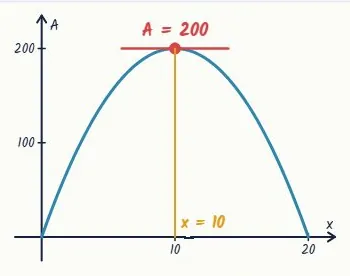
The graph of the area
- A parabola, opening down.
- Zero gradient at x = 10.
- The top: A = 200.
The 2025 weakness: the model
- A = xy has two variables.
- The constraint gives y = 40 − 2x.
- Substitute: A in terms of x alone.
| A = xy | two variables | stuck |
| 2x + y = 40 | y = 40 − 2x | constraint |
| A = x(40 − 2x) | one variable | ready |
An open box from 12 cm card
- Cut x from each corner.
- Expand, then differentiate.
- height x, base 12 − 2xx off each end
- V = x(12 − 2x)²height × base²
- = x(144 − 48x + 4x²)expand
- = 4x³ − 48x² + 144x
- dV/dx = 12x² − 96x + 144differentiate
- = 12(x² − 8x + 12)
- = 12(x − 2)(x − 6)factorise
Solve, reject, check
- x = 6 makes no box.
- Second derivative: a max.
- dV/dx = 12(x − 2)(x − 6)
- 12(x − 2)(x − 6) = 0stationary
- x = 2 or x = 6
- x = 6: base 12 − 12 = 0no box
- d²V/dx² = 24x − 96
- x = 2: 48 − 96 = −48 < 0a maximum
- V = 2(12 − 4)²
- = 2 × 64 = 128 cm³
A minimum: an open tank
- Open top: base, four sides.
- The volume gives h.
- x²h = 32 000volume
- h = 32 000/x²
- S = x² + 4xhbase + four sides
- = x² + 4x(32 000/x²)substitute h
- = x² + 128 000/x
- = x² + 128 000x⁻¹power form
- dS/dx = 2x − 128 000x⁻²differentiate
- = 2x − 128 000/x²
Solve, check, answer
- Clear the fraction first.
- Positive: a minimum.
- dS/dx = 2x − 128 000/x²
- 2x − 128 000/x² = 0stationary
- 2x³ = 128 000multiply by x²
- x³ = 64 000, so x = 40
- h = 32 000/1600 = 20
- d²S/dx² = 2 + 256 000/x³
- x = 40: 2 + 4 = 6 > 0a minimum
- S = 1600 + 128 000/40
- = 1600 + 3200 = 4800 cm²
Maximum or minimum?
- Achieved, Merit: you may assume it.
- Excellence: be ready to show it.
- S'' = 6 > 0 at x = 40: a minimum.
A rectangle under y = 12 − x²
- Corners at ±x on the axis.
- Width 2x, height y.
- width 2x, height 12 − x²
- A = 2x(12 − x²)
- = 24x − 2x³expand
- dA/dx = 24 − 6x²
- 24 − 6x² = 0stationary
- 6x² = 24, so x² = 4
- x = 2x > 0, a length
- d²A/dx² = −12x = −24 < 0a maximum
- A = 4 × 8 = 32width 4, height 8
Answer the question asked
- Greatest area? Give the area, not x.
- Dimensions? Give both.
- Say why you rejected a value.
Show the model and the derivative
- No credit for a calculator answer alone.
- Unknown constants stop the calculator.
- Use it to check, not to replace.
Where the marks are
- Achieved: differentiate a given model.
- Merit: build the one-variable model.
- Excellence: your own model, justified.
What to take away
- Build a function of one variable first. The calculus is the short part.
| Name | the variables |
| Write | the quantity |
| Constraint | down to one variable |
| Differentiate | set it equal to 0 |
| Check | reject impossible x |
| Answer | what was asked, units |
Your turn: four questions
- Pause here and answer each one.
- You may assume each is a max or min.
- Write the model and the derivative.
| Given | Find | |
|---|---|---|
| 1 | rectangle, perimeter 60 | maximum area |
| 2 | P = −2x² + 48x − 100 | maximum profit |
| 3 | 18 cm square card | maximum box volume |
| 4 | square base, 4000 cm³ | min surface, open top |
Show answer
1. A = x(30 − x), dA/dx = 30 − 2x, x = 15: 225 m², a square. 2. dP/dx = −4x + 48, x = 12: P = 188. 3. V = x(18 − 2x)², dV/dx = 12(x − 3)(x − 9), x = 3 (x = 9 gives no box): 432 cm³. 4. S = x² + 16 000/x, dS/dx = 2x − 16 000/x², x = 20, h = 10: 1200 cm².
The answers: questions 1 and 2
- 1. 2x + 2y = 60, y = 30 − xperimeter
- A = x(30 − x) = 30x − x²
- dA/dx = 30 − 2x = 0, x = 15
- y = 15: A = 15 × 15 = 225 m²a square
- 2. dP/dx = −4x + 48differentiate
- −4x + 48 = 0, x = 12
- d²P/dx² = −4 < 0a maximum
- P = −288 + 576 − 100 = 188
The answers: question 3
- 3. V = x(18 − 2x)²base 18 − 2x
- = 4x³ − 72x² + 324xexpand
- dV/dx = 12x² − 144x + 324differentiate
- = 12(x − 3)(x − 9) = 0factorise
- x = 9: base 18 − 18 = 0no box
- x = 3: V = 3(18 − 6)²
- = 3 × 144 = 432 cm³
The answers: question 4
- 4. x²h = 4000, h = 4000/x²volume
- S = x² + 4xh = x² + 16 000/xsubstitute h
- dS/dx = 2x − 16 000/x² = 0
- 2x³ = 16 000, x³ = 8000multiply by x²
- x = 20, h = 4000/400 = 10
- S = 400 + 16 000/20
- = 400 + 800 = 1200 cm²
Is your child on track?
Take the free placement test