Stationary points, concavity and points of inflection
What this lesson covers
- A stationary point is where the derivative is zero; concavity is the sign of the second derivative.
- Set the full derivative equal to zero before clearing any denominator.
Where the gradient is zero
- Stationary: dy/dx = 0, a flat tangent.
- Maximum, minimum or inflection.
- d²y/dx² gives the concavity.
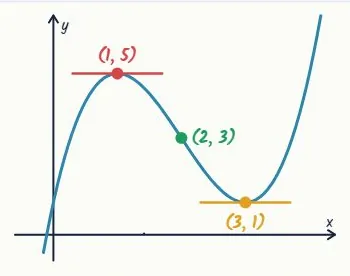
y = x³ − 6x² + 9x + 1
- A peak, then a dip.
- Flat tangents at both.
- An inflection between them.
Finding the stationary points
- Write dy/dx = 0.
- Factorise, then solve.
- Give both coordinates.
- y = x³ − 6x² + 9x + 1
- dy/dx = 3x² − 12x + 9differentiate
- 3x² − 12x + 9 = 0stationary: dy/dx = 0
- 3(x² − 4x + 3) = 0
- 3(x − 1)(x − 3) = 0factorise
- x = 1 or x = 3
- x = 1: y = 1 − 6 + 9 + 1 = 5
- x = 3: y = 27 − 54 + 27 + 1 = 1
- (1, 5) and (3, 1)
Classifying with d²y/dx²
- Negative: concave down.
- Positive: concave up.
- d²y/dx² = 6x − 12differentiate again
- x = 1: 6 − 12 = −6 < 0concave down
- (1, 5) is a maximum
- x = 3: 18 − 12 = 6 > 0concave up
- (3, 1) is a minimum
Increasing and decreasing
- Increasing: dy/dx > 0.
- Decreasing: dy/dx < 0.
- Test each interval.
- dy/dx = 3(x − 1)(x − 3)
- x = 0: 3(−1)(−3) = 9 > 0x < 1
- x = 2: 3(1)(−1) = −3 < 01 < x < 3
- x = 4: 3(3)(1) = 9 > 0x > 3
- decreasing for 1 < x < 3
- increasing for x < 1, x > 3
Concavity and inflection
- Zero, then a sign change.
- A zero alone is not enough.
- 6x − 12 = 0, so x = 2d²y/dx² = 0
- x < 2: 6x − 12 < 0concave down
- x > 2: 6x − 12 > 0concave up
- sign changes at x = 2
- y = 8 − 24 + 18 + 1 = 3
- inflection at (2, 3)
The 2025 error: rational functions
- Candidates cleared the denominator first.
- Write the full derivative = 0.
- Then clear the denominator.
y = x/(x² + 4)
- Quotient rule first.
- Whole fraction = 0 first.
- y = x/(x² + 4)
- u = x, v = x² + 4quotient rule
- u′ = 1, v′ = 2x
- dy/dx = (vu′ − uv′)/v²
- = (x² + 4 − 2x²)/(x² + 4)²
- = (4 − x²)/(x² + 4)²simplify the top
- (4 − x²)/(x² + 4)² = 0write this first
Then clear the denominator
- Fraction = 0: top = 0.
- Give both coordinates.
- (4 − x²)/(x² + 4)² = 0
- 4 − x² = 0top = 0
- x² = 4, so x = ±2
- x = 2: y = 2/(4 + 4) = 1/4
- x = −2: y = −2/8 = −1/4
- (2, 1/4) and (−2, −1/4)
y = xe^−x
- Product rule.
- e^−x is never zero.
- u = x, v = e^−xproduct rule
- u′ = 1, v′ = −e^−xchain rule
- dy/dx = e^−x − xe^−xu′v + uv′
- = (1 − x)e^−xfactorise
- (1 − x)e^−x = 0stationary
- e^−x > 0, so x = 1e^−x is never 0
- y = 1 × e^−1 = 1/e
- stationary at (1, 1/e)
The second derivative
- Product rule again.
- Check the sign change.
- dy/dx = (1 − x)e^−x
- d²y/dx² = −e^−x − (1 − x)e^−x
- = (x − 2)e^−xcollect
- x = 1: −e^−1 < 0a maximum
- (x − 2)e^−x = 0 at x = 2
- x − 2 goes from − to +e^−x > 0
- y = 2e^−2 = 2/e²
- inflection at (2, 2/e²)
y = x + 2cos x, 0 ≤ x ≤ 2π
- sin x = 1/2 in the range.
- Find both y-values.
- dy/dx = 1 − 2sin x
- 1 − 2sin x = 0stationary
- sin x = 1/2
- x = π/6 or x = 5π/60 ≤ x ≤ 2π
- y(π/6) = π/6 + 2(√3/2)
- = π/6 + √3 ≈ 2.26
- y(5π/6) = 5π/6 + 2(−√3/2)
- = 5π/6 − √3 ≈ 0.886
Classifying with −2cos x
- Negative: a maximum.
- Positive: a minimum.
- x = π/6 or x = 5π/6
- d²y/dx² = −2cos x
- π/6: −2(√3/2) = −√3 < 0
- maximum at (π/6, π/6 + √3)
- 5π/6: −2(−√3/2) = √3 > 0
- minimum at (5π/6, 5π/6 − √3)
Unknown constants
- y = xe^−kx: stationary at x = 1/k.
- The calculator cannot do this.
- Show the derivative every time.
Where the marks are
- Achieved: both coordinates, conditions.
- Merit: find and classify, clear algebra.
- Excellence: harder inflections, constants.
What to take away
- Full derivative = 0, then both coordinates.
| Stationary | dy/dx = 0, written |
| Rational | whole dy/dx = 0 first |
| Point | both x and y |
| Increasing | dy/dx > 0 |
| Concavity | sign of d²y/dx² |
| Inflection | d²y/dx² = 0, sign change |
Your turn: four questions
- Pause here and answer each one.
- Question 2 uses the curve from question 1.
- Question 3: full derivative = 0 first.
| Curve | Find | |
|---|---|---|
| 1 | y = x³ − 3x² − 9x + 5 | stationary points |
| 2 | the same curve | decreasing; inflection |
| 3 | y = (x + 1)/(x² + 3) | stationary points |
| 4 | y = x ln x | stationary point, type |
Show answer
1. dy/dx = 3x² − 6x − 9 = 3(x − 3)(x + 1) = 0: (−1, 10) and (3, −22). 2. Decreasing for −1 < x < 3. d²y/dx² = 6x − 6 = 0 at x = 1: inflection (1, −6). 3. dy/dx = (3 − 2x − x²)/(x² + 3)² = 0, so x = 1 or −3: (1, 1/2) and (−3, −1/6). 4. dy/dx = ln x + 1 = 0, x = 1/e: (1/e, −1/e). d²y/dx² = 1/x > 0, a minimum.
The answers: questions 1 and 2
- 1. dy/dx = 3x² − 6x − 9 = 0
- 3(x − 3)(x + 1) = 0factorise
- x = −1: y = −1 − 3 + 9 + 5 = 10
- x = 3: y = 27 − 27 − 27 + 5 = −22
- (−1, 10) and (3, −22)
- 2. decreasing for −1 < x < 3dy/dx < 0 between roots
- d²y/dx² = 6x − 6 = 0, x = 1changes sign
- y = 1 − 3 − 9 + 5 = −6
- inflection at (1, −6)
The answers: question 3
- 3. top: (x² + 3)(1) − (x + 1)(2x)quotient rule
- dy/dx = (3 − 2x − x²)/(x² + 3)²simplify
- (3 − 2x − x²)/(x² + 3)² = 0write this first
- x² + 2x − 3 = 0top = 0
- (x − 1)(x + 3) = 0factorise
- x = 1: y = 2/4 = 1/2
- x = −3: y = −2/12 = −1/6
- (1, 1/2) and (−3, −1/6)
The answers: question 4
- 4. dy/dx = ln x + x(1/x)product rule
- = ln x + 1
- ln x + 1 = 0, ln x = −1stationary
- x = e^−1 = 1/e
- y = (1/e) ln(1/e) = −1/eln(1/e) = −1
- d²y/dx² = 1/x = e > 0concave up
- minimum at (1/e, −1/e)
Is your child on track?
Take the free placement test