Tangents and normals: from gradient to finished equation
What this lesson covers
- The derivative gives the tangent's gradient; the normal's gradient is its negative reciprocal.
- An equation is finished only when it is in y = mx + c or general form.
Two lines through one point
- Tangent: the same gradient as the curve.
- Normal: at right angles to the tangent.
- Each needs a point and a gradient.
y = x³ − 3x + 1 at (2, 3)
- The tangent has the curve’s gradient.
- The normal is at right angles.
- Gradients multiply to −1.
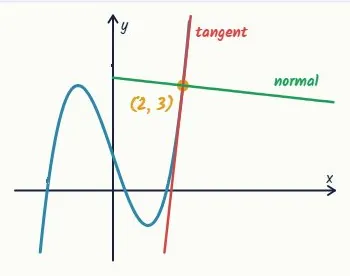
The tangent at x = 2
- A point, then a gradient.
- Finish as y = mx + c.
- x = 2: y = 8 − 6 + 1 = 3the point
- dy/dx = 3x² − 3differentiate
- x = 2: m = 3(4) − 3 = 9the gradient
- y − 3 = 9(x − 2)point-gradient form
- y − 3 = 9x − 18expand
- y = 9x − 15add 3
Try it: slide the tangent
- Move along y = x³ − 3x. The gradient is 0 exactly at the turning points.
The normal at x = 2
- Negative reciprocal: −1/9.
- Either form is finished.
- tangent m = 9
- normal m = −1/9−1 ÷ 9
- y − 3 = −(1/9)(x − 2)through (2, 3)
- y = −x/9 + 2/9 + 3expand
- y = −x/9 + 29/93 = 27/9
- 9y = −x + 29× 9
- x + 9y − 29 = 0general form
- 9 × (−1/9) = −1at right angles
Try it: tangent and normal
The 2025 error: unfinished equations
- Values substituted is not finished.
- Y = mx + c, or general form.
- Evaluate every number fully.
| Written as | |
|---|---|
| y − 3 = 9(x − 2) | not finished |
| y = 9x − 15 | y = mx + c |
| 9x − y − 15 = 0 | general form |
Graphing calculator
A point with a given gradient
- Set dy/dx equal to 9.
- Two points: find both y.
- dy/dx = 3x² − 3
- 3x² − 3 = 9gradient 9
- 3x² = 12, so x² = 4
- x = ±2
- x = 2: y = 8 − 6 + 1 = 3
- x = −2: y = −8 + 6 + 1 = −1
- (2, 3) and (−2, −1)
Same gradient: parallel tangents
- Same gradient, 9.
- Parallel lines never meet.
- at (−2, −1): y + 1 = 9(x + 2)
- y + 1 = 9x + 18expand
- y = 9x + 17
- at (2, 3): y = 9x − 15as before
- m = 9 for both: parallelnever meet
Where a tangent meets an axis
- Y = e²ˣ at x = 1.
- Then set y = 0.
- x = 1: y = e²the point (1, e²)
- dy/dx = 2e²ˣchain rule
- x = 1: m = 2e²the gradient
- y − e² = 2e²(x − 1)point-gradient form
- y = 2e²x − 2e² + e²expand
- y = 2e²x − e²
- y = 0: 2e²x = e²meets the x-axis
- x = 1/2divide by 2e²
Where two tangents meet
- Find each tangent first.
- Set the equations equal.
- x = 0: y = 1, m = 3(0) − 3 = −3
- y − 1 = −3(x − 0)point-gradient form
- y = −3x + 1
- x = 2: y = 9x − 15from before
- −3x + 1 = 9x − 15set them equal
- 16 = 12x, so x = 4/3add 3x + 15
- y = −3(4/3) + 1 = −3substitute back
- they meet at (4/3, −3)
A normal to y = tan x
- The same steps with trig.
- Normal gradient −1/2.
- x = π/4: y = tan(π/4) = 1
- dy/dx = sec² xderivative of tan x
- cos²(π/4) = 1/2
- m = sec²(π/4) = 21 ÷ (1/2)
- normal m = −1/2−1 ÷ 2
- y − 1 = −(1/2)(x − π/4)point-gradient form
- y = −x/2 + π/8 + 1expand
Calculus meets coordinate geometry
- Point, derivative, gradient, line.
- In that order, every time.
- Show the derivative.
Where the marks are
- Achieved: a tangent’s gradient.
- Merit: equations, given gradients, meetings.
- Excellence: form your own equations.
What to take away
- A point, a gradient, and a finished equation.
| Point | both coordinates |
| Gradient | dy/dx at that x |
| Normal | −1 ÷ tangent gradient |
| Finish | y = mx + c |
| Given gradient | dy/dx = m, solve |
| Meeting | solve together |
Common mistakes
- Tangent: y − 3 = (3(2)² − 3)(x − 2), done.Evaluate every number and finish the line: y = 9x − 15. Unfinished equations lost marks in 2025.
- The tangent has gradient 9, so the normal has gradient −9.The normal's gradient is the negative reciprocal, −1/9, so that 9 × (−1/9) = −1.
- y − 3 = (3x² − 3)(x − 2)The gradient of a line is a number: substitute x = 2 into dy/dx first, m = 3(4) − 3 = 9.
- 3x² − 3 = 9, so x² = 4 and x = 2.x² = 4 gives x = ±2, so there are two points with gradient 9: (2, 3) and (−2, −1).
Your turn: four questions
- Question 1: the x-intercept too.
- Finish every equation.
| Curve | Find | |
|---|---|---|
| 1 | y = x ln x at x = e | tangent; x-intercept |
| 2 | y = √(4x + 1) at x = 2 | normal |
| 3 | y = x³ − 12x | points, gradient 15 |
| 4 | y = x², x = 1 and x = 3 | where tangents meet |
Show answer
1. Point (e, e), dy/dx = ln x + 1 = 2: y = 2x − e, meeting the x-axis at x = e/2. 2. Point (2, 3), dy/dx = 2/√(4x + 1) = 2/3, normal gradient −3/2: y = −3x/2 + 6. 3. 3x² − 12 = 15, x = ±3: (3, −9) and (−3, 9). 4. y = 2x − 1 and y = 6x − 9 meet at (2, 3).
The answers: questions 1 and 2
- 1. x = e: y = e ln e = ethe point
- dy/dx = ln x + 1 = 2product rule
- y − e = 2(x − e), y = 2x − e
- y = 0: x = e/2meets the x-axis
- 2. x = 2: y = √9 = 3the point
- dy/dx = 2/√(4x + 1) = 2/3chain rule
- normal m = −3/2−1 ÷ (2/3)
- y − 3 = −(3/2)(x − 2)
- y = −3x/2 + 6expand
The answers: question 3
- 3. dy/dx = 3x² − 12
- 3x² − 12 = 15gradient 15
- 3x² = 27, x² = 9, x = ±3
- x = 3: y = 27 − 36 = −9
- x = −3: y = −27 + 36 = 9
- (3, −9) and (−3, 9)
The answers: question 4
- 4. dy/dx = 2x
- x = 1: point (1, 1), m = 2
- y − 1 = 2(x − 1), y = 2x − 1
- x = 3: point (3, 9), m = 6
- y − 9 = 6(x − 3), y = 6x − 9
- 2x − 1 = 6x − 9set them equal
- 4x = 8, so x = 2
- y = 2(2) − 1 = 3substitute back
- they meet at (2, 3)
Sample question: Achieved
Find the equation of the tangent to y = 2x² − 5x + 1 at the point where x = 3.
Hint
Find the y value at x = 3 and the gradient from dydx at x = 3. Then use y − y1 = m(x − x1).
Answer
y = 7x − 17
Step by step
- A tangent needs a point and a gradient.
- The point: x = 3 gives y = 18 − 15 + 1 = 4, so the point is (3, 4).
- The gradient: dydx = 4x − 5, which is 12 − 5 = 7 at x = 3.
- Use y − y1 = m(x − x1): y − 4 = 7(x − 3).
- Finish it: y − 4 = 7x − 21, so y = 7x − 17.
- Check the point is on the line: 7(3) − 17 = 4. Correct.
Full working
- x = 3: y = 18 − 15 + 1 = 4the point (3, 4)
- dydx = 4x − 5 = 7 at x = 3
- y − 4 = 7(x − 3)
- y = 7x − 17
Sample questions: Merit
Find the equation of the normal to y = √(2x + 5) at the point where x = 2, and the point where the normal crosses the x-axis.
Hint
Write y = (2x + 5)^½ and use the chain rule. The normal's gradient is the negative reciprocal of the tangent's.
Answer
The normal is y = −3x + 9, and it crosses the x-axis at (3, 0).
Step by step
- The point: x = 2 gives y = √9 = 3, so the point is (2, 3).
- Write y = (2x + 5)^½. Chain rule: dydx = ½(2x + 5)^−½ × 2 = 1√(2x + 5).
- At x = 2 the tangent's gradient is 1√9 = 13.
- The normal is at right angles to the tangent, so its gradient is the negative reciprocal: −1 ÷ (13) = −3.
- Normal: y − 3 = −3(x − 2), so y = −3x + 6 + 3 = −3x + 9.
- It crosses the x-axis where y = 0: −3x + 9 = 0, so x = 3. The point is (3, 0).
- The classic mistake is to use the tangent's gradient, 13, for the normal. Check: 13 × (−3) = −1, so they are perpendicular.
Full working
- x = 2: y = √9 = 3the point (2, 3)
- dydx = 1√(2x + 5) = 13 at x = 2chain rule
- normal gradient = −3negative reciprocal
- y − 3 = −3(x − 2), y = −3x + 9
- y = 0: x = 3
- y = −3x + 9, crossing the x-axis at (3, 0)
Find the equations of the two tangents to y = x³ − 3x² that are parallel to the line y = 9x + 1.
Hint
Parallel lines have the same gradient, so solve dydx = 9. Each solution gives a point and a tangent.
Answer
y = 9x − 27 and y = 9x + 5
Step by step
- Parallel lines have equal gradients. So the tangents we want have gradient 9.
- dydx = 3x² − 6x. Set it equal to 9: 3x² − 6x − 9 = 0.
- Divide by 3: x² − 2x − 3 = 0, which factorises to (x − 3)(x + 1) = 0. So x = 3 or x = −1.
- Find each point on the curve. x = 3: y = 27 − 27 = 0, so (3, 0). x = −1: y = −1 − 3 = −4, so (−1, −4).
- Tangent at (3, 0): y − 0 = 9(x − 3), so y = 9x − 27.
- Tangent at (−1, −4): y + 4 = 9(x + 1), so y = 9x + 5.
- Both have gradient 9, and neither is the line y = 9x + 1 itself, so they are both parallel to it.
- Check: 9(−1) + 5 = −4, so (−1, −4) is on the second tangent. Correct.
Full working
- dydx = 3x² − 6x = 9parallel: same gradient
- (x − 3)(x + 1) = 0, x = 3 or −1
- points (3, 0) and (−1, −4)
- y = 9(x − 3) = 9x − 27
- y + 4 = 9(x + 1), y = 9x + 5
- y = 9x − 27 and y = 9x + 5
Sample questions: Excellence
Find the equations of the tangents to the curve y = x² + 4 that pass through the origin, and the points where they touch the curve.
Hint
The origin is not on the curve. Let the tangent touch at (a, a² + 4), write its equation in terms of a, then make it pass through (0, 0).
Answer
y = 4x, touching at (2, 8), and y = −4x, touching at (−2, 8)
Step by step
- The origin is not on the curve (at x = 0, y = 4), so we do not know where the tangents touch. Call the touching point (a, a² + 4).
- The gradient there is dydx = 2x = 2a.
- Tangent: y − (a² + 4) = 2a(x − a).
- It must pass through (0, 0). Put x = 0 and y = 0: −(a² + 4) = 2a(−a) = −2a².
- So a² + 4 = 2a², which gives a² = 4 and a = 2 or a = −2.
- a = 2: the point is (2, 8) and the gradient is 4. The tangent is y − 8 = 4(x − 2), so y = 4x.
- a = −2: the point is (−2, 8) and the gradient is −4. The tangent is y − 8 = −4(x + 2), so y = −4x.
- Both lines pass through the origin, as required. The answer is symmetric because the curve is symmetric about the y-axis.
- Check that y = 4x only touches: x² + 4 = 4x gives (x − 2)² = 0, a repeated root. So it meets the curve at one point only.
Full working
- point (a, a² + 4), gradient 2a
- y − (a² + 4) = 2a(x − a)
- −(a² + 4) = −2a²passes through (0, 0)
- a² = 4, a = ±2
- a = 2: y = 4x at (2, 8); a = −2: y = −4x at (−2, 8)
- x² + 4 = 4x gives (x − 2)² = 0check: it touches
- y = 4x at (2, 8) and y = −4x at (−2, 8)
P is the point (1, 1) on the curve y = x². The normal at P meets the curve again at Q. Find the coordinates of Q, and the point where the tangents at P and Q meet.
Hint
Find the normal at P, then solve it together with y = x². You already know x = 1 is one solution. Then find the tangent at each point and solve them together.
Answer
Q = (−32, 94), and the tangents meet at (−14, −32).
Step by step
- At P, dydx = 2x = 2, so the tangent gradient is 2 and the normal gradient is −12.
- Normal: y − 1 = −(12)(x − 1), so y = −x2 + 32.
- Where it meets the curve: x² = −x2 + 32. Multiply by 2: 2x² + x − 3 = 0.
- We know x = 1 is a root, so x − 1 is a factor: (x − 1)(2x + 3) = 0. The other root is x = −32.
- Q: y = (−32)² = 94, so Q = (−32, 94).
- Tangent at P: gradient 2, so y − 1 = 2(x − 1), which is y = 2x − 1.
- Tangent at Q: gradient 2(−32) = −3, so y − 94 = −3(x + 32), which is y = −3x − 94.
- Solve them together: 2x − 1 = −3x − 94, so 5x = −54 and x = −14.
- Then y = 2(−14) − 1 = −32. The tangents meet at (−14, −32).
- Check on the other tangent: −3(−14) − 94 = 34 − 94 = −32. Correct.
Full working
- normal at P: gradient −12, y = −x2 + 32
- 2x² + x − 3 = (x − 1)(2x + 3) = 0x = 1 is P
- Q = (−32, 94)
- tangent at P: y = 2x − 1
- tangent at Q: gradient −3, y = −3x − 94
- 2x − 1 = −3x − 94, x = −14, y = −32
- Q = (−32, 94); tangents meet at (−14, −32)
Practise this
Report a mistake
More in AS 91578
 The derivative toolkit: chain, product and quotient rules11 min
 Stationary points, concavity and points of inflection11 minTangents and normals: from gradient to finished equation11 min
 Parametric differentiation, and the second derivative11 min
 Related rates of change: spheres, cones and the chain rule10 min
 Optimisation: building the model and finding the max or min11 min
 Limits, continuity and differentiability from a graph8 min
 Derivative toolkit: 7 exam questions solved step by step11 min
 Stationary points: 7 exam questions solved step by step12 min
 Tangents and normals: 7 exam questions solved step by step12 min
 Parametric curves: 7 exam questions solved step by step11 min
 Related rates of change: 7 exam questions solved step by step11 min
 Optimisation: 7 exam questions solved step by step11 min
 Limits and continuity: 7 exam questions solved step by step11 min
Is your child on track?
Take the free placement test