The constant of integration: find c, never assume it
What this lesson covers
- Every indefinite integral carries a constant, and the question's conditions decide its value.
- A starting value of zero does not mean the constant is zero.
Why every integral ends in + c
- A constant differentiates to zero.
- So integrating cannot recover it.
- The question gives you enough to find it.
A family of curves: y = x² − 2x + c
- Each c shifts the curve up or down.
- Same gradient at every x.
- The point (3, 5) picks c = 2.
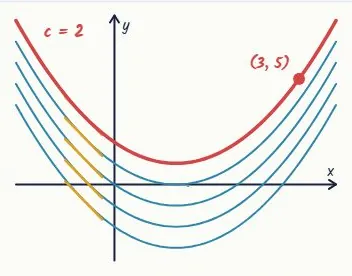
The curve through (3, 5)
- Integrate, keep + c.
- Substitute the point.
- y = ∫ (2x − 2) dx
- = x² − 2x + ckeep + c
- 5 = 3² − 2(3) + cx = 3, y = 5
- 5 = 3 + c
- c = 2
- y = x² − 2x + 2
Finding c from a point
- Integrate, keep + c.
- Substitute the point.
- Then write the curve.
- dy/dx = 6x² − 4x, through (1, 5)
- y = 6x³/3 − 4x²/2 + cintegrate, + c
- y = 2x³ − 2x² + c
- 5 = 2(1)³ − 2(1)² + cx = 1, y = 5
- 5 = 2 − 2 + c, so c = 5
- y = 2x³ − 2x² + 5
The 2025 error: + c left out
- Omitted, or assumed to be zero.
- Handled inconsistently in long solutions.
- Write + c, then find it straight away.
Acceleration to velocity
- v = 3, s = 0 when t = 0.
- Integrate a to get v.
- a = 6t − 4
- v = ∫ (6t − 4) dt
- = 3t² − 4t + ckeep + c
- v(0) = 3: 3 = 0 − 0 + c
- c = 3
- v = 3t² − 4t + 3
Velocity to displacement
- Integrate v to get s.
- A new letter: d.
- v = 3t² − 4t + 3
- s = ∫ (3t² − 4t + 3) dt
- = t³ − 2t² + 3t + da new constant, d
- s(0) = 0: 0 = 0 + d
- d = 0
- s = t³ − 2t² + 3t
- s(2) = 8 − 8 + 6 = 6t = 2
- s = 6 m at t = 2
Two integrations, two constants
- Find the first before integrating again.
- A different letter for each.
- Match each condition to its constant.
Starting at zero does not mean c = 0
- Polynomials: often c = 0 at t = 0.
- 2025: exponential s, s = 0 at t = 0.
- The constant was not zero.
v = 8e^(−2t), s = 0 at t = 0
- Integrate, keep + c.
- e⁰ = 1, not 0.
- So c = 4, not 0.
- s = ∫ 8e^(−2t) dt
- = 8 × (1/(−2))e^(−2t) + c÷ −2
- = −4e^(−2t) + c
- 0 = −4e⁰ + ct = 0, s = 0
- 0 = −4 + ce⁰ = 1
- c = 4
- s = 4 − 4e^(−2t)
Does the answer fit?
- c = 0 starts at −4.
- The correct s starts at 0.
- It approaches 4 m.
- c = 0: s = −4e^(−2t)
- s(0) = −4e⁰ = −4 ≠ 0does not fit
- s(0) = 4 − 4e⁰ = 0fits s(0) = 0
- s(1) = 4 − 4e^(−2)
- ≈ 3.46 mcalculator
- t → ∞: e^(−2t) → 0
- s → 4 m
Cos does it too: v = 2sin t
- tⁿ, sin t: 0 at t = 0.
- eᵏᵗ, cos t: 1 at t = 0.
- Substitute, never assume.
- s = ∫ 2sin t dt
- = −2cos t + csin to −cos
- 0 = −2cos 0 + ct = 0, s = 0
- 0 = −2 + ccos 0 = 1
- c = 2
- s = 2 − 2cos t
Where the marks are
- Achieved: find c from given information.
- Merit: a, v and s with starting values.
- Excellence: your own equations, consistent.
What to take away
- Keep + c, substitute the condition, and never assume c = 0.
| Every integral | + c |
| Find c | substitute the condition |
| a to v to s | a new constant each time |
| At t = 0 | e and cos give 1 |
| Check | your s fits the start |
Your turn: four questions
- Pause here and answer each one.
- Questions 3 and 4 start at zero.
- Show the substitution that finds c.
| Given | Find | |
|---|---|---|
| 1 | dy/dx = 3x² + 2, (1, 6) | the curve |
| 2 | a = 12t, v = 2, s = 1 | s, if both at t = 0 |
| 3 | v = 6e^(3t) | s, if s = 0 at t = 0 |
| 4 | v = 4sin 2t | s, if s = 0 at t = 0 |
Show answer
1. y = x³ + 2x + c, c = 3: y = x³ + 2x + 3. 2. v = 6t² + 2, s = 2t³ + 2t + 1. 3. s = 2e^(3t) + c, c = −2: s = 2e^(3t) − 2. 4. s = −2cos 2t + c, c = 2: s = 2 − 2cos 2t.
The answers: questions 1 and 2
- 1. y = x³ + 2x + cintegrate 3x² + 2
- 6 = 1 + 2 + c, so c = 3point (1, 6)
- y = x³ + 2x + 3
- 2. v = ∫ 12t dt = 6t² + c
- v(0) = 2: 2 = 0 + c, c = 2
- v = 6t² + 2
- s = ∫ (6t² + 2) dt = 2t³ + 2t + d
- s(0) = 1: 1 = 0 + d, d = 1
- s = 2t³ + 2t + 1
The answers: questions 3 and 4
- 3. s = ∫ 6e^(3t) dt
- = 2e^(3t) + c÷ 3
- 0 = 2e⁰ + c = 2 + ct = 0, s = 0
- c = −2, s = 2e^(3t) − 2
- 4. s = ∫ 4sin 2t dt
- = −2cos 2t + csin to −cos, ÷ 2
- 0 = −2cos 0 + c = −2 + ct = 0, s = 0
- c = 2, s = 2 − 2cos 2t
Is your child on track?
Take the free placement test