Definite integrals and area, including between two curves
What this lesson covers
- A definite integral gives a signed area, so regions below the axis count as negative.
- The area between two curves is the integral of the top curve minus the bottom one.
A definite integral
- Integrate, then F(b) − F(a).
- The answer is a signed area.
- Below the x axis counts as negative.
∫ from −1 to 2 of (3x² − 2x) dx
- Integrate each term.
- Top limit, then bottom.
- Subtract, with brackets.
- ∫₋₁² (3x² − 2x) dx
- = [x³ − x²]₋₁²integrate each term
- F(2) = 2³ − 2² = 8 − 4 = 4top limit
- F(−1) = (−1)³ − (−1)²bottom limit
- = −1 − 1 = −2
- F(2) − F(−1) = 4 − (−2)brackets
- = 6
Missing brackets: a 2025 error
- No brackets: a sign is lost.
- Put all of F(a) in brackets.
- F(2) = 4, F(−1) = −1 − 1
- 4 − −1 − 1no brackets
- = 4 + 1 − 1 = 4sign lost
- 4 − (−1 − 1)all of F(a) in brackets
- = 4 − (−2)
- = 6
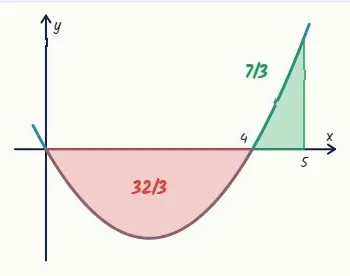
y = x² − 4x, from 0 to 5
- Below the axis from 0 to 4.
- Above the axis from 4 to 5.
- Straight across: −25/3.
Roots, then F at every limit
- Split at the roots.
- Evaluate F at 0, 4 and 5.
- x² − 4x = x(x − 4) = 0factorise
- x = 0 or x = 4
- F(x) = x³/3 − 2x²integrate
- F(0) = 0
- F(4) = 64/3 − 32 = −32/3
- F(5) = 125/3 − 50 = −25/3
- ∫₀⁵ = F(5) − F(0) = −25/3not the area
Split at the roots
- Integrate each piece.
- Add the sizes, not signs.
- F(0) = 0
- F(4) = −32/3
- F(5) = −25/3
- ∫₀⁴ = F(4) − F(0) = −32/3below the axis
- ∫₄⁵ = F(5) − F(4)
- = −25/3 − (−32/3) = 7/3above the axis
- Area = 32/3 + 7/3add the sizes
- = 39/3 = 13
- −32/3 + 7/3 = −25/3pieces add up
The area between two curves
- Integrate top minus bottom.
- Limits: where the curves meet.
- If they swap over, split there.
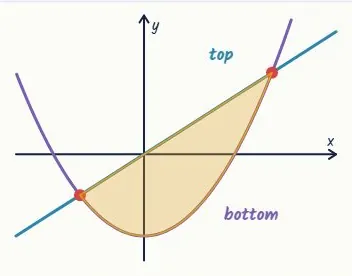
Between y = x and y = x² − 2
- They meet at two points.
- The line is on top.
- Top minus bottom: no splitting.
Where they meet, and the integral
- Set the curves equal.
- Then top minus bottom.
- x² − 2 = xset equal
- x² − x − 2 = 0rearrange
- (x − 2)(x + 1) = 0factorise
- x = −1 or x = 2
- A = ∫₋₁² (x − (x² − 2)) dxtop − bottom
- = ∫₋₁² (2 + x − x²) dxsimplify
Evaluating the area
- Integrate, then subtract.
- Area = 9/2.
- A = ∫₋₁² (2 + x − x²) dx
- = [2x + x²/2 − x³/3]₋₁²integrate
- F(2) = 4 + 2 − 8/3 = 10/3
- F(−1) = −2 + 1/2 + 1/3
- = −7/6
- A = 10/3 − (−7/6)brackets
- = 20/6 + 7/6 = 27/6
- = 9/2
Solving for an unknown limit
- Integrate, then set equal.
- Reject a root, and say why.
- ∫₀ᵏ (2x + 1) dx = 12
- [x² + x]₀ᵏ = 12integrate
- (k² + k) − 0 = 12substitute k and 0
- k² + k − 12 = 0rearrange
- (k − 3)(k + 4) = 0factorise
- k = 3 or k = −4
- k = −4k must be positive
- k = 3
- 3² + 3 = 12
Keep the 1/a factor
- Reverse chain rule: ÷ 2.
- Dropping it scored nothing.
- ∫ e²ˣ dx, from 0 to ln 2
- = [(1/2)e²ˣ] from 0 to ln 2
- e^(2 ln 2) = e^(ln 4) = 4top limit
- e⁰ = 1bottom limit
- = (1/2)(4 − 1) = 3/2
- 4 − 1 = 3no 1/2: no credit
Trig limits are in radians
- Integrate: divide by 3.
- Check the calculator mode.
- ∫ cos 3x dx, from 0 to π/6
- = [(1/3)sin 3x] from 0 to π/6
- 3(π/6) = π/2, sin(π/2) = 1top limit
- sin 0 = 0bottom limit
- = (1/3)(1 − 0) = 1/3
Show the integrated function
- No credit for a calculator answer alone.
- Unknown constants stop the calculator.
- Brackets, substitution, answer.
Where the marks are
- Achieved: evaluate, or solve for an unknown.
- Merit: areas, including below the axis.
- Excellence: unfamiliar areas, clear notation.
What to take away
- Signed area: split at the roots, and integrate top minus bottom.
| Evaluate | F(b) − F(a) |
| Brackets | around F(a) |
| Below the axis | split at the roots |
| Between curves | top − bottom |
| Unknown limit | check both roots |
| Show it | every integration |
Your turn: four questions
- Pause here and answer each one.
- Question 2: find the roots first.
- Question 3: which curve is on top?
| Given | Find | |
|---|---|---|
| 1 | 6x² − 4x, x = 1 to 2 | the integral |
| 2 | y = x² − 3x, x = 0 to 4 | total area |
| 3 | y = 6 − x² and y = x | area enclosed |
| 4 | ∫₀ᵏ e²ˣ dx = 4 | k, exactly |
Show answer
1. [2x³ − 2x²] from 1 to 2 = 8 − 0 = 8. 2. Roots 0 and 3: ∫₀³ = −9/2 and ∫₃⁴ = 11/6, so the area is 9/2 + 11/6 = 19/3. 3. They meet at x = −3 and x = 2; ∫(6 − x − x²) dx from −3 to 2 = 125/6 ≈ 20.8. 4. (e²ᵏ − 1)/2 = 4, so e²ᵏ = 9 and k = ln 3 ≈ 1.10.
The answers: questions 1 and 2
- 1. [2x³ − 2x²]₁²integrate
- = (16 − 8) − (2 − 2) = 8
- 2. x(x − 3) = 0, so x = 0 or 3roots
- F(x) = x³/3 − 3x²/2integrate
- ∫₀³ = F(3) − F(0) = 9 − 27/2
- = −9/2
- ∫₃⁴ = F(4) − F(3)
- = −8/3 − (−9/2) = 11/6
- Area = 9/2 + 11/6 = 19/3add the sizes
The answers: question 3
- 3. 6 − x² = xset equal
- x² + x − 6 = 0rearrange
- (x + 3)(x − 2) = 0, so x = −3 or 2
- A = ∫₋₃² (6 − x² − x) dxparabola on top
- = [6x − x³/3 − x²/2]₋₃²integrate
- F(2) = 12 − 8/3 − 2 = 22/3
- F(−3) = −18 + 9 − 9/2 = −27/2
- A = 22/3 − (−27/2) = 125/6
- ≈ 20.8
The answers: question 4
- 4. ∫₀ᵏ e²ˣ dx = [(1/2)e²ˣ]₀ᵏreverse chain rule
- = (1/2)(e²ᵏ − 1) = 4substitute k and 0
- e²ᵏ − 1 = 8, so e²ᵏ = 9multiply by 2
- 2k = ln 9ln both sides
- k = (1/2)ln 9 = ln 3ln 9 = 2 ln 3
- ≈ 1.10
Is your child on track?
Take the free placement test