Tables, trees and Venn diagrams from written information
What this lesson covers
- Most probability questions become easy once the information is in a table, a tree or a Venn diagram.
- Choose the structure that matches how the information is given.
Organise first, then calculate
- Questions arrive as a paragraph of words.
- A table, tree or Venn makes them easy.
- Skipping this step: a 2025 finding.
Let the wording choose
- Two variables: a two-way table.
- One, the other, or both: a Venn diagram.
- "Of those who": a tree.
| Information | Structure |
|---|---|
| Two variables | two-way table |
| Overlapping groups | Venn diagram |
| "Of those who..." | tree |
| Values of X | probability table |
Words into a two-way table
- 200 orders, 120 takeaway.
- 95 with food, 45 of them takeaway.
- Place the givens, mark the gaps.
| Food | No food | Total | |
|---|---|---|---|
| Takeaway | 45 | ? | 120 |
| Dine-in | ? | ? | ? |
| Total | 95 | ? | 200 |
Fill the gaps by subtraction
- Totals first.
- Each gap: total − known.
- Check the last cell twice.
- dine-in: 200 − 120 = 80row totals
- no food: 200 − 95 = 105column totals
- takeaway, no food: 120 − 45 = 75
- dine-in, food: 95 − 45 = 50
- dine-in, no food: 80 − 50 = 30
- check: 105 − 75 = 30
The finished table
- Rows and columns add up.
- Now ready for any probability.
| Food | No food | Total | |
|---|---|---|---|
| Takeaway | 45 | 75 | 120 |
| Dine-in | 50 | 30 | 80 |
| Total | 95 | 105 | 200 |
Try it: complete the table
A Venn diagram, middle first
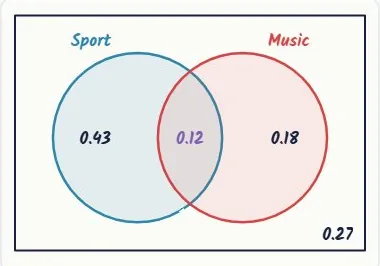
- P(sport) = 0.55, P(music) = 0.3.
- Both: 0.12, in the middle.
- Then the other three regions.
Each region, worked
- Circle minus the middle.
- Neither: 1 minus the rest.
- only sport = 0.55 − 0.12 = 0.43
- only music = 0.3 − 0.12 = 0.18
- neither = 1 − (0.43 + 0.12 + 0.18)
- = 1 − 0.73 = 0.27
- 0.43 + 0.12 + 0.18 + 0.27 = 1
Try it: each region
Given "or" instead of "both"
- Use the addition rule.
- Neither = 1 − P(S or M).
- P(S or M) = P(S) + P(M)addition rule
- − P(S and M)
- 0.73 = 0.55 + 0.3 − P(S and M)
- P(S and M) = 0.55 + 0.3 − 0.73
- = 0.12
- neither = 1 − 0.73 = 0.27outside both circles
Completing the Venn: a 2025 error
- Wrong: circles as "only".
- Take the middle away first.
- only sport = 0.55whole circle
- only music = 0.3whole circle
- neither = 1 − (0.55 + 0.12 + 0.3)
- = 1 − 0.97 = 0.03overlap counted 3 times
- right: 0.43, 0.12, 0.18, 0.27
The same numbers as a table
- Four Venn regions, four table cells.
- Totals match the circles.
- Use whichever reads more easily.
| Music | No music | Total | |
|---|---|---|---|
| Sport | 0.12 | 0.43 | 0.55 |
| No sport | 0.18 | 0.27 | 0.45 |
| Total | 0.3 | 0.7 | 1 |
Words into a tree
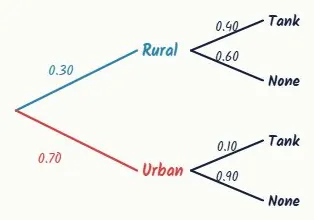
- First stage: rural 0.3, urban 0.7.
- "40% of rural" goes after rural.
- "10% of urban" goes after urban.
Multiply along, add across
- Multiply along each path.
- Add the paths you want.
- rural, tank: 0.3 × 0.4 = 0.12
- rural, none: 0.3 × 0.6 = 0.18
- urban, tank: 0.7 × 0.1 = 0.07
- urban, none: 0.7 × 0.9 = 0.63
- 0.12 + 0.18 + 0.07 + 0.63 = 1
- P(tank) = 0.12 + 0.07two tank paths
- = 0.19
A probability table sums to 1
- X: people in a car.
- Missing: 1 minus the rest.
- P(X = 1) = 0.45, P(X = 2) = 0.3
- P(X = 4) = 0.1
- P(X = 3) = p
- 0.45 + 0.3 + p + 0.1 = 1the table sums to 1
- 0.85 + p = 1
- p = 1 − 0.85 = 0.15
- every value from 0 to 1
The completed table
- The gap is 0.15.
- Every value from 0 to 1.
- Together they total 1.
| x | P(X = x) |
|---|---|
| 1 | 0.45 |
| 2 | 0.3 |
| 3 | ? = 0.15 |
| 4 | 0.1 |
Try it: organise the words
Where the marks are
- Achieved: pick a structure, find a probability.
- Merit: complete Venns and trees accurately.
- Excellence: use it to judge a claim.
What to take away
- Organise the words first, then check every set totals 1.
| Two variables | two-way table |
| Overlaps | Venn, middle first |
| "Of those" | second-stage branch |
| Every set | totals 1 (or n) |
| Missing P | 1 minus the rest |
| Check | each p from 0 to 1 |
Common mistakes
- Only sport = 0.55, only music = 0.3, so neither = 1 − (0.55 + 0.12 + 0.3) = 0.03.Take the middle off each circle first: only sport 0.43, only music 0.18, so neither = 1 − 0.73 = 0.27.
- P(S or M) = 0.73, so P(S and M) = 0.55 × 0.3.Use the addition rule: P(S and M) = 0.55 + 0.3 − 0.73 = 0.12. Multiplying assumes independence.
- 40% of rural and 10% of urban have a tank, so P(tank) = 0.4 + 0.1 = 0.5.Multiply along each path, then add: P(tank) = 0.3 × 0.4 + 0.7 × 0.1 = 0.19.
- P(X = 3) = 1 − 0.45 − 0.3 = 0.25Every probability in the table counts: p = 1 − (0.45 + 0.3 + 0.1) = 0.15.
Your turn: four questions
- Draw the structure first.
- Show your working.
| Given | Find | |
|---|---|---|
| 1 | A 0.6, B 0.5, both 0.3 | Venn regions |
| 2 | wet 0.3; late 0.5, 0.2 | P(late) |
| 3 | 0.15, 0.4, ?, 0.1 | P(X = 2) |
| 4 | 40: 25 N, 18 H, 8 both | P(neither) |
Show answer
1. Only A 0.6 − 0.3 = 0.3, both 0.3, only B 0.5 − 0.3 = 0.2, neither 1 − 0.8 = 0.2. 2. 0.3 × 0.5 + 0.7 × 0.2 = 0.15 + 0.14 = 0.29. 3. P(X = 2) = 1 − (0.15 + 0.4 + 0.1) = 0.35. 4. Only netball 17, both 8, only hockey 10, neither 5; P(neither) = 5/40 = 0.125.
The answers: questions 1 and 2
- 1. only A = 0.6 − 0.3 = 0.3
- only B = 0.5 − 0.3 = 0.2
- neither = 1 − (0.3 + 0.3 + 0.2)
- = 1 − 0.8 = 0.2
- 2. wet, late: 0.3 × 0.5 = 0.15
- dry, late: 0.7 × 0.2 = 0.14
- P(late) = 0.15 + 0.14 = 0.29
The answers: questions 3 and 4
- 3. 0.15 + 0.4 + p + 0.1 = 1the table sums to 1
- 0.65 + p = 1
- P(X = 2) = 1 − 0.65 = 0.35
- 4. only N = 25 − 8 = 17
- only H = 18 − 8 = 10
- neither = 40 − (17 + 8 + 10)
- = 40 − 35 = 5
- P(neither) = 5 ÷ 40 = 0.125
Sample question: Achieved
At a Tauranga school, 45% of Year 13 students take Physics, 35% take Chemistry and 15% take both. Use a Venn diagram to find the probability that a Year 13 student takes Physics only, Chemistry only, and neither.
Hint
Put the 15% in the middle first, then subtract it from each circle.
Answer
Physics only 0.3, Chemistry only 0.2, neither 0.35
Step by step
- Both is the overlap, so write 0.15 in the middle of the Venn diagram first.
- The Physics circle holds 0.45 altogether, including the middle. Physics only: 0.45 − 0.15 = 0.3.
- Chemistry only: 0.35 − 0.15 = 0.2.
- Inside the circles: 0.3 + 0.15 + 0.2 = 0.65.
- Neither is everything outside: 1 − 0.65 = 0.35.
- Classic mistake: writing 0.45 and 0.35 as the only regions. That counts the overlap twice.
- Check: 0.3 + 0.15 + 0.2 + 0.35 = 1.
Full working
- both = 0.15middle first
- P only = 0.45 − 0.15 = 0.3
- C only = 0.35 − 0.15 = 0.2
- neither = 1 − (0.3 + 0.15 + 0.2) = 0.35
- 0.3, 0.2 and 0.35
Sample questions: Merit
250 tourists are surveyed in Rotorua. 60% are from overseas and the rest are from New Zealand. 70 of the overseas tourists visited the hot pools, and 85 of the New Zealand tourists did not. Complete a two-way table and find the probability that a randomly chosen tourist (a) visited the hot pools, (b) is from overseas and did not visit the hot pools.
Hint
Turn 60% into a count first, then fill each gap by subtracting from a total.
Answer
(a) 85 ÷ 250 = 0.34 (b) 80 ÷ 250 = 0.32
Step by step
- Two variables (where from, hot pools or not), so a two-way table fits.
- Turn the percentage into a count: 60% of 250 = 0.6 × 250 = 150 overseas. So 250 − 150 = 100 from NZ.
- Place the given numbers: overseas and hot pools = 70; NZ and no hot pools = 85.
- Overseas, no hot pools: 150 − 70 = 80.
- NZ, hot pools: 100 − 85 = 15.
- Column totals: hot pools 70 + 15 = 85; no hot pools 80 + 85 = 165. Check: 85 + 165 = 250.
- (a) P(hot pools) = 85 ÷ 250 = 0.34.
- (b) Overseas and no hot pools is one cell: 80 ÷ 250 = 0.32.
- Classic mistake: using 70% instead of 70 people. The 70 is a count, not a percentage.
Full working
- overseas = 0.6 × 250 = 150, NZ = 100
- overseas, no pools = 150 − 70 = 80
- NZ, pools = 100 − 85 = 15
- pools = 70 + 15 = 8585 + 165 = 250 check
- (a) 85 ÷ 250 = 0.34
- (a) 0.34 (b) 0.32
X is the number of Waiheke ferry sailings delayed by more than 10 minutes on a weekday morning. P(X = 0) = 0.36, P(X = 1) = k, P(X = 2) = 2k and P(X = 3) = k², and X cannot be more than 3. Find k and P(X ≥ 2).
Hint
A probability table adds to 1; that gives a quadratic in k, and a probability cannot be negative.
Answer
k = 0.2, P(X ≥ 2) = 0.44
Step by step
- Every probability table adds to exactly 1.
- So 0.36 + k + 2k + k² = 1.
- Tidy it: k² + 3k + 0.36 − 1 = 0, so k² + 3k − 0.64 = 0.
- Solve with the quadratic formula: k = −3 ± √(9 + 2.56)2 = −3 ± 3.42.
- So k = 0.2 or k = −3.2.
- A probability must be between 0 and 1, so reject −3.2. k = 0.2.
- The table is 0.36, 0.2, 0.4, 0.04. Check: 0.36 + 0.2 + 0.4 + 0.04 = 1.
- P(X ≥ 2) means X = 2 or X = 3: 0.4 + 0.04 = 0.44.
- Classic mistake: forgetting the k² term is also a probability, or keeping the negative root.
Full working
- 0.36 + k + 2k + k² = 1the table adds to 1
- k² + 3k − 0.64 = 0
- k = −3 ± 3.42 = 0.2 or −3.2
- k = 0.2a probability cannot be negative
- P(X ≥ 2) = 0.4 + 0.04
- k = 0.2, P(X ≥ 2) = 0.44
Sample questions: Excellence
In Auckland, 35% of commuters take the bus. Of those who take the bus, 20% are late to work at least once a week. Of those who do not, 12% are. A report makes two claims: (1) "Bus users are more likely to be late at least once a week." (2) "Most commuters who are late at least once a week take the bus." Use a probability tree to evaluate both claims.
Hint
Claim 1 compares the two second-stage branches; Claim 2 needs the bus share among all late commuters, P(bus | late).
Answer
Claim 1 is supported: 0.2 > 0.12. Claim 2 is not: P(late) = 0.07 + 0.078 = 0.148, and P(bus | late) = 0.07 ÷ 0.148 = 0.4730, which is less than half. Most late commuters do not take the bus, because far more people do not take the bus.
Step by step
- The words "of those who" tell you to use a tree. First stage: bus 0.35, not bus 0.65.
- Second stage: after bus, late 0.2 and not late 0.8. After not bus, late 0.12 and not late 0.88.
- Claim 1 compares the late branches: 0.2 for bus users and 0.12 for others. 0.2 > 0.12, so it is supported.
- Claim 2 is about late commuters, so the group is the late ones. We need P(bus | late).
- Multiply along the late paths. Bus and late: 0.35 × 0.2 = 0.07. Not bus and late: 0.65 × 0.12 = 0.078.
- Add them: P(late) = 0.07 + 0.078 = 0.148.
- P(bus | late) = 0.07 ÷ 0.148 = 0.4730.
- Most means more than 0.5. 0.4730 is less, so Claim 2 is not supported.
- Why? Bus users are more likely to be late, but only 35% of commuters use the bus, so they are outnumbered among the late.
- Classic mistake: answering Claim 2 with 0.2. That is P(late | bus), the wrong way round.
- Check: the four paths add to 1: 0.07 + 0.28 + 0.078 + 0.572 = 1.
Full working
- P(latebus) = 0.2 > P(late | not bus) = 0.12 | Claim 1 supported
- bus and late: 0.35 × 0.2 = 0.07
- not bus and late: 0.65 × 0.12 = 0.078
- P(late) = 0.07 + 0.078 = 0.148
- P(bus|late) = 0.07 ÷ 0.148 = 0.4730less than 0.5
- Claim 1 supported; Claim 2 not supported
At a school, 50% of students play a sport, and 80% play a sport or a musical instrument (or both). The probability that a student plays an instrument but no sport is twice the probability that a student does both. Find the probability that a student plays an instrument, and the probability that a student does exactly one of the two. The school has 240 students: how many do exactly one?
Hint
Let the middle of the Venn diagram be b. Then the instrument-only region is 2b; use the addition rule for "or".
Answer
P(both) = 0.15, so P(instrument) = 0.45. P(exactly one) = 0.35 + 0.3 = 0.65, which is 156 students.
Step by step
- Draw a Venn with circles S (sport) and M (music). Call the middle region b.
- Instrument only is twice the middle, so the M-only region is 2b. The whole M circle is b + 2b = 3b.
- Recall the addition rule: P(S or M) = P(S) + P(M) − P(S and M).
- Substitute: 0.8 = 0.5 + 3b − b, so 0.8 = 0.5 + 2b.
- Solve: 2b = 0.3, so b = 0.15.
- P(M) = 3b = 0.45.
- Now every region. Sport only: 0.5 − 0.15 = 0.35. Music only: 2 × 0.15 = 0.3. Neither: 1 − 0.8 = 0.2.
- Check: 0.35 + 0.15 + 0.3 + 0.2 = 1.
- Exactly one means sport only or music only, not both: 0.35 + 0.3 = 0.65.
- Out of 240 students: 0.65 × 240 = 156.
- Classic mistake: reading 80% as the sport circle plus the music circle. "Or" counts the middle once, which is why we subtract it.
Full working
- both = b, M only = 2b, so P(M) = 3b
- 0.8 = 0.5 + 3b − baddition rule
- b = 0.15, P(M) = 0.45
- S only 0.35, M only 0.3, neither 0.2sum to 1
- exactly one = 0.35 + 0.3 = 0.65
- 0.65 × 240 = 156
- P(M) = 0.45; exactly one 0.65, which is 156 students
Practise this
Report a mistake
More in AS 91585
Tables, trees and Venn diagrams from written information10 min Conditional probability from tables, trees and Venn diagrams9 min
 Independent or mutually exclusive? The two tests10 min
 Relative risk: times as likely, and when you need a ratio9 min
 True probability, model estimates and experimental estimates8 min
 Organising information: 7 exam questions solved step by step11 min
 Conditional probability: 7 exam questions solved step by step10 min
 Independent or exclusive: 7 exam questions solved step by step10 min
 Relative risk: 7 exam questions solved step by step10 min
 Probability estimates: 7 exam questions solved step by step9 min
Is your child on track?
Take the free placement test