Conditional probability from tables, trees and Venn diagrams
What this lesson covers
- A conditional probability restricts attention to one group, so its denominator is that group's total.
- The notation P(A | B) is read 'A given B', and the order matters.
A probability inside one group
- Look only at outcomes that meet a condition.
- The denominator changes.
- It becomes that group's total.
Reading P(A | B)
- Say it: "the probability of A given B".
- After the bar: the group you are in.
- Denominator: the total of B.
| Means | |
|---|---|
| P(A | B) | "A given B" |
| After the bar | the group you are in |
| Before the bar | what you want in it |
| Denominator | the group's total |
Cycling to work: 500 residents
- 200 under 40: 60 of them cycle.
- 300 aged 40 and over: 45 cycle.
- 105 cyclists in all.
| Cycle | Do not | Total | |
|---|---|---|---|
| Under 40 | 60 | 140 | 200 |
| 40 and over | 45 | 255 | 300 |
| Total | 105 | 395 | 500 |
The gaps, by subtraction
- Each gap: total − known.
- Check the grand total.
- under 40, do not: 200 − 60 = 140
- 40+, do not: 300 − 45 = 255
- cycle: 60 + 45 = 105
- do not: 140 + 255 = 395
- 105 + 395 = 500
Words into notation
- "Of cyclists" means given C.
- "Of under-40s" means given U.
- "Under 40 and cycle": no condition.
| Question asks | Write |
|---|---|
| % of cyclists under 40 | P(U | C) |
| % of under-40s who cycle | P(C | U) |
| % under 40 and cycle | P(U and C) |
One numerator, three denominators
- And: divide by everyone.
- Given: divide by the group.
- P(C and U) = 60 ÷ 500everyone
- = 0.12
- P(C | U) = 60 ÷ 200under-40s only
- = 0.3
- P(U | C) = 60 ÷ 105cyclists only
- = 0.57144 decimal places
The order matters
- P(C | U) = 0.3: 30% of under-40s cycle.
- P(U | C) = 0.5714: 57% of cyclists are under 40.
- Say which group you mean.
With probabilities, not counts
- Divide by P(B).
- Same as the counts.
- P(A | B) = P(A and B) ÷ P(B)
- P(U) = 200 ÷ 500 = 0.4from the table
- P(C | U) = 0.12 ÷ 0.4substitute
- = 0.3same as 60 ÷ 200
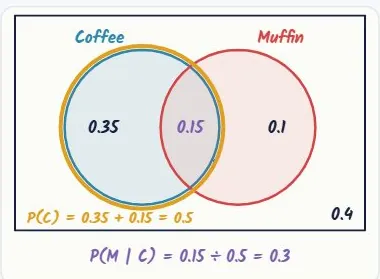
In a Venn, the condition is a circle
- Given coffee: only the coffee circle.
- Its total: 0.35 + 0.15 = 0.5.
- P(M | C) = 0.15 ÷ 0.5 = 0.3.
Other conditions from the same Venn
- Only the given regions.
- Given no muffin: outside.
- P(M) = 0.15 + 0.1 = 0.25the muffin circle
- P(C | M) = 0.15 ÷ 0.25both ÷ P(M)
- = 0.6
- P(not M) = 0.35 + 0.4 = 0.75outside the circle
- P(C | not M) = 0.35 ÷ 0.75coffee only ÷ P(not M)
- = 0.46674 decimal places
Second branches are conditional
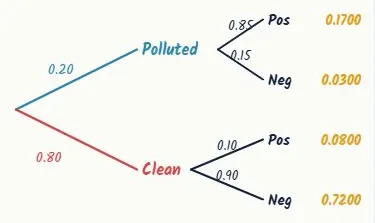
- Polluted 0.2, clean 0.8.
- P(pos | polluted) = 0.85.
- P(pos | clean) = 0.1.
Multiply along each path
- Each path: multiply.
- The four paths total 1.
- polluted, pos: 0.2 × 0.85 = 0.17
- polluted, neg: 0.2 × 0.15 = 0.03
- clean, pos: 0.8 × 0.1 = 0.08
- clean, neg: 0.8 × 0.9 = 0.72
- 0.17 + 0.03 + 0.08 + 0.72 = 1
Reversing the conditional
- Add the positive paths.
- Path ÷ matching paths.
- P(pos) = 0.17 + 0.08both positive paths
- = 0.25
- P(polluted | pos)
- = P(polluted and pos) ÷ P(pos)
- = 0.17 ÷ 0.25substitute
- = 0.68
Say what it means
- The test catches 85% of polluted streams.
- Of positives, 68% are polluted.
- Clean streams are far more common.
Where the marks are
- Achieved: a conditional from a table or tree.
- Merit: accurate, with correct notation.
- Excellence: support or reject a claim.
What to take away
- Given picks the group, and the group picks the denominator.
| P(A | B) | A given B |
| Denominator | the given group |
| Formula | P(A and B) ÷ P(B) |
| Order | P(A | B) ≠ P(B | A) |
| Reverse | path ÷ matching paths |
| Answer | in context, 4 dp |
Your turn: four questions
- Pause here and answer each one.
- Name the condition before you divide.
- Four decimal places, then context.
| Given | Find | |
|---|---|---|
| 1 | the cycling table | P(C | 40+) |
| 2 | the cycling table | P(40+ | C) |
| 3 | 0.2, 0.1, 0.3, 0.4 | P(A | B) |
| 4 | U 0.1; flag 0.9, 0.05 | P(U | flag) |
Show answer
1. P(cycle | 40 and over) = 45 ÷ 300 = 0.15. 2. P(40 and over | cycle) = 45 ÷ 105 = 0.4286. 3. P(B) = 0.1 + 0.3 = 0.4; P(A | B) = 0.1 ÷ 0.4 = 0.25. 4. P(flag) = 0.09 + 0.045 = 0.135; P(U | flag) = 0.09 ÷ 0.135 = 0.6667.
The answers: questions 1 to 3
- 1. P(C | 40+) = 45 ÷ 30040 and over only
- = 0.15
- 2. P(40+ | C) = 45 ÷ 105cyclists only
- = 0.42864 decimal places
- 3. P(B) = 0.1 + 0.3 = 0.4both + only B
- P(A | B) = 0.1 ÷ 0.4both ÷ P(B)
- = 0.25
The answers: question 4
- 4. U and flag: 0.1 × 0.9 = 0.09
- not U, flag: 0.9 × 0.05 = 0.045
- P(flag) = 0.09 + 0.045 = 0.135both flagged paths
- P(U | flag) = 0.09 ÷ 0.135U path ÷ P(flag)
- = 0.66674 decimal places
Is your child on track?
Take the free placement test