Modelling with three unknowns
What this lesson covers
- Name three unknowns.
- Each fact gives one equation.
- A parabola through three points is a system.
Tickets
- 100 tickets earn $1600. Adults pay $20, children $10 and seniors $15, with twice as many adults as children.
- a + c + s = 100
- 20a + 10c + 15s = 1600
- a = 2c
- s = 100 − 3c
- 40c + 10c + 1500 − 45c = 1600
- c = 20
- 20 children, 40 adults, 40 seniors
Try it: solve the system
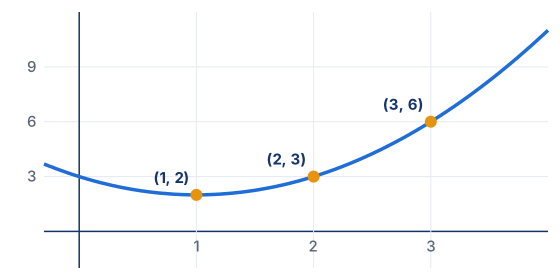
Parabola through (1, 2), (2, 3), (3, 6)
- Use y = ax² + bx + c.
- a + b + c = 2
- 4a + 2b + c = 3
- 9a + 3b + c = 6
- 3a + b = 1 and 5a + b = 3
- a = 1, b = −2, c = 3
- y = x² − 2x + 3
Three points fix a parabola
- Each point gives one equation in a, b and c, so three points give exactly one curve.
Try it: three points fix a parabola
A symmetrical trick
- 2 coffees, a tea and a muffin cost $17. A coffee, 2 teas and a muffin cost $16. A coffee, a tea and 2 muffins cost $19.
- 2c + t + m = 17, c + 2t + m = 16, c + t + 2m = 19
- add all three: 4(c + t + m) = 52
- c + t + m = 13divide by 4
- c = 4, t = 3, m = 6
Common mistakes
- Reusing the letter c for two things.Pick different letters for each unknown.
- Stopping at the letters.Answer in context.
Your turn
A parabola passes through (0, 3). Find c in y = ax² + bx + c.
a + b + c = 12, a = 2b and c = b. Find b.
How many facts are needed to find three unknowns?
Find the parabola through (0, 1), (1, 0) and (2, 3).
Show answer
1. c = 3 2. 4b = 12, so b = 3 3. Three independent facts 4. y = 2x² − 3x + 1
Sample question: Achieved
A school concert sold 250 tickets. Adult tickets cost $15, student tickets $8 and child tickets $5, and the total taken was $2550. Twice as many student tickets as child tickets were sold. How many of each ticket were sold?
Hint
Name three unknowns, write one equation for each fact, then substitute s = 2c.
Answer
100 adult, 100 student and 50 child tickets
Step by step
- Name the unknowns: a = adult tickets, s = student tickets, c = child tickets.
- Each fact gives one equation. Tickets: a + s + c = 250.
- Money: 15a + 8s + 5c = 2550.
- Twice as many students as children: s = 2c. Careful: it is s = 2c, not c = 2s.
- Substitute s = 2c into the first: a + 3c = 250, so a = 250 − 3c.
- Into the money equation: 15(250 − 3c) + 16c + 5c = 2550.
- 3750 − 45c + 21c = 2550, so −24c = −1200 and c = 50.
- s = 2 × 50 = 100 and a = 250 − 150 = 100.
- Check: 100 + 100 + 50 = 250 and 1500 + 800 + 250 = 2550. Both correct.
- Answer in context: 100 adult, 100 student and 50 child tickets.
Full working
- a + s + c = 250tickets
- 15a + 8s + 5c = 2550money
- s = 2ctwice as many students
- 15(250 − 3c) + 16c + 5c = 2550substitute
- 24c = 1200, c = 50
- 100 adult, 100 student, 50 child
Sample questions: Merit
A parabola y = ax² + bx + c passes through (−1, 8), (2, −1) and (3, 4). Find a, b and c, and hence find the exact minimum value of y.
Hint
Each point gives one equation in a, b and c. For the minimum, the vertex is at x = −b2a.
Answer
y = 2x² − 5x + 1; the minimum value is −178
Step by step
- The unknowns are a, b and c. Substitute each point's x and y.
- (−1, 8): a − b + c = 8. (2, −1): 4a + 2b + c = −1. (3, 4): 9a + 3b + c = 4.
- c has coefficient 1 in all three, so remove it by subtracting.
- Second − first: 3a + 3b = −9, so a + b = −3.
- Third − second: 5a + b = 5.
- Subtract: 4a = 8, so a = 2. Then b = −5, and c = 8 − 2 − 5 = 1.
- So y = 2x² − 5x + 1. a > 0, so the parabola opens upwards and has a minimum.
- The vertex is at x = −b2a = 54.
- y = 2 × 2516 − 5 × 54 + 1 = 258 − 508 + 88 = −178.
- Check a point: x = 3 gives 18 − 15 + 1 = 4. Correct.
Full working
- a − b + c = 8, 4a + 2b + c = −1, 9a + 3b + c = 4substitute the points
- a + b = −3 and 5a + b = 5remove c
- a = 2, b = −5, c = 1
- x = −b2a = 54vertex
- y = 258 − 508 + 88
- y = 2x² − 5x + 1, minimum −178
Mere invested $20 000 in three accounts paying 3%, 4% and 6% interest a year. After one year she earned $910 in interest. She put $3000 more in the 6% account than in the 3% account. How much did she put in each account?
Hint
Use x, y and z for the three amounts. The interest equation uses the rates as decimals.
Answer
$5000 at 3%, $7000 at 4% and $8000 at 6%
Step by step
- Name the unknowns: x at 3%, y at 4%, z at 6%, all in dollars.
- Total: x + y + z = 20 000.
- Interest: 0.03x + 0.04y + 0.06z = 910. Multiply by 100 to clear decimals: 3x + 4y + 6z = 91 000.
- $3000 more at 6% than at 3%: z = x + 3000.
- Substitute into the total: x + y + x + 3000 = 20 000, so y = 17 000 − 2x.
- Into the interest: 3x + 4(17 000 − 2x) + 6(x + 3000) = 91 000.
- 3x + 68 000 − 8x + 6x + 18 000 = 91 000, so x + 86 000 = 91 000 and x = 5000.
- y = 17 000 − 10 000 = 7000 and z = 8000.
- Check: 5000 + 7000 + 8000 = 20 000, and 150 + 280 + 480 = 910. Both correct.
- Classic mistake: using 3, 4 and 6 instead of 0.03, 0.04 and 0.06 without scaling the $910 too.
Full working
- x + y + z = 20 000total
- 3x + 4y + 6z = 91 000interest × 100
- z = x + 3000$3000 more at 6%
- y = 17 000 − 2xfrom the total
- 3x + 4(17 000 − 2x) + 6(x + 3000) = 91 000, x = 5000
- $5000 at 3%, $7000 at 4%, $8000 at 6%
Sample questions: Excellence
Video of a rugby up-and-under kick shows the ball is 11.25 m high after 0.5 s, 18.5 m high after 1 s and 22.5 m high after 3 s. Model the height as h = at² + bt + c. Find a, b and c. Hence find the greatest height and the time the ball would hit the ground if no one caught it, and give one limitation of the model.
Hint
Each time gives one linear equation in a, b and c. Then use the vertex for the greatest height and the quadratic formula for h = 0.
Answer
h = −5t² + 22t + 1.5; greatest height 25.7 m at 2.2 s; hits the ground at about 4.47 s
Step by step
- The unknowns are a, b and c. Substitute each (t, h) pair.
- t = 0.5: 0.25a + 0.5b + c = 11.25. t = 1: a + b + c = 18.5. t = 3: 9a + 3b + c = 22.5.
- Remove c. Second − first: 0.75a + 0.5b = 7.25. Third − second: 8a + 2b = 4, so 4a + b = 2.
- Double the first of these: 1.5a + b = 14.5. Subtract from 4a + b = 2: 2.5a = −12.5, so a = −5.
- b = 2 − 4 × (−5) = 22, and c = 18.5 + 5 − 22 = 1.5.
- So h = −5t² + 22t + 1.5. a = −5 matches gravity, about half of 9.8, which is a good sign. c = 1.5 m is the height of the boot at the kick.
- Greatest height at the vertex: t = −b2a = 2210 = 2.2 s. h = −5(2.2)² + 22(2.2) + 1.5 = 25.7 m.
- Ground: −5t² + 22t + 1.5 = 0. Quadratic formula: t = 22 + √51410, taking the positive root.
- √514 = 22.6716, so t = 4.47 s. The negative root is before the kick, so reject it.
- Check: t = 3 gives −45 + 66 + 1.5 = 22.5. Correct.
- Limitation: the model ignores air resistance and wind, and the heights read off video have measurement error, so the landing time is only an estimate.
Full working
- 0.25a + 0.5b + c = 11.25, a + b + c = 18.5, 9a + 3b + c = 22.5
- 0.75a + 0.5b = 7.25 and 4a + b = 2remove c
- 2.5a = −12.5, a = −5
- b = 22, c = 1.5
- t = 2210 = 2.2, h = 25.7vertex
- t = 22 + √51410 = 4.47h = 0, positive root
- h = −5t² + 22t + 1.5; max 25.7 m; lands at 4.47 s
A garden centre sells three fertiliser blends. One bag of A contains 4 kg of nitrogen, 2 kg of phosphorus and 2 kg of potassium. One bag of B contains 2 kg, 4 kg and 2 kg, and one bag of C contains 2 kg, 2 kg and 4 kg. A farmer wants a mix with exactly 44 kg of nitrogen, 30 kg of phosphorus and 22 kg of potassium. Show that this mix is impossible. Find the least amount of potassium the farmer would have to accept, keeping the nitrogen and phosphorus the same, for a mix to be possible.
Hint
Solve with x, y and z bags of A, B and C. A negative number of bags is not possible. Then replace 22 with K and require all three to be 0 or more.
Answer
The solution is x = 10, y = 3, z = −1, which needs a negative number of bags, so it is impossible. A mix is possible when K ≥ 743, so at least 24.7 kg of potassium
Step by step
- Let x, y and z be the bags of A, B and C.
- Nitrogen: 4x + 2y + 2z = 44. Phosphorus: 2x + 4y + 2z = 30. Potassium: 2x + 2y + 4z = 22.
- The pattern is symmetric, so add all three: 8(x + y + z) = 96, so x + y + z = 12.
- Nitrogen is 2(x + y + z) + 2x = 24 + 2x = 44, so x = 10.
- The same way: 24 + 2y = 30 gives y = 3, and 24 + 2z = 22 gives z = −1.
- There is exactly one solution, and it needs −1 bags of C. That cannot happen, so the mix is impossible.
- Now let the potassium be K kg. Adding gives 8(x + y + z) = 74 + K, so x + y + z = 74 + K8.
- z = K − 2(x + y + z)2 = (K − 74 + K4) ÷ 2 = 3K − 748.
- z ≥ 0 needs 3K ≥ 74, so K ≥ 743 = 24.67 kg.
- Also check x and y: y = 15 − 74 + K8 ≥ 0 needs K ≤ 46, and x needs K ≤ 102. So K = 743 is allowed.
- At K = 743 the mix is 293 ≈ 9.67 bags of A, 83 ≈ 2.67 of B and none of C. If only whole bags are sold, the farmer must look further.
- Classic mistake: stopping at the algebra. A correct solution of the equations can still be impossible in context.
Full working
- 4x + 2y + 2z = 44, 2x + 4y + 2z = 30, 2x + 2y + 4z = 22
- 8(x + y + z) = 96, x + y + z = 12add all three
- x = 10, y = 3, z = −1z < 0, impossible
- potassium K: x + y + z = 74 + K8
- z = 3K − 748 ≥ 0, K ≥ 743
- y ≥ 0 needs K ≤ 46; x ≥ 0 needs K ≤ 102
- impossible; at least 743 ≈ 24.7 kg of potassium
What to take away
- One fact, one equation.
- Check with the original story.
Report a mistake
More in AS 91587
Is your child on track?
Take the free placement test