Place value: what each digit is worth
1 of 7Next →
What this lesson covers
- Whole numbers can be represented in the base 10 number system, where each digit has a place value 10 times that of the digit on the right.
- Each digit’s value depends both on its position (e.g. the tens position) and the numeral in the position. Zero is used as a placeholder.
The same digit, two different values
- Look at 3,300. There are two 3s.
- One is worth 3,000. The other is worth 300.
- Same digit. Where it stands changes what it is worth.
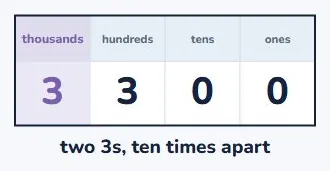
Each column is ten times the one on its right
- Ones, then tens, then hundreds, then thousands.
- Every step left multiplies by 10.
- That is what "base 10" means. One rule, repeated.
| column | worth | how it is built |
|---|---|---|
| ones | 1 | the start |
| tens | 10 | 10 × 1 |
| hundreds | 100 | 10 × 10 |
| thousands | 1,000 | 10 × 100 |
Try it: build a number
Reading a four-digit number
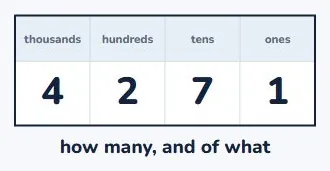
- 4,271. Start at the left and name each column.
- Four thousand, two hundred, seventy, one.
- The digit tells you how many. The column tells you of what.
Zero has a job
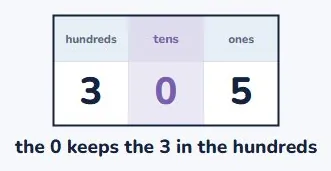
- 305 is three hundred and five.
- Not thirty-five. The 0 is doing something.
- It is holding the tens column open.
Take the zero away and everything moves
- Same 3, same 5. No 0 between them.
- The 3 falls into the tens column.
- Now it is worth 30, not 300. Zero was holding it up.
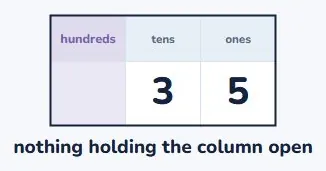
Where the zero sits changes the number
- Same two digits, three different numbers.
- Only the zero moved.
- Zero is not nothing. Zero is a place being held.
| number | you say | what the 0 is doing |
|---|---|---|
| 305 | three hundred and five | 0 keeps the tens column open |
| 35 | thirty-five | no 0, so the 3 falls into the tens |
| 350 | three hundred and fifty | 0 holds the ones instead |
Compare from the left
- The leftmost column is worth the most.
- So the first column where they differ settles it.
- Nothing on the right can catch up.
| th | h | t | o | |
|---|---|---|---|---|
| 4,271 | 4 | 2 | 7 | 1 |
| 4,190 | 4 | 1 | 9 | 0 |
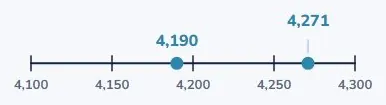
Try it: hop in thousands and hundreds
Why the right cannot catch up
- 4,271 beats 4,190 on the hundreds column.
- The 9 in 4,190 looks big, but it is only 90.
- One hundred beats ninety, however big the 9 looks.
Common mistakes
- Three hundred and five is written 35, or 3005.It is 305: the 0 holds the tens column open, so the 3 stays in the hundreds.
- 4,190 is bigger than 4,271 because 9 is a big digit.Compare from the left: the thousands match, then 2 hundreds beats 1 hundred, so 4,271 is bigger.
- In 3,300 both 3s are worth 3.The column tells you what a digit is worth: one 3 is worth 3,000 and the other is worth 300.
- 4,271 is four thousand, two hundred and seven, one.Name each column: four thousand, two hundred and seventy-one, because the 7 is in the tens column.
Your turn: which is bigger?
- 2,608 or 2,680?
- 5,040 or 5,400?
- Work left to right. Stop at the first difference.
| which is bigger? | |
|---|---|
| 2,608 | 2,680 |
| 5,040 | 5,400 |
Show answer
2,680 is bigger: thousands and hundreds tie, then 8 tens beats 0 tens. 5,400 is bigger: thousands tie, then 4 hundreds beats 0 hundreds. Both pairs use the same digits in a different order, so counting digits does not help and the zero has to be read rather than skipped.
What each digit is worth
- Where a digit stands changes what it is worth.
- Zero holds a column open. It is a job, not a nothing.
- Compare from the left and stop at the first difference.
| idea | what to remember |
|---|---|
| place value | position and digit, together |
| base 10 | each column 10× the one on its right |
| zero | holds a column open |
| reading | how many, and of what |
| comparing | left to right, first difference wins |
Practise this
Worksheet with answersWithout answersDownload PDF
Report a mistake
More in Number

Is your child on track?
Take the free placement test