Rounding, and counting in steps
What this lesson covers
- Rounding can support predicting or estimating the result of a calculation.
- Rounding is based on identifying the nearest place value or unit (ten, hundred, thousand) for a given number; a number line supports this.
Rounding is a question, not a rule
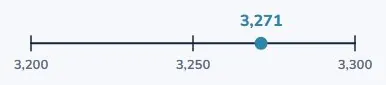
- Round 3,271 to the nearest hundred.
- There are only two answers it could be: 3,200 or 3,300.
- The only question is which one is nearer.
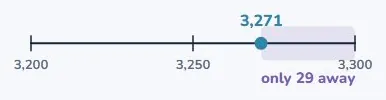
So look at it
- 3,271 sits closer to 3,300 than to 3,200.
- So it rounds to 3,300.
- You did not need a rule. You could see it.
The place you round to picks the two ends
- Nearest ten? The ends are 3,270 and 3,280.
- Nearest hundred? The ends are 3,200 and 3,300.
- Same number, different question, different answer.
| number | round to | between | answer |
|---|---|---|---|
| 4,700 | nearest thousand | 4,000 or 5,000 | 5,000 |
| 3,271 | nearest hundred | 3,200 or 3,300 | 3,300 |
| 3,271 | nearest ten | 3,270 or 3,280 | 3,270 |
The one case you cannot look at
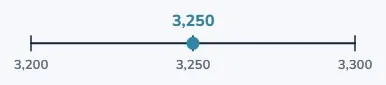
- 3,250 is exactly halfway between 3,200 and 3,300.
- Neither is nearer. Looking cannot settle it.
- So somebody chose: exactly halfway rounds up.
What rounding is for
- 3,271 add 4,850 is hard in your head.
- 3,300 add 4,900 is not. That is about 8,200.
- A rounded answer tells you what to expect.
| the real sum | the rounded sum | so expect |
|---|---|---|
| 3,271 + 4,850 | 3,300 + 4,900 | about 8,200 |
| 6,120 − 2,890 | 6,100 − 2,900 | about 3,200 |
Tenths work the same way
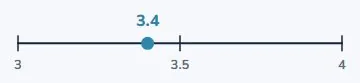
- 3.4 sits between 3 and 4.
- It is nearer 3, so it rounds to 3.
- Same question. Nothing new to learn.
Counting in steps is the same line
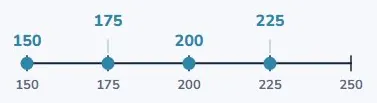
- Counting in 25s is jumping along in equal hops.
- 150, 175, 200, 225.
- Same number line. Bigger jumps.
Counting in 100s moves one column
- Start at 2,340 and count in 100s.
- 2,440, 2,540, 2,640. Only the hundreds digit moves.
- That is place value doing the work again.
| start at | count in | and you get |
|---|---|---|
| 2,340 | 100s | 2,440 · 2,540 · 2,640 |
| 2,340 | 1,000s | 3,340 · 4,340 · 5,340 |
| 150 | 25s | 175 · 200 · 225 |
Until the column runs out
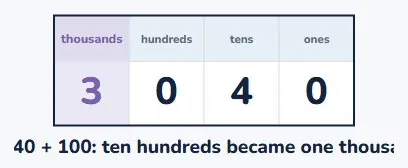
- 2,640, then 2,740, then 2,840, then 2,940.
- Next hop needs a tenth hundred. There is no such digit.
- So it becomes 3,040; the thousands column takes it.
Your turn
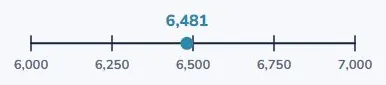
- Round 6,481 to the nearest hundred.
- Round 6,481 to the nearest thousand.
- Count on in 50s from 6,450. Three hops.
Show answer
6,500: between 6,400 and 6,500, and 81 is past halfway. 6,000: between 6,000 and 7,000, and 481 is short of halfway, which is the one people get wrong because 6,481 "looks big". 6,500 · 6,550 · 6,600. Draw the two ends first in both rounding questions; the answer follows from the picture.
Rounding and counting
- Find the two ends, then see which is nearer.
- Exactly halfway is the only time you need the rule.
- Counting in steps is the same line, jumped along.
| idea | what to remember |
|---|---|
| rounding | which of the two ends is nearer? |
| the two ends | the place you round to picks them |
| exactly halfway | rounds up: the one real rule |
| what it is for | knowing what to expect before you work it out |
| counting in steps | equal hops along the same line |
Is your child on track?
Take the free placement test