Big numbers, factors and rounding
What this lesson covers
- The base 10 number system extends to millions (1,000,000).
- Factors are whole numbers that divide another number exactly.
- Factor pairs are two whole numbers that multiply together to give another whole number (e.g. 3 and 4 are a factor pair of 12).
- Rounding can support predicting or estimating the result of a calculation.
- Rounding is based on identifying the nearest place value or unit (ten, hundred, thousand) for a given number; a number line supports this.
Nobody says the exact number
- A library counts its books. There are 648,357 of them.
- Ask how many books it has and nobody says that.
- They say "about six hundred and fifty thousand".
| thousands | ones |
|---|---|
| 648 | 357 |
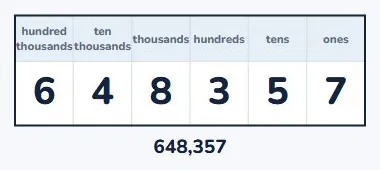
Digits come in groups of three
- Count from the right and group the digits in threes.
- The last three are the ones. The next three are the thousands.
- The comma is not decoration. It marks where a group ends.
| thousands | ones |
|---|---|
| 648 | 357 |
Read the group, then say its name
- Read 648, then say "thousand".
- Then read 357.
- Six hundred and forty eight thousand, three hundred and fifty seven.
One more group and you have a million
- The biggest number here has six digits.
- Add one more and you reach 1,000,000.
- A million is a thousand thousands. The pattern just keeps going.
| millions | thousands | ones |
|---|---|---|
| 1 | 000 | 000 |
Compare from the left
- Which is bigger: 648,357 or 648,375?
- Start at the left and find the first digit that differs.
- Both have 648,3. Then 5 against 7. So 648,375 is bigger.
A factor divides exactly
- A factor of a number divides it with nothing left over.
- 4 is a factor of 36, because 36 ÷ 4 = 9.
- 5 is not, because 36 ÷ 5 leaves 1 behind.
Factors come in pairs
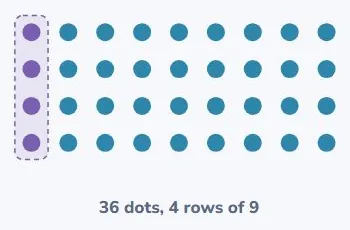
- Factors arrive two at a time, because 4 × 9 = 36.
- So 4 and 9 are a factor pair of 36.
- Every rectangle you can build from 36 dots is a pair.
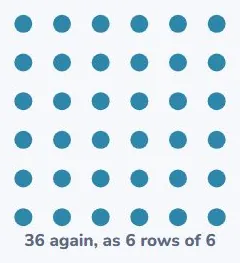
Find them in order and you find them all
- Start at 1 and work up. 1 × 36, 2 × 18, 3 × 12, 4 × 9.
- 5 does not divide 36, so there is no pair with 5.
- Then 6 × 6. The two sides have met, so you are done.
| first | second |
|---|---|
| 1 | 36 |
| 2 | 18 |
| 3 | 12 |
| 4 | 9 |
| 6 | 6 |
Rounding is picking the nearest
- Rounding is not making a number shorter. It is choosing the nearest one.
- Nearest what? That has to be said, or the answer means nothing.
- Nearest ten, nearest hundred, nearest thousand.
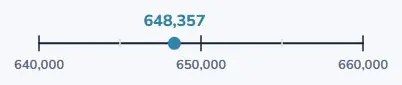
The number line settles it
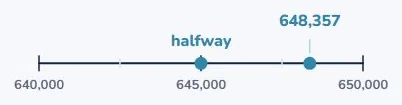
- To the nearest ten thousand, 648,357 sits between 640,000 and 650,000.
- It is much closer to 650,000.
- Halfway is 645,000, and it is past that.
Same number, five answers
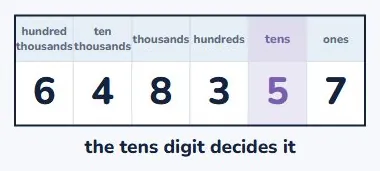
- Look at the digit to the RIGHT of the place you are rounding to.
- 5 or more rounds up. Less than 5 rounds down.
- One number, five different right answers.
| to the nearest | 648,357 becomes |
|---|---|
| hundred thousand | 600,000 |
| ten thousand | 650,000 |
| thousand | 648,000 |
| hundred | 648,400 |
| ten | 648,360 |
Decimals round the same way
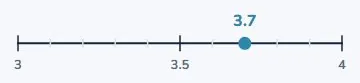
- 3.7 is past halfway to 4, so it rounds to 4.
- 12.42 has not reached halfway, so it rounds to 12.
- The rule did not change. Only the size of the step did.
Your turn
- 1. Write 205,060 in words.
- 2. Find every factor pair of 24.
- 3. Round 481,629 to the nearest thousand, and to the nearest ten thousand.
- 4. Round 9.6 and 40.31 to the nearest whole number.
Show answer
1. Two hundred and five thousand, and sixty. 2. 1 and 24, 2 and 12, 3 and 8, 4 and 6. 3. 482,000 and 480,000. 4. 10 and 40.
What to take away
- Group digits in threes from the right, and read a group at a time.
- Factors divide exactly, and they come in pairs.
- "Round it" is not a question until you say nearest what.
| to the nearest | 648,357 becomes |
|---|---|
| hundred thousand | 600,000 |
| ten thousand | 650,000 |
| thousand | 648,000 |
| hundred | 648,400 |
| ten | 648,360 |
| 3.7 to a whole | 4 |
Is your child on track?
Take the free placement test