Negative numbers and counting on
What this lesson covers
- Negative numbers are to the left of 0 on a horizontal number line and below 0 on a vertical number line.
- Negative numbers are represented symbolically with a negative sign (−) and named ‘negative’ along with the numeral (e.g. −4 is named negative four).
- Zero is neither positive nor negative.
- Negative numbers arise in a range of situations (e.g. debt, temperature).
Four below zero
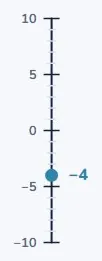
- A thermometer on a frosty morning does not stop at zero.
- It keeps going down.
- Four below zero is written −4.
Say "negative", not "minus"
- −4 is read "negative four".
- The small dash in front is a negative sign.
- "Minus" is the name of a subtraction. This is not one.
| written | said |
|---|---|
| −4 | negative four |
| −1 | negative one |
| −12 | negative twelve |
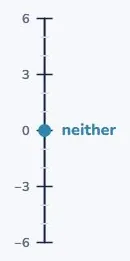
Zero is neither
- Above zero the numbers are positive.
- Below zero they are negative.
- Zero itself is neither. It is the place they meet.
Turn the line on its side
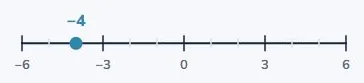
- A thermometer stands up, so its negatives sit below zero.
- Lay the same line flat and nothing changes but the direction.
- Now the negatives are to the left of zero.
Money does it too
- Temperature is not the only place negatives turn up.
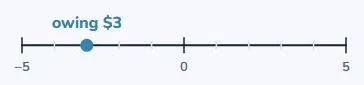
- If you have $5 and you owe $8, you are $3 short.
- A bank writes that balance as −3.
Further down is smaller
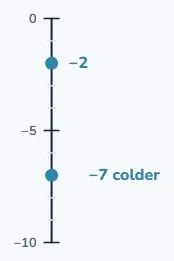
- Which is colder, −2 or −7?
- −7 is further down the thermometer, so it is colder.
- Further from zero on the negative side means smaller.
Count backwards past zero
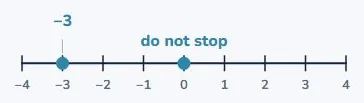
- Count down from 3. Three, two, one, zero.
- Do not stop. The next number is −1.
- Then −2, then −3. The counting never had to stop.
Counting in elevens
- Start at 0 and add 11 each time.
- Zero, eleven, twenty two, thirty three, forty four.
- Both digits climb together, which makes it easy to check.
| step | you land on |
|---|---|
| start | 0 |
| add 11 | 11 |
| add 11 | 22 |
| add 11 | 33 |
| add 11 | 44 |
| add 11 | 55 |
| add 11 | 66 |
And in twelves
- Start at 12 and add 12 each time.
- Twelve, twenty four, thirty six, forty eight, sixty.
- These are the twelve times table, said out loud.
| step | you land on |
|---|---|
| start | 12 |
| add 12 | 24 |
| add 12 | 36 |
| add 12 | 48 |
| add 12 | 60 |
| add 12 | 72 |
Big steps from an untidy number
- Count in thousands from 3,450.
- Only the thousands digit changes: 4,450 then 5,450.
- The start does not have to be a round number.
| step | you land on |
|---|---|
| start | 3,450 |
| add 1,000 | 4,450 |
| add 1,000 | 5,450 |
| add 1,000 | 6,450 |
Bigger steps, same idea
- Count in ten thousands from the same 3,450.
- 13,450 then 23,450 then 33,450.
- One digit does the work. The rest sit still.
| step | you land on |
|---|---|
| start | 3,450 |
| add 10,000 | 13,450 |
| add 10,000 | 23,450 |
| add 10,000 | 33,450 |
Your turn
- 1. Say these out loud: −6, −11, −20.
- 2. Count backwards from 2 down to −4.
- 3. Which is warmer, −9 or −3?
- 4. Count in ten thousands from 6,200, four steps.
Show answer
1. Negative six, negative eleven, negative twenty. 2. 2, 1, 0, −1, −2, −3, −4. 3. −3 is warmer, because it is closer to zero. 4. 16,200 then 26,200 then 36,200 then 46,200.
What to take away
- Below zero on a thermometer, left of zero on a flat line.
- −4 is said "negative four". Zero is neither positive nor negative.
- Counting does not stop at zero, and a step can be any size.
| written | said |
|---|---|
| −4 | negative four |
| 0 | zero, neither |
| 4 | four |
Is your child on track?
Take the free placement test