Working out probabilities, and the 0 to 1 line
What this lesson covers
- Likelihood can be visualised using a number line from 0 to 1.
- The sample space is the set of all possible outcomes of an experiment.
- The probability of an event, if events are believed to be equally likely, is the number of ways the event can happen divided by the total number of possible outcomes.
- The sum of the probabilities of all outcomes is equal to 1.
What is the chance of NOT landing on 6?
- You could count the other five numbers and divide.
- Or you could take one sixth away from one.
- By the end of this you will see why the second one works.
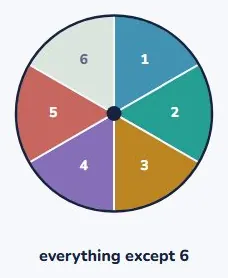
First, list everything that can happen
- The set of all possible outcomes is the sample space.
- For this spinner: 1, 2, 3, 4, 5, 6. Six things, nothing missing.
- Get this list wrong and every answer after it is wrong.
| the sample space | how many |
|---|---|
| 1, 2, 3, 4, 5, 6 | 6 outcomes |
| heads, tails | 2 outcomes |
| the days of the week | 7 outcomes |
Then count, and divide
- Count the ways your event can happen. That is the top.
- Count every outcome in the sample space. That is the bottom.
- The probability is the first divided by the second.
| part of the fraction | what it counts |
|---|---|
| the top | outcomes in your event |
| the bottom | outcomes altogether |
An even number
- Ways it can happen: 2, 4, 6. That is 3.
- Outcomes altogether: 6.
- So the probability is 3 over 6, which is a half.
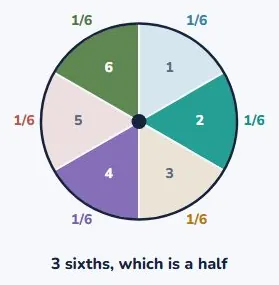
Four more, all by counting
- Landing on 4 is 1 way out of 6.
- More than 4 is 2 ways, so 2 sixths, a third.
- And a 7 is 0 ways, so the probability is 0.
| event | ways | probability |
|---|---|---|
| landing on 4 | 1 | 1/6 |
| an even number | 3 | 3/6 = 1/2 |
| more than 4 | 2 | 2/6 = 1/3 |
| landing on 7 | 0 | 0 |
| a number under 10 | 6 | 6/6 = 1 |
The two ends fall out of the rule
- An impossible event has 0 ways, so 0 over 6 is 0.
- A certain event has all 6, so 6 over 6 is 1.
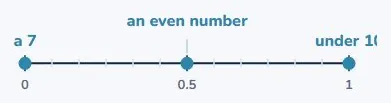
- That is where the 0 and the 1 on the scale come from.
| event | fraction | value |
|---|---|---|
| a 7 | 0/6 | 0 |
| an even number | 3/6 | 0.5 |
| a number under 10 | 6/6 | 1 |
All of them together make 1
- Six outcomes, each one sixth. Add them: six sixths.
- Which is 1. Something has to happen, so it must be.
- That is not just tidy. It is a shortcut.
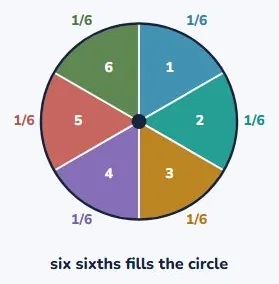
Back to the opening question
- Landing on 6 has probability one sixth.
- Everything that is not a 6 must make up the rest.
- So it is 1 take away one sixth, which is five sixths.
| event | probability |
|---|---|
| landing on 6 | 1/6 |
| NOT landing on 6 | 1 − 1/6 = 5/6 |
The rule has a condition
- Counting outcomes only works if they are equally likely.
- The curriculum says so, and it is not decoration.
- Equal parts on the spinner is what made the counting fair.
| spinner | can you just count? |
|---|---|
| six equal parts | yes |
| one big part, three small | no |
Where counting breaks
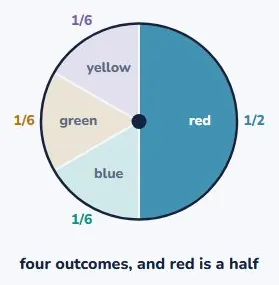
- Four colours, so four outcomes. But red is half the circle.
- Counting would say red is 1 out of 4. It is actually a half.
- When the parts differ, use the sizes, not the count.
Every probability has a place on the line
- Draw a line from 0 to 1 and you can put any event on it.
- Impossible at the left end, certain at the right.
- A half sits exactly in the middle.
Placing everyday events
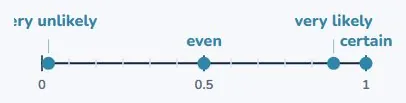
- Eating something later today: likely, so past the half way point.
- Snow in Auckland tomorrow: very unlikely, so near 0.
- You do not need a number. You need the right region.
Your turn
- 1. Write the sample space for one roll of an ordinary die.
- 2. On this spinner, the probability of an odd number?
- 3. If the chance of rain is 1/4, what is the chance of no rain?
- 4. Place "you will sleep tonight" on the 0 to 1 line.
Show answer
1. 1, 2, 3, 4, 5, 6: six outcomes. 2. 3 ways out of 6, so a half. 3. 1 − 1/4 = 3/4. 4. Very close to 1, but not quite certain.
What to take away
- List the sample space first. Everything, once each.
- Probability is ways it happens over outcomes altogether.
- And they all add to 1, so "not" is a subtraction.
| job | the move |
|---|---|
| starting out | list every possible outcome |
| a probability | ways it happens ÷ outcomes altogether |
| "not" something | take its probability away from 1 |
| unequal parts | use the sizes, not the count |
Is your child on track?
Take the free placement test