Chance, trials, outcomes and how likely things are
What this lesson covers
- Situations that involve chance, uncertainty, and randomness are called chance-based situations. Probability can be used to describe such situations.
- A trial is a single run of a chance-based situation that results in one of a set of possible outcomes.
- The possible outcomes for a chance-based situation can be arranged into events.
- The probability of an outcome is the chance of it occurring.
- Probabilities are associated with values between 0 and 1, where: 0 is impossible between 0 and 0.5 or 1/2 ranges from very unlikely to unlikely 0.5 or 1/2 is equally likely between 0.5 or 1/2 and 1 range from likely to very likely 1 is certain.
Two questions that are not alike
- Will it land on 4? Will it land on an even number?
- Those are different kinds of question, not just different ones.
- The whole of probability depends on knowing which is which.
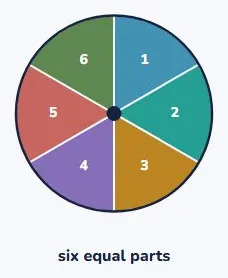
Chance-based means not settled yet
- Some questions have an answer waiting to be worked out.
- Others genuinely are not decided until they happen.
- Those are chance-based, and probability is how we talk about them.
| question | chance-based? |
|---|---|
| what is 7 × 8 | no, the answer already exists |
| where will it land | yes, nothing decides it until it stops |
| will it rain tomorrow | yes |
One spin is one trial
- A trial is a single run of a chance-based situation.
- Spin it once: that is one trial, and it gives one result.
- Spin it thirty times and you have done thirty trials.
| trial | result |
|---|---|
| 1st spin | 3 |
| 2nd spin | 6 |
| 3rd spin | 3 |
An outcome is one thing that can happen
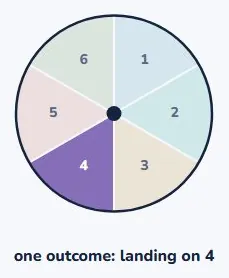
- This spinner has six possible outcomes: 1, 2, 3, 4, 5, 6.
- Landing on 4 is one outcome. Just the one.
- Every trial produces exactly one of them.
An event is a set of outcomes
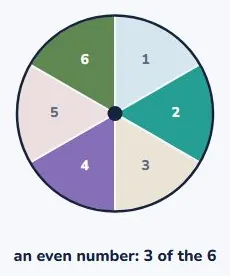
- "An even number" is not one outcome. It is three.
- 2, 4 and 6: any of them makes it happen.
- A set of outcomes you have decided to care about is an event.
Outcome or event?
- An outcome is a single result. An event is a collection.
- So every outcome is also an event, containing just itself.
- And an event can hold two, three, or all six.
| description | which is it | how many outcomes |
|---|---|---|
| landing on 4 | outcome | 1 of the 6 |
| landing on an even number | event | 3 of the 6 |
| landing on more than 4 | event | 2 of the 6 |
| landing on 7 | event with nothing in it | 0 of the 6 |
An event can hold nothing at all
- "Landing on 7" is a perfectly good description.
- It just contains none of the six outcomes.
- An event with no outcomes in it cannot happen. It is impossible.
| event | outcomes in it | so |
|---|---|---|
| a number bigger than 0 | 6 | certain |
| an even number | 3 | a fair chance |
| a 7 | 0 | impossible |
Probability is how likely it is
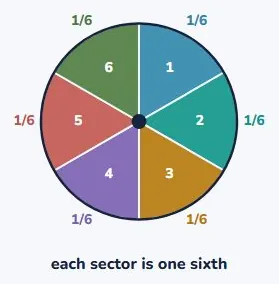
- The six parts are the same size, so none is favoured.
- So each outcome has a one in six chance.
- That number is the probability of the outcome.
Probability runs from 0 to 1
- Nothing is less likely than impossible, which is 0.
- Nothing is more likely than certain, which is 1.
- Everything real sits somewhere in between those two.

The five words for where you are
- Exactly half way along is equally likely: a 50-50 chance.
- Below half is unlikely. Above half is likely.
- But it is a sliding scale, not five separate boxes.
| probability | what you call it |
|---|---|
| 0 | impossible |
| between 0 and 1/2 | unlikely |
| 1/2 | equally likely |
| between 1/2 and 1 | likely |
| 1 | certain |
Using the words on real events
- The sun rising tomorrow is certain. A coin landing heads is even.
- This spinner landing on 7 is impossible.
- And rain in Auckland tomorrow is genuinely arguable.
| event | how likely |
|---|---|
| the sun will rise tomorrow | certain |
| this spinner lands on 7 | impossible |
| a coin lands heads | equally likely |
| it rains in Auckland tomorrow | arguable, and that is fine |
What actually happens when you spin it
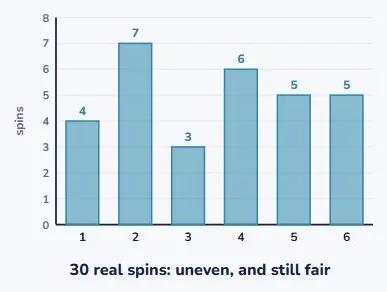
- Thirty trials on a fair spinner. Expect about 5 of each.
- You will not get exactly 5 of each. Nobody ever does.
- The spinner is still fair. Real trials wobble around the expected.
Your turn
- 1. Is "landing on 3 or 5" an outcome or an event?
- 2. How many outcomes are in "a number less than 3"?
- 3. Name the likelihood of "you will breathe in the next minute".
- 4. Give an event on this spinner that is impossible.
Show answer
1. An event: it holds two outcomes. 2. Two: 1 and 2. 3. Certain. 4. Anything with no outcomes in it: landing on 0, on 9, on a letter.
What to take away
- A trial is one run. An outcome is one possible result.
- An event is a set of outcomes, and it can hold none or all.
- Probability runs from 0, impossible, to 1, certain.
| word | means | on this spinner |
|---|---|---|
| chance-based | the result is not settled in advance | spinning it |
| trial | one single run of it | one spin |
| outcome | one thing that could result | landing on 4 |
| event | a set of outcomes you chose | landing on an even number |
| probability | how likely that is | one sixth for each number |
Is your child on track?
Take the free placement test