 Vertex Learn
Weight, friction, and air and water resistance
What this lesson covers
- Weight as the pull of gravity on an object's mass
- Why objects with more mass need a bigger force to speed up, slow down, turn or change shape
- Friction between touching surfaces, and how the surfaces change it
- Fluids, and how air and water push against things moving through them
- Planning fair tests of these forces and checking how consistent the results are
- Where people make use of friction and where they reduce it
Forces, gravity and weight
- A force is a push or a pull.
- Gravity is a pull that Earth puts on everything, towards the ground.
- Weight is the force of gravity pulling on an object's mass. The more mass something has, the bigger its weight.
- Mass is measured in kilograms (kg). Very large masses, like a truck or a whale, are measured in tonnes. 1 tonne = 1000 kg.
More mass needs a bigger force
- An empty supermarket trolley is easy to push. A full one takes a much harder push to get moving.
- The full trolley is also harder to stop and harder to steer round a corner.
- This is true of every object: the more mass it has, the bigger the force needed to change its speed or its direction.
- It also takes a bigger force to change the shape of a big lump of clay than a small one.
- That is why a loaded truck needs much stronger brakes than a bike.
Try it: push against friction
Friction
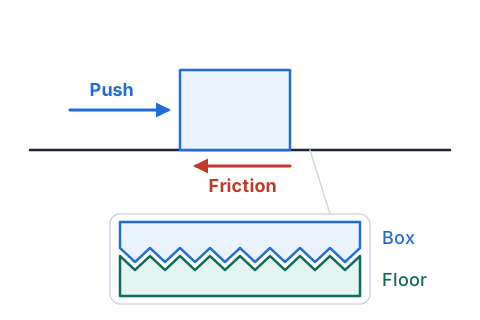
- Friction is a force between two surfaces that are touching. It pushes against one surface sliding over the other.
- Friction always acts in the opposite direction to the movement.
- Even surfaces that feel smooth have tiny bumps. The bumps catch on each other, and that makes friction.
- Rough surfaces, like carpet or sandpaper, give more friction than smooth ones, like ice or a polished floor.
- Friction is why a toy car rolling along the floor slows down and stops without anyone touching it.
Variables in a friction test
- A variable is anything that can change in a test.
- To test friction on different surfaces, change only the surface. Keep everything else the same, so the test is fair.
| Kind of variable | In this test |
|---|---|
| Change | The floor surface after the ramp |
| Measure | How far the car rolls after the ramp, in cm |
| Keep the same | The car, its mass, the ramp height, the start line, letting go without a push |
Example: testing surfaces with a toy car
- Room 4 rolled a toy car down the same ramp three times onto each floor and measured how far it went.
- Which surface had the most friction? Which results were the least consistent, and why?
| Surface | Try 1 (cm) | Try 2 (cm) | Try 3 (cm) |
|---|---|---|---|
| Lino | 182 | 176 | 185 |
| Carpet | 61 | 58 | 60 |
| Towel | 35 | 50 | 22 |
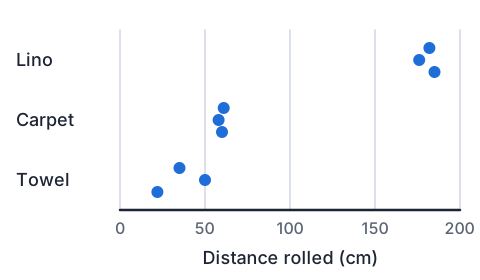
- The car went shortest on the towel, then carpet, then linomore friction stops it sooner
- Lino tries are within 9 cm and carpet within 3 cmconsistent, well controlled
- Towel tries range from 22 to 50 cmnot consistent
- The towel had the most friction, but its results spread out, probably because it wrinkled differently each time
Are the results consistent?
- Doing each test three times lets you check your results.
- If the three results are close together, the variables were probably well controlled.
- If they are spread out, something changed that should have stayed the same, such as a towel wrinkling or someone pushing the car.
- When results are spread out, find the cause, fix it, and test again.
Fluids push back too
- A fluid is a liquid or a gas, something that can flow. Air and water are both fluids.
- Anything moving through air or water gets pushed against by it. In air this push is called air resistance. In water it is called water resistance.
- A wide, flat shape meets more air or water than a narrow, pointed one, so it gets a bigger push back.
- Drop a flat sheet of paper and a crumpled one: they have the same weight, but the flat sheet drifts down slowly because of air resistance.
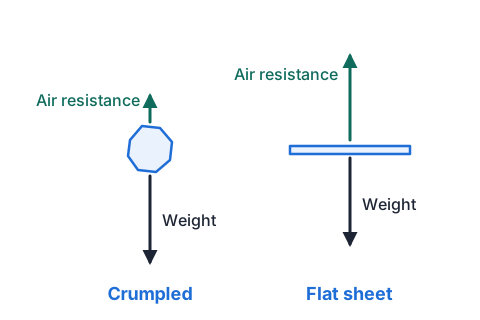
Example: shapes falling through water
- Room 4 made three shapes from the same 20 g of plasticine and dropped each into a tall jar of water. They timed how long each took to reach the bottom, three times.
- Which shape met the most water resistance?
| Shape | Try 1 (s) | Try 2 (s) | Try 3 (s) |
|---|---|---|---|
| Pointed | 0.9 | 0.9 | 1.0 |
| Ball | 1.0 | 1.1 | 1.0 |
| Flat disc | 2.6 | 2.4 | 2.5 |
- Same mass, same jar, same drop heightonly the shape changed
- The flat disc took about 2.5 s, more than twice as long as the othersread the table
- The flat disc met the most water resistance, because its wide face pushes against more water
Using friction, and reducing it
- Sometimes we want lots of friction, so things grip. Sometimes we want very little, so things slide or turn easily.
| Friction helps | Friction is reduced |
|---|---|
| Knobbly tractor tyres grip a muddy paddock | A playground slide is smooth and polished |
| Bike brakes rub on the wheel to slow it | Grease on swing hinges lets them turn freely |
| Rugby boot sprigs stop players slipping | Ice skates glide on smooth ice |
| Wax on a surfboard stops your feet sliding | A swimmer's smooth cap and suit cut water resistance |
Try it: more friction or less?
Common mistakes
- A rolling ball stops because it runs out of force.It stops because friction and air resistance push against its motion; without them it would keep rolling.
- Mass and weight are the same thing.Mass is how much matter there is, in kg; weight is the pull of gravity on that mass.
- Smooth surfaces have no friction at all.Smooth surfaces still have tiny bumps, so there is some friction, just less than on rough surfaces.
- Air does not push on anything, because you cannot see it.Air is a fluid, and it pushes against anything moving through it; that push is air resistance.
Find the slipperiest object with a tilting board
You need: a chopping board or a large hardback book, a ruler, a coin, a rubber eraser, a plastic bottle lid, a toy block, paper and a pencil
- Lay the board flat on the floor and put all four objects in a row at one end.
- Slowly lift that end of the board, a little at a time.
- The moment an object starts to slide, hold the board still and measure how high the raised end is with the ruler.
- Do it three times for each object and write down the heights.
- Look at your results: the object that slid at the lowest height has the least friction with the board, and the one that needed the steepest slope has the most.
Safety: Ask an adult which board you can use, and do it on the floor so nothing heavy can fall onto your feet or break.
Your turn
Why is it harder to push a full supermarket trolley than an empty one?
A toy car is rolled onto ice, lino and carpet. On which surface will friction stop it soonest?
Group A's three results were 40 cm, 42 cm and 41 cm. Group B's were 20 cm, 55 cm and 38 cm. Which group controlled its variables better?
What force slows down a swimmer moving through the pool?
Why do mountain bike tyres have big knobbly treads?
Show answer
1. The full trolley has more mass, so it needs a bigger force to change its speed. 2. Carpet, because its rough surface gives the most friction. 3. Group A, because its results are close together; Group B's spread from 20 cm to 55 cm, so something was not kept the same. 4. Water resistance, the push of the water against the swimmer. 5. The knobbly treads increase friction, so the tyres grip on mud and loose dirt.
Forces and Motion: Basics
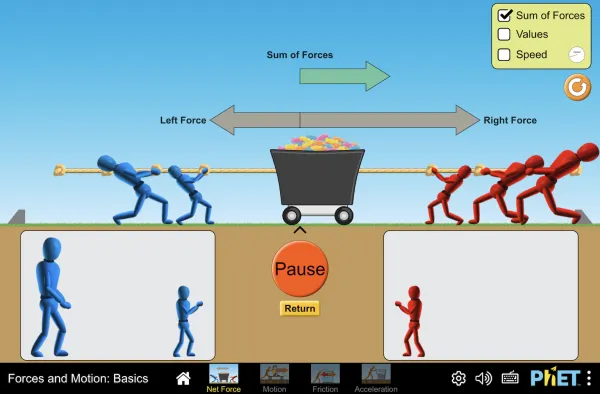
Full screen · PhET Interactive Simulations, University of Colorado Boulder, CC BY 4.0
Recap
- Weight is gravity pulling on an object's mass. Mass is measured in kg and tonnes.
- More mass means a bigger force is needed to change speed, direction or shape.
- Friction acts between touching surfaces, against the movement. Rough surfaces give more.
- Air and water are fluids, and they push against things moving through them.
- In a fair test change one variable; repeat it and check the results are close together.
- We increase friction for grip and reduce it for smooth sliding.
The maths behind it
Report a mistake
How is Year 5 maths going?
See the Year 5 maths guide