Angles, and telling the time
What this lesson covers
- Angle classification can aid the estimation of angle size.
- Angles are classified with reference to the benchmark angles of 90°, 180°, and 360°. Acute angles are less than 90°. Right angles are exactly 90°. Obtuse angles are more than 90° and less than 180°. Reflex angles are more than 180° and less than 360°.
- A point in time is typically measured in hours and minutes past midnight.
- Clocks relate seconds to minutes and minutes to hours according to a system based on 60.
Five words for every angle
- An angle measures turn, from barely open to all the way round.
- There are five words that say roughly where you are.
- They are not labels for a test. They are how you check an answer.
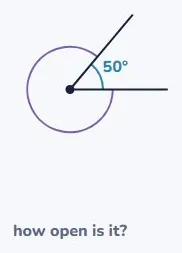
Acute and right
- An acute angle is less than 90°. Sharp, like a pizza slice.
- A right angle is exactly 90°, like the corner of this page.
- 90° is the first benchmark, and it is a quarter of a full turn.
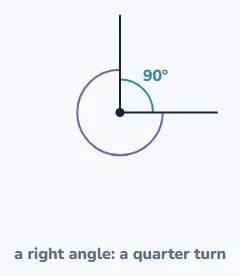
Obtuse and straight
- Obtuse is more than 90° but less than 180°.
- At exactly 180° the two arms make a straight line.
- So 180° is a half turn, and the second benchmark.
Reflex is the long way round
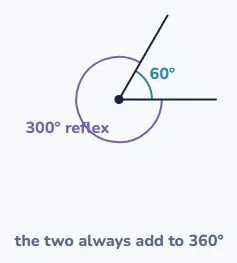
- Two arms make two angles: the small one and the rest.
- Here the small one is 60°, so the other is 300°.
- More than 180° and less than 360° is reflex.
All five, with their bounds
- Three of them are exact sizes: 90°, 180°, 360°.
- The other two are ranges between those benchmarks.
- Learn the ranges, not just the names.
| name | size | looks like |
|---|---|---|
| acute | less than 90° | a slice of pizza |
| right | exactly 90° | the corner of a page |
| obtuse | between 90° and 180° | a reclined chair |
| straight | exactly 180° | a flat line |
| reflex | between 180° and 360° | the long way round |
Why the words are useful
- Naming an angle gives you a bound before you measure.
- Obtuse means the answer must be between 90 and 180.
- So if your protractor says 35°, you know you misread it.
| it looks | so it must be | a reading of 35° is |
|---|---|---|
| acute | under 90° | believable |
| obtuse | 90° to 180° | wrong |
Using a protractor
- Vertex on the cross, one arm along the zero line.
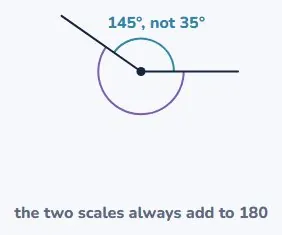
- A protractor has two scales, and one of them is wrong for you.
- This is obtuse, so it reads 145°, not 35°.
You already own an angle measurer
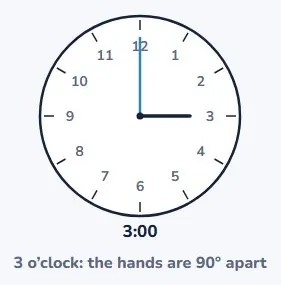
- A clock face is a full turn cut into twelve.
- So one hour of the hour hand is 30°.
- At 3 o’clock the hands are exactly a right angle apart.
A clock runs on 60s
- 60 seconds make a minute, 60 minutes make an hour.
- That is why quarter of an hour is 15 minutes, not 25.
- Nothing about a clock is base 10. Do not treat it as if it were.
| this much | makes |
|---|---|
| 60 seconds | 1 minute |
| 60 minutes | 1 hour |
| 15 minutes | a quarter of an hour |
| 30 minutes | half an hour |
Analogue and digital
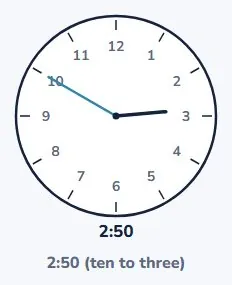
- The short hand is between 2 and 3, so the hour is 2.
- The long hand is at 50 minutes past.
- So 2:50, which most people say as "ten to three".
24-hour time, and its two exceptions
- A point in time is counted in hours and minutes past midnight.
- Afternoon times add 12: 3 p.m. is 15:00. Mornings do not.
- But noon is 12:00 and midnight is 00:00. Never 24:00.
| said as | written as | why |
|---|---|---|
| 3 a.m. | 03:00 | morning: no change |
| 3 p.m. | 15:00 | afternoon: add 12 |
| 12 noon | 12:00 | not 24:00 |
| 12 midnight | 00:00 | the start of the day |
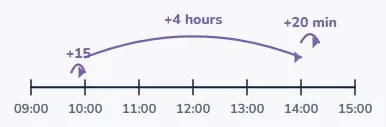
How long from 09:45 to 14:20?
- Do not subtract in columns. Minutes go up in 60s, not 10s.
- Count on instead: 15 minutes gets you to 10:00.
- Then 4 whole hours to 14:00, then 20 minutes.
Add up what you counted
- 15 minutes, then 4 hours, then 20 minutes.
- The minutes come to 35, and there are 4 hours.
- So 4 hours 35 minutes. No borrowing anywhere.
| jump | lands on |
|---|---|
| 15 minutes | 10:00 |
| 4 hours | 14:00 |
| 20 minutes | 14:20 |
| total | 4 hours 35 minutes |
Your turn
- 1. Classify 45°, 90°, 120°, 200° and 180°.
- 2. An angle looks obtuse. Your protractor says 60°. What now?
- 3. Write 7 p.m., 7 a.m. and midnight in 24-hour time.
- 4. How long from 08:50 to 13:15?
Show answer
1. acute, right, obtuse, reflex, straight. 2. You read the wrong scale; it is 120°. 3. 19:00, 07:00, 00:00. 4. 10 min to 09:00, 4 hours to 13:00, 15 min more: 4 hours 25 minutes.
What to take away
- The benchmarks are 90°, 180° and 360°. Everything else sits between.
- Classify before you measure, and the name checks the reading.
- For a duration, count on. Never subtract clock times in columns.
| job | the move |
|---|---|
| name an angle | compare it to 90° and 180° |
| read a protractor | pick the scale your arm starts on |
| p.m. to 24-hour | add 12, except noon and midnight |
| find a duration | count on to the next hour first |
Is your child on track?
Take the free placement test