 Vertex Learn
Mass, volume and density: why things float or sink
What this lesson covers
- What matter and mass are, and how mass is measured in grams and kilograms
- What volume is, and its units: millilitres, litres and cubic metres
- Why two objects can be the same size but have different masses
- How to work out density by dividing mass by volume
- Using density to predict whether something floats or sinks
- Measuring carefully, and knowing what your equipment cannot do
Matter and mass
- Matter is the stuff that everything is made of. If something has mass, it is matter: a rock, a glass of water, even the air around you.
- Mass is how much matter is in an object.
- We measure mass in grams (g) and kilograms (kg). There are 1000 g in 1 kg.
- A paper clip has a mass of about 1 g. A full 1 litre bottle of water has a mass of about 1 kg.
- To measure mass you use scales, such as kitchen scales or bathroom scales.
Volume: how much space something takes up
- Volume is the amount of space an object or a substance fills. Solids, liquids and gases all have volume.
- Small volumes are measured in millilitres (mL). A teaspoon holds about 5 mL.
- Larger volumes are measured in litres (L). There are 1000 mL in 1 L.
- Very large volumes, like the water in a swimming pool, are measured in cubic metres (m³). A cubic metre is a box 1 m long, 1 m wide and 1 m high, and it holds 1000 L.
| Unit | Short form | Good for |
|---|---|---|
| millilitre | mL | Medicine, a cup of milk |
| litre | L | A bottle of juice, a bucket of water |
| cubic metre | m³ | A swimming pool, a water tank |
Try it: millilitres and litres
Measuring volume
- A measuring cylinder is a tall, narrow jug with a scale on the side. It measures the volume of a liquid more exactly than a kitchen jug.
- Water curves up a little at the edges of the cylinder. Read the scale at the bottom of the curve, with your eye level with the water.
- You can measure a box-shaped solid with a ruler: volume = length × width × height.
- For a lumpy solid, like a stone, use displacement. Displacement means the object pushes water out of the way, so the water level goes up by the object's volume.
Example: the volume of a stone
- Tai pours water into a measuring cylinder up to 50 mL.
- He gently slides in a stone. It sinks, and the water rises to 65 mL.
- What is the volume of the stone?
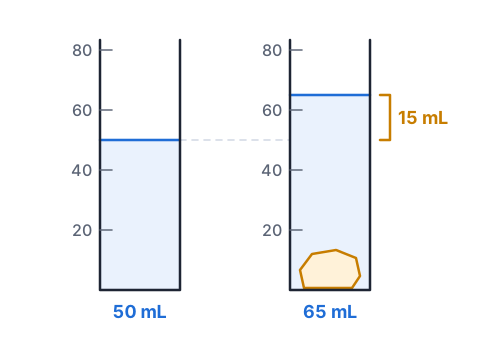
- 65 mL − 50 mL = 15 mLthe water rose by the stone's volume
- The stone's volume is 15 mL
Same size, different mass
- Two objects can have the same volume but different masses. A wooden block and a steel block the same size feel very different in your hand.
- It works the other way too. A big bag of popcorn has a much bigger volume than a small bag of sugar, but the sugar can have more mass.
- So you cannot tell how heavy something is just from its size. You need to know how tightly its matter is packed.
Density: how tightly packed
- Density tells you how much mass is packed into each bit of volume.
- To find it, divide the mass by the volume: density = mass ÷ volume.
- If the mass is in grams and the volume is in millilitres, the density is in grams per millilitre (g/mL).
- Water has a density of about 1 g/mL. That makes water a handy number to compare everything else with.
Example: the density of the stone
- Tai puts the same stone on kitchen scales. Its mass is 39 g. Its volume, from the cylinder, is 15 mL.
- What is the density of the stone, and will it float in water?
- density = mass ÷ volumethe rule
- 39 g ÷ 15 mL = 2.6 g/mLput in the numbers
- 2.6 g/mL is more than water's 1 g/mLcompare with water
- The stone is 2.6 g/mL, so it sinks
Float or sink?
- An object floats in a liquid if it is less dense than that liquid. It sinks if it is denser.
- A foam block floats on water because foam is much less dense than water. A coin sinks because metal is far denser.
- The same rule works in gases. A helium balloon rises because helium is less dense than the air around it.
- The closer an object's density is to the liquid's, the lower it floats. An apple floats with most of it under the water.
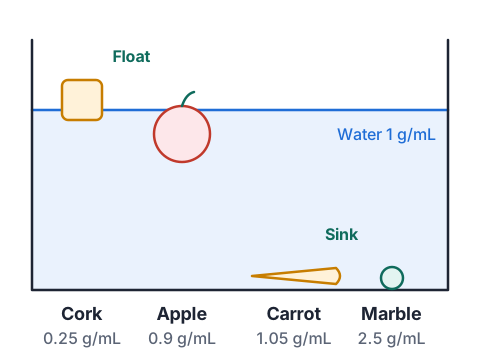
Try it: float or sink?
Example: testing predictions
- Room 7 measured four objects, worked out each density, predicted float or sink, then tested them in a bucket of water.
- Which predictions were right, and what should they have predicted for the carrot?
| Object | Mass | Volume | Density | Prediction | Result |
|---|---|---|---|---|---|
| Cork | 6 g | 24 mL | 0.25 g/mL | Float | Floated |
| Apple | 180 g | 200 mL | 0.9 g/mL | Sink | Floated |
| Carrot | 63 g | 60 mL | 1.05 g/mL | Float | Sank |
| Marble | 10 g | 4 mL | 2.5 g/mL | Sink | Sank |
- Cork 0.25 and apple 0.9 are less than 1 g/mLless dense than water, so they float
- Carrot 1.05 and marble 2.5 are more than 1 g/mLdenser than water, so they sink
- Cork and marble were predicted right; apple and carrot were not
- The carrot should have been predicted to sink, because 1.05 g/mL is just over 1 g/mL
Try it: will it float in water?
How good are your measurements?
- Every measuring tool has limits. Kitchen scales often show whole grams only, so a 0.4 g feather may read as 0 g.
- A measuring cylinder with marks every 2 mL cannot tell you 15 mL from 16 mL very well.
- Air bubbles stuck to a stone, or water splashing out, make a displacement reading wrong.
- To make results more trustworthy, measure each thing more than once and check the readings agree.
- Always write the unit with the number: 39 g, 15 mL, 2.6 g/mL. A number without a unit is not a measurement.
Common mistakes
- Heavy things sink and light things float.Density decides it, not mass: a huge log floats because wood is less dense than water, while a tiny coin sinks.
- Density is volume divided by mass.Density is mass divided by volume, so 39 g in 15 mL is 39 ÷ 15 = 2.6 g/mL.
- Read the measuring cylinder at the top of the curved water edge, looking down.Read at the bottom of the curve with your eye level with the water, or the reading comes out too high.
- Mass and volume are the same thing, because bigger things weigh more.Mass is how much matter there is and volume is how much space it fills; a bag of popcorn is big but light.
Find the density of an apple and a potato
You need: kitchen scales, a measuring jug, water, an apple, a potato, a pencil, paper
- Put the apple on the kitchen scales and write down its mass in grams. Do the same for the potato.
- Fill the jug with water to a line you can read easily, such as 500 mL, and write it down.
- Lower the potato in. Read the new water level at eye level, and take away the first reading to get its volume.
- Empty and refill the jug to the same line. Put the apple in and push it just under the surface with the pencil tip, then read the level.
- Work out mass ÷ volume for each one. Look for this: the one under 1 g/mL floats when you let go, and the one over 1 g/mL sinks.
Safety: Ask an adult before using the kitchen scales and food, keep the jug on a flat bench, and wipe up spilt water straight away so nobody slips.
Your turn
Water in a measuring cylinder is at 40 mL. A toy dinosaur is dropped in and sinks, and the water rises to 52 mL. What is the volume of the toy?
A block of wood has a mass of 80 g and a volume of 100 mL. Work out its density. Will it float or sink in water?
Which unit would you use for the water in a school swimming pool: millilitres, grams, kilograms or cubic metres?
Two balls are exactly the same size. One has a mass of 20 g and the other has a mass of 200 g. Which ball is denser?
Ana reads a measuring cylinder from above and writes 47 mL. Her teacher reads it with her eye level with the water and gets 45 mL. Whose reading is better, and why?
Show answer
1. 12 mL, because 52 − 40 = 12. 2. 80 ÷ 100 = 0.8 g/mL. That is less than water's 1 g/mL, so it floats. 3. Cubic metres (m³), because a pool holds a very large volume. Grams and kilograms measure mass, not volume. 4. The 200 g ball, because it packs more mass into the same volume. 5. The teacher's, because you read at eye level at the bottom of the curve. Looking from above makes the reading too high.
Density
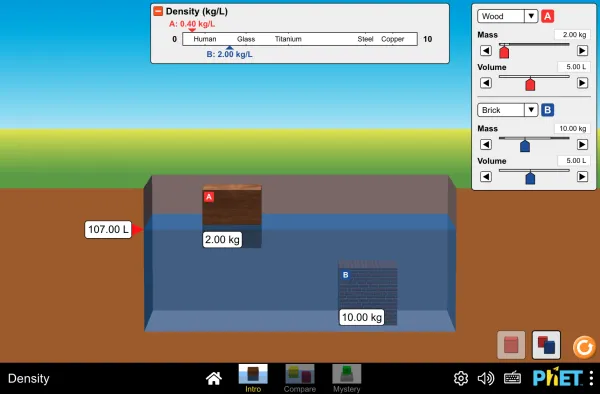
Full screen · PhET Interactive Simulations, University of Colorado Boulder, CC BY 4.0
Recap
- Matter is anything with mass. Mass is measured in grams and kilograms.
- Volume is the space something fills, measured in mL, L or m³. Displacement finds the volume of a lumpy solid.
- Objects can be the same size with different masses.
- Density = mass ÷ volume. Water is about 1 g/mL.
- Less dense than the liquid: it floats. Denser than the liquid: it sinks.
- Measure more than once, know your equipment's limits, and always write the unit.
The maths behind it
Report a mistake
How is Year 5 maths going?
See the Year 5 maths guide