Measuring accurately, and converting units
What this lesson covers
- Different measurement tools and scales use different-sized units; the unit must be recorded with the measurement amount.
- Measurements can be communicated using mixed or decimal units.
- There are 1000 millimetres in a metre, 10 millimetres in a centimetre, 100 centimetres in a metre, and 1000 metres in a kilometre.
Five what?
- How long is this line? Suppose you answer "five".
- Five millimetres, or five metres? They differ by a thousand.
- A number on its own is not a measurement at all.
| answer | is it a measurement? |
|---|---|
| 5 | no, five of what? |
| 5 cm | yes |
| 5 m | yes, and 100 times longer |
Always write the unit
- Different tools and scales use different-sized units.
- So the unit has to be recorded with the amount, every time.
- Leaving it off is not untidy. It makes the answer meaningless.
| written | roughly |
|---|---|
| 5 mm | across a match head |
| 5 cm | across a plum |
| 5 m | across a classroom |
| 5 km | a long walk |
Five tools, five quantities
- Each tool measures one kind of thing, in its own units.
- Pick the tool for the quantity, then the unit for the size.
- You would not weigh a truck in grams.
| tool | measures | units |
|---|---|---|
| ruler | length | mm, cm, m |
| scales | mass | g, kg |
| measuring jug | capacity | mL, L |
| thermometer | temperature | °C |
| timer | duration | s, min, h |
Measuring with a ruler
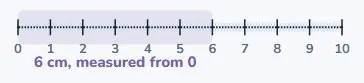
- Line the object up with the 0 mark, not the end of the ruler.
- The end is often plastic before the scale even starts.
- Then read the mark the object finishes at. This is 6 cm.
What is one mark worth?
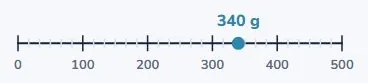
- Before reading any scale, work out one small mark.
- Here the labels are 100 g apart with 5 gaps between them.
- So one mark is 20 g. Assume 1 g and you are out by twenty times.
Millimetres inside centimetres
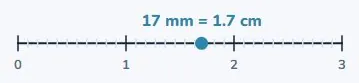
- There are 10 millimetres in every centimetre.
- So the little marks on a ruler are the tenths.
- 17 small marks is 17 mm, which is 1.7 cm.
The four facts to know
- These are worth memorising, because everything else follows.
- Notice they are all 10s, 100s and 1000s.
- Which is why converting is only ever moving digits.
| this many | make |
|---|---|
| 1000 mm | 1 m |
| 10 mm | 1 cm |
| 100 cm | 1 m |
| 1000 m | 1 km |
Metres into centimetres
- 100 cm make a metre, so a metre is 100 centimetres.
- Going m to cm: multiply by 100, so digits two places left.
- Going cm to m: divide by 100, so two places right.
| hundreds | tens | ones | tenths | |
|---|---|---|---|---|
| 2.5 m | 2 | 5 | ||
| 250 cm | 2 | 5 | 0 |
Three conversions
- 2.5 m × 100 = 250 cm.
- 340 cm ÷ 100 = 3.4 m.
- 0.07 m × 100 = 7 cm. Small numbers work the same way.
| from | to | how |
|---|---|---|
| 2.5 m | 250 cm | × 100 |
| 340 cm | 3.4 m | ÷ 100 |
| 0.07 m | 7 cm | × 100 |
Mixed units or decimal units
- A measurement can be written either way.
- 1 m 45 cm and 1.45 m are the same length.
- Mixed is easier to say. Decimal is easier to calculate with.
| mixed units | decimal units |
|---|---|
| 1 m 45 cm | 1.45 m |
| 2 km 300 m | 2.3 km |
| 3 cm 8 mm | 3.8 cm |
Time is the exception
- Money is in 100s, so $2.50 really is two and a half dollars.
- Time is in 60s. 2 hours 30 minutes is 2.5 hours.
- It is never 2.30 hours. That is not two and a half of anything.
| written | means | because |
|---|---|---|
| $2.50 | two and a half dollars | 50 of 100 cents |
| 2.5 hours | 2 hours 30 minutes | 30 of 60 minutes |
| 2.30 hours | not 2 h 30 min | nobody means this |
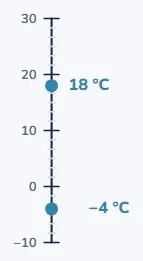
A thermometer is a number line
- Same vertical line you used for negative numbers.
- The unit is degrees Celsius, written °C.
- And it reads below zero without anything changing.
Your turn
- 1. A scale is labelled every 50 g with 5 gaps. One mark?
- 2. Convert 4.2 m to cm, and 65 cm to m.
- 3. Write 2 m 7 cm in decimal metres.
- 4. Write 3 hours 15 minutes as a decimal number of hours.
Show answer
1. 10 g a mark. 2. 420 cm, and 0.65 m. 3. 2.07 m: the 7 is in the hundredths, because 7 cm is 7/100 of a metre. 4. 3.25 hours, because 15 minutes is a quarter of 60.
What to take away
- Every measurement needs a unit, or it is not a measurement.
- Before reading a scale, work out what one mark is worth.
- Converting metres and centimetres is × 100 and ÷ 100.
| job | the move |
|---|---|
| give an answer | number and unit, always |
| read a scale | find one mark first |
| m to cm | × 100 |
| cm to m | ÷ 100 |
Is your child on track?
Take the free placement test