Tenths, hundredths and comparing decimals
What this lesson covers
- Hundredths can be created by dividing whole numbers by 100 and can be expressed as fractions or decimals.
- Equivalent fractions can be generated using common factors.
A question almost everybody gets wrong
- Which is bigger, 0.12 or 0.2?
- Most people pick the first one, because 12 beats 2.
- That is the wrong answer. Here is why.
| this one | or this one |
|---|---|
| 0.12 | 0.2 |
Cut one whole into ten
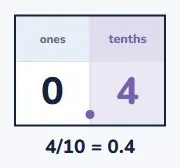
- Ten equal pieces. Each one is one tenth.
- As a fraction, 1/10. As a decimal, 0.1.
- Four pieces is 4/10, or 0.4. Same amount, two spellings.
Cut each tenth into ten again
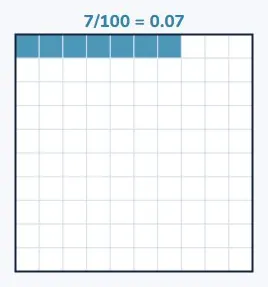
- A hundred pieces now. Each one is one hundredth.
- Or: divide one whole by 100.
- As a fraction, 1/100. As a decimal, 0.01.
The two places are not alike
- 0.7 is seven tenths. 0.07 is seven hundredths.
- The second is ten times smaller than the first.
- That middle zero is not decoration. It holds the tenths empty.
| decimal | fraction | in words |
|---|---|---|
| 0.7 | 7/10 | seven tenths |
| 0.07 | 7/100 | seven hundredths |
Written the same way, it is easy
- 5 tenths beats 3 tenths. No surprises there.
- A fraction against a decimal? Convert one of them first.
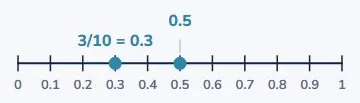
- 3/10 against 0.5 becomes 0.3 against 0.5.
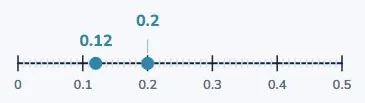
Now put them on a line
- 0.2 sits at two tenths.
- 0.12 sits between one tenth and two tenths.
- It has not even reached 0.2. So 0.2 is bigger.
Compare place by place, from the left
- Tenths first: 1 against 2. Two wins, so stop there.
- You never needed to look at the hundredths.
- Length is the false signal. Place value is the real one.
| number | tenths | hundredths |
|---|---|---|
| 0.12 | 1 | 2 |
| 0.20 | 2 | 0 |
A zero on the right is free
- Writing 0.2 as 0.20 did not change it.
- It only says out loud that there are no hundredths.
- Use it to make two decimals the same length.
| written | means | value |
|---|---|---|
| 0.2 | 2 tenths | the same |
| 0.20 | 2 tenths and 0 hundredths | the same |
With whole numbers on the front
- 3.55 against 3.84. Ones first: 3 and 3, no help.
- Move right to the tenths: 5 against 8.
- 8 is more, so 3.84 is bigger. Hundredths never came up.
| number | ones | tenths | decides it |
|---|---|---|---|
| 3.55 | 3 | 5 | |
| 3.84 | 3 | 8 | bigger |
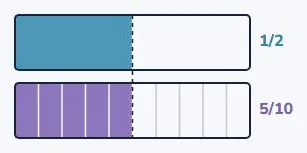
One half is 0.5
- Half of ten is five, so 1/2 is the same as 5/10.
- 5/10 is 0.5. It is also 50/100.
- One amount, three ways of writing it.
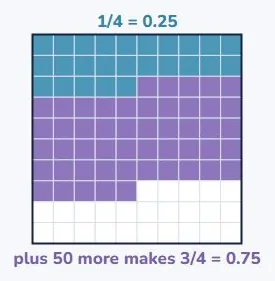
Quarters on a hundred square
- Count a quarter out: two full rows and five more.
- That is 25 squares, so 1/4 = 25/100 = 0.25.
- Fill 50 more and 75 of them is 3/4 = 0.75.
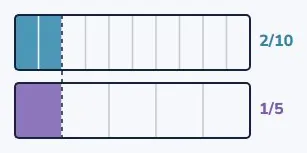
Equivalent fractions come from common factors
- 20/100. Both 20 and 100 divide by 10, giving 2/10.
- Both 2 and 10 divide by 2, giving 1/5.
- Three fractions, one amount. All of them are 0.2.
Per cent means per hundred
- A percentage is already a count of hundredths.
- 50% is 50/100, which is 1/2, which is 0.5.
- Know the hundredths and you already know these.
| percent | fraction | decimal |
|---|---|---|
| 10% | 1/10 | 0.1 |
| 25% | 1/4 | 0.25 |
| 50% | 1/2 | 0.5 |
Your turn
- 1. Write four tenths, then nine hundredths, as decimals.
- 2. Which is bigger, 0.3 or 0.15?
- 3. Order these, smallest first: 0.6, 0.06, 0.16.
- 4. Write 3/4 as a decimal, and 25% as a fraction.
Show answer
1. 0.4 and 0.09. 2. 0.3: compare the tenths, 3 beats 1. 3. 0.06, 0.16, 0.6. 4. 0.75, and 1/4.
What to take away
- The second place past the point is hundredths.
- Compare place by place from the left, never by length.
- Learn these three cold. They come up constantly.
| fraction | decimal | percent |
|---|---|---|
| 1/2 | 0.5 | 50% |
| 1/4 | 0.25 | 25% |
| 3/4 | 0.75 | 75% |
Is your child on track?
Take the free placement test