 Vertex Learn
Heat: where thermal energy comes from and where it goes
What this lesson covers
- What thermal energy and temperature are
- Where thermal energy comes from: the Sun, fire, friction and electricity
- Why thermal energy always moves from warmer things to cooler things
- Why the flow stops once both things are at the same temperature
- How light warms the things it shines on
- Asking testable questions and running a fair test with temperature or melting
Thermal energy and temperature
- Energy is what makes things happen: things move, light up, or warm up.
- Thermal energy is the energy something has because it is hot. The hotter something is, the more thermal energy it has. Heat is thermal energy on the move.
- Temperature tells you how hot or cold something is. It is measured in degrees Celsius (°C) with a thermometer.
- Water freezes at 0 °C and boils at 100 °C. A healthy person's body is about 37 °C.
Where thermal energy comes from
- A source of thermal energy is anything that makes things warmer.
- Friction is the rubbing force between two surfaces. Rub your hands together fast and they warm up.
| Source | Example |
|---|---|
| The Sun | A deck warming up on a summer afternoon |
| Fire | A campfire or a gas barbecue |
| Friction | Rubbing your hands on a frosty morning; bike brakes after a long hill |
| Electricity | A toaster, a heater or an electric blanket |
Try it: where does the heat come from?
Warm to cool, never the other way
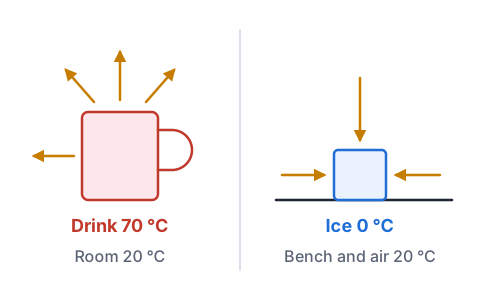
- Thermal energy always moves from a warmer thing to a cooler thing. It never moves from cool to warm on its own.
- A hot drink cools down because thermal energy moves out of it into the cooler cup and air.
- An ice block melts because thermal energy moves into it from the warmer air and bench.
- When you hold an ice cube, your hand feels cold. That is not cold going into your hand. It is thermal energy leaving your hand and going into the ice.
The flow stops when temperatures match
- Thermal energy keeps moving between two things for as long as one is warmer than the other.
- The warm thing cools down and the cool thing warms up.
- Once both are at the same temperature, there is no warmer side, so the overall flow stops.
- That is why a cup of tea left on the table ends up at room temperature, and a cold drink left out does too.
Try it: in or out?
Example: a cold jar in warm water
- Room 9 stood a small jar of cold water in a big bowl of warm tap water. They read a thermometer in each every 2 minutes.
- What happened, and why did the readings stop changing?
| Time (min) | 0 | 2 | 4 | 6 | 8 | 10 |
|---|---|---|---|---|---|---|
| Bowl (°C) | 40 | 38 | 37 | 36 | 35 | 35 |
| Jar (°C) | 8 | 20 | 28 | 32 | 35 | 35 |
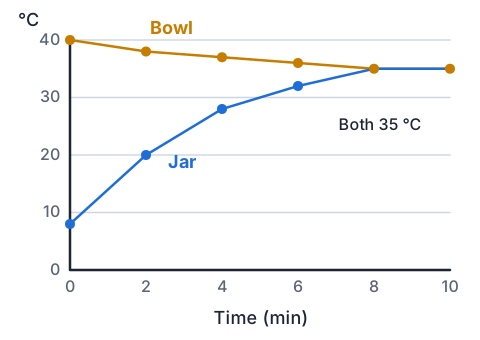
- Bowl went down from 40 °C to 35 °Cit lost thermal energy
- Jar went up from 8 °C to 35 °Cit gained thermal energy
- At 8 minutes both read 35 °Csame temperature, so no more overall flow
- Thermal energy moved from the warm bowl into the cold jar until both were 35 °C
Light can warm things
- When light shines on an object, some of the light is soaked up. Soaking up light is called absorbing it.
- The absorbed light turns into thermal energy, so the object gets warmer.
- Dark colours absorb more light than pale colours. A black car seat in the sun gets much hotter than a white one.
- Shade blocks the light, so the ground under a tree or a sail stays cooler. That is why playgrounds in New Zealand often have shade sails.
Asking a question you can test
- A testable question is one you can answer by changing one thing and measuring what happens.
- "Is summer the best season?" is not testable, because "best" is an opinion.
- "Does ice melt faster on a metal tray or a plastic tray?" is testable. You change the tray and time the melting.
- Some testable questions are still not right for a classroom, for example if they need a fire, boiling water or weeks of waiting. Choose ones that are safe and quick.
Keeping the test fair
- A variable is anything that can change in an experiment.
- In a fair test you change only one variable, measure one variable, and keep every other variable the same.
- If you change two things at once, you cannot tell which one caused the result.
| Kind of variable | In this test |
|---|---|
| Change (one thing) | The material of the tray |
| Measure | Time until the ice cube has fully melted |
| Keep the same | Size of the ice cube, the room, the start time, the tray thickness |
Example: which tray melts ice fastest?
- Room 9 put same-sized ice cubes on a metal tray, a plastic board and a wooden board, all in the same room. They timed each one until it had melted, and did it three times.
- Which material melted the ice fastest, and why?
| Material | Try 1 (min) | Try 2 (min) | Try 3 (min) |
|---|---|---|---|
| Metal tray | 6 | 7 | 6 |
| Plastic board | 15 | 14 | 16 |
| Wooden board | 19 | 18 | 20 |
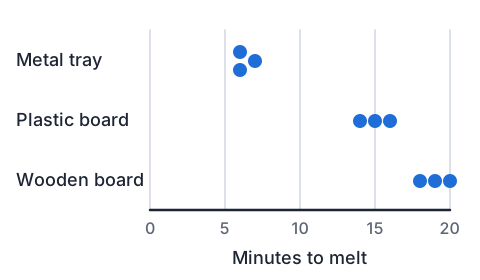
- Metal took 6 to 7 minutes, plastic 14 to 16, wood 18 to 20read the table
- The three tries for each material are close togetherthe test was well controlled
- Metal lets thermal energy from the warm room flow into the ice fastestthe explanation
- The metal tray melted the ice fastest
Explaining everyday heat
- Ice in a drink: thermal energy moves from the drink into the ice, so the ice melts and the drink gets colder.
- A chilly bin: its thick plastic and foam walls slow the flow of thermal energy from the warm air outside into the cold food.
- A woolly hat: it does not make heat. It slows the thermal energy leaving your warm head into the cold air.
- A car parked in the sun: sunlight is absorbed by the seats and dashboard and turns into thermal energy, so the inside gets very hot.
Common mistakes
- When I hold ice, the cold moves into my hand.Thermal energy moves out of your warmer hand into the ice; your hand feels cold because it is losing energy.
- A jumper makes heat, so it warms you up.A jumper makes no thermal energy; it slows the energy leaving your body, so you stay warm.
- A hot drink keeps cooling until it is colder than the room.It stops cooling once it reaches room temperature, because then nothing around it is cooler.
- Using a big ice cube on one tray and a small one on another is still a fair test.The ice cube size is a variable too, so it must be the same on every tray or you cannot compare the trays.
Race ice cubes on different materials
You need: 4 ice cubes from the same tray, a metal baking tray, a plastic chopping board, a wooden chopping board, a folded tea towel, a clock or timer, paper and a pencil
- Put the four surfaces side by side on a bench in the same room, away from sunny windows.
- Write down a prediction: which surface will melt the ice fastest?
- Place one ice cube on each surface at the same moment and start the timer.
- Check every minute and write down the time when each ice cube has fully melted.
- Look at your results: the ice on the metal tray usually melts first, because metal lets thermal energy from the room reach the ice fastest, and the tea towel usually comes last.
Safety: Ask an adult before taking things from the kitchen and the freezer, and wipe up the melt water afterwards so nobody slips.
Your turn
You rub your hands together quickly and they get warm. What is the source of the thermal energy?
A cold can of drink sits on a table in a room at 22 °C. Which way does thermal energy move?
A bowl of soup at 60 °C is left on the bench in a room at 20 °C. What temperature will it end up at?
Which of these is a testable question: "Is summer the best season?" or "Does a lid change how fast hot water cools?"
Mia tests ice melting on two trays. She uses a big ice cube on the metal tray and a small one on the plastic tray. What is wrong with her test?
Show answer
1. Friction, from rubbing the two surfaces together. 2. From the warmer air and table into the cold can, so the can warms up. 3. It cools to 20 °C, room temperature, then stops cooling. 4. "Does a lid change how fast hot water cools?", because you can change one thing (lid or no lid) and measure the temperature. 5. It is not a fair test: the ice cube size should be the same, so only the tray material changes.
Energy Forms and Changes
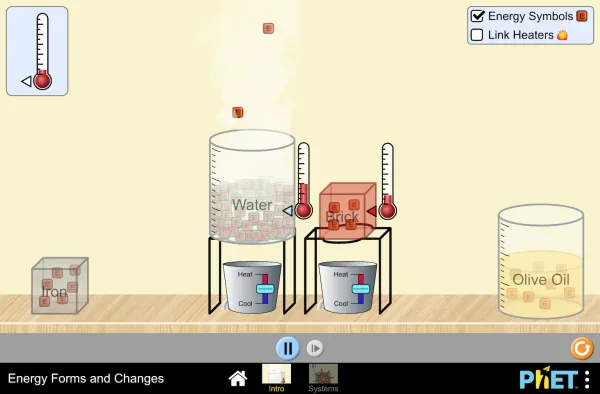
Full screen · PhET Interactive Simulations, University of Colorado Boulder, CC BY 4.0
Recap
- Thermal energy is the energy of hot things. Temperature, in °C, says how hot something is.
- Thermal energy comes from the Sun, fire, friction and electricity.
- It always moves from warmer to cooler, never the other way on its own.
- It keeps moving until both things are at the same temperature.
- Absorbed light turns into thermal energy, so things in sunlight warm up; dark colours absorb more.
- A fair test changes one variable, measures one, and keeps the rest the same.
The maths behind it
Report a mistake
How is Year 5 maths going?
See the Year 5 maths guide