Area, perimeter and volume
What this lesson covers
- Volume is a measure of regions in three-dimensional space.
- The areas of rectangles (including squares) can be calculated by multiplication of side lengths.
Same paper, different fence
- Two rectangles can cover exactly the same amount of paper.
- And still need different lengths of fence around them.
- Area and perimeter measure different things. Here is the difference.
| rectangle | covers | fence needed |
|---|---|---|
| 6 by 2 | 12 cm² | 16 cm |
| 4 by 3 | 12 cm² | 14 cm |
Perimeter is the distance around
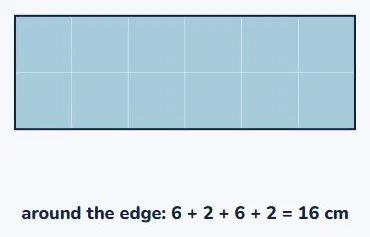
- Walk all the way round the edge and measure how far you went.
- For a 6 by 2 rectangle: 6 + 2 + 6 + 2.
- That is 16 cm. A perimeter is a length, so the unit is cm.
A regular polygon is quicker
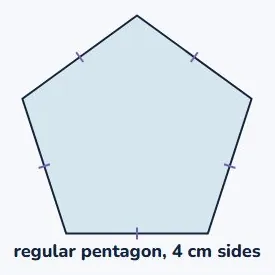
- Regular means every side is the same length.
- So you do not add five numbers. You multiply one.
- A pentagon with 4 cm sides: 5 × 4 = 20 cm.
An awkward shape, and a surprise
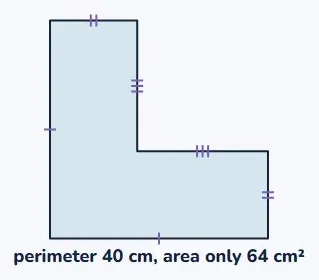
- Take a 10 by 10 square and cut a 6 by 6 corner out of it.
- Add the six sides: 10 + 4 + 6 + 6 + 4 + 10 = 40 cm.
- The square was also 40 cm. The fence did not change.
Area is the covering
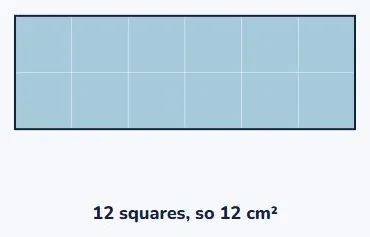
- Area is how much surface the shape covers.
- Measure it in squares. A square 1 cm each way is 1 cm².
- Count them: this rectangle covers 12 squares, so 12 cm².
Why you can just multiply
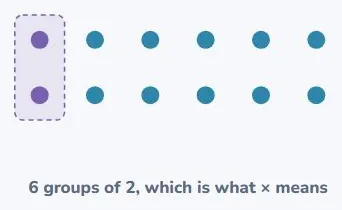
- You do not have to count 12 squares one at a time.
- It is 6 columns with 2 squares in each: 6 groups of 2.
- Groups of something is multiplication. So area is 6 × 2.
The units keep them apart
- Perimeter is a length, so centimetres.
- Area is a covering, so square centimetres, written cm².
- Writing cm² for a perimeter means you measured the wrong thing.
| measurement | what it is | unit |
|---|---|---|
| perimeter | distance around | cm |
| area | surface covered | cm² |
| volume | space filled | cm³ |
Same area, different perimeter
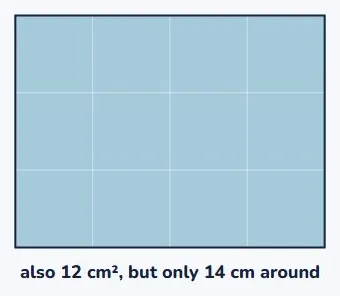
- 6 by 2 covers 12 squares. So does 4 by 3.
- But 6 + 2 + 6 + 2 is 16, and 4 + 3 + 4 + 3 is 14.
- Squarer shapes need less fence for the same area.
And the other way round
- 5 by 1 and 3 by 3 both have a perimeter of 12 cm.
- But 5 by 1 covers 5 squares and 3 by 3 covers 9.
- Knowing one of the two tells you nothing about the other.
| rectangle | perimeter | area |
|---|---|---|
| 5 by 1 | 12 cm | 5 cm² |
| 3 by 3 | 12 cm | 9 cm² |
An area you cannot multiply
- For a curved shape, cover it in squares and count.
- Full squares count 1. Two halves make 1.
- More than half counts as 1, less than half counts as 0.
| squares | how many | worth |
|---|---|---|
| full squares | 9 | 9 |
| about half | 4 | 2 |
| more than half | 3 | 3 |
| less than half | 5 | 0 |
Volume is space, not surface
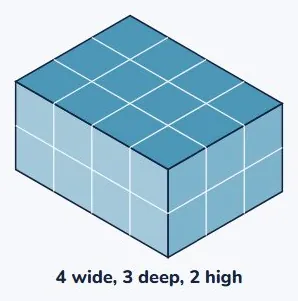
- Volume measures a region of three-dimensional space.
- Measure it in cubes 1 cm each way: 1 cm³.
- Fill the box with centicubes and count them.
Count a layer, then count the layers
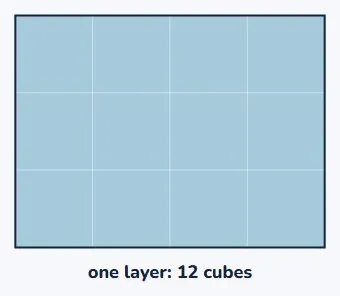
- The bottom layer is a 4 by 3 rectangle, so 12 cubes.
- There are 2 layers, so 12 × 2 = 24 cubes.
- The volume is 24 cm³. It was an area problem twice over.
Your turn
- 1. Find the area and perimeter of an 8 by 3 rectangle.
- 2. A regular hexagon has 5 cm sides. Perimeter?
- 3. Find another rectangle with area 24 cm² and its perimeter.
- 4. A box is 5 by 2 by 3 cubes. How many cubes?
Show answer
1. 24 cm² and 22 cm. 2. 6 × 5 = 30 cm. 3. 12 by 2 gives perimeter 28 cm; 6 by 4 gives 20 cm; 8 by 3 gives 22 cm. 4. One layer is 5 × 2 = 10, times 3 layers, so 30 cubes or 30 cm³.
What to take away
- Perimeter goes around and is measured in cm.
- Area covers, is measured in cm², and for a rectangle is × .
- Volume is layers of area, and is measured in cm³.
| job | the move | unit |
|---|---|---|
| perimeter | add every side | cm |
| area of a rectangle | multiply the sides | cm² |
| area of an odd shape | count squares, round the parts | cm² |
| volume of a cuboid | one layer × number of layers | cm³ |
Is your child on track?
Take the free placement test