Big numbers and rounding
What this lesson covers
- The base 10 number system extends infinitely in two directions.
- Rounding can support predicting or estimating the result of a calculation.
- Rounding is based on identifying the nearest place value or unit (ten, hundred, thousand) for a given number; a number line supports this.
- Square numbers are produced by multiplying a number by itself.
- Cube numbers are produced by multiplying a number by itself twice (e.g. 4 × 4 × 4).
Nobody says the exact number
- About five million people live in New Zealand.
- On any given day there is an exact number.
- Nobody ever says it, and that is not laziness.
| Millions | Thousands | Ones |
|---|---|---|
| 5 | 283 | 471 |
Big numbers come in threes
- Digits are grouped in threes from the right.
- Each group has a name: ones, thousands, millions.
- The commas are not decoration. They mark the groups.
| Millions | Thousands | Ones |
|---|---|---|
| 5 | 283 | 471 |
Reading it out loud
- Read each group, then say its name.
- 5: five million.
- 283: two hundred and eighty-three thousand.
- 471: four hundred and seventy-one.
| Millions | Thousands | Ones |
|---|---|---|
| 5 | 283 | 471 |
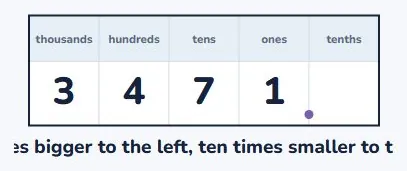
Every column is ten times the last
- Move left and each column is worth ten times more.
- Move right and each is worth ten times less.
- Neither direction runs out. That is what base ten means.
Comparing two big numbers
- Line them up and read from the left.
- Both start with 5 million. Both have 2 hundred thousand.
- The first difference is the ten thousands: 8 against 9.
- So 5,293,000 is the bigger number.
| Millions | Thousands | Ones |
|---|---|---|
| 5 | 283 | 471 |
| 5 | 293 | 000 |
More digits is not the same as bigger
- Count the digits first: 7 beats 6 every time.
- Only when the digit count matches do you compare left to right.
- A number with more digits cannot lose.
| Number | Digits |
|---|---|
| 998,999 | 6 |
| 5,283,471 | 7 |
What rounding is for
- A rounded number is easier to hold in your head.
- It is also how you check an answer is sensible.
- If 5,283,471 ÷ 5 came out near 1 million, something is wrong.
| Millions | Thousands | Ones |
|---|---|---|
| 5 | 283 | 471 |
| 5 | 000 | 000 |
Rounding on a number line
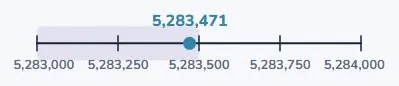
- To round to the nearest thousand, find the thousands either side.
- 5,283,471 sits between 5,283,000 and 5,284,000.
- Halfway is 5,283,500. Our number is left of it.
- So it is nearer 5,283,000.
The only question is which side of halfway
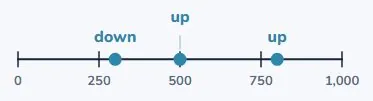
- Left of halfway rounds down. Right of halfway rounds up.
- Exactly halfway rounds up, by agreement.
- That is the whole rule, and the line shows it.
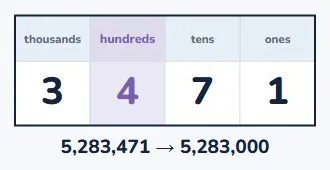
The shortcut: look at the next digit right
- Rounding to the thousands? Look at the hundreds digit.
- It is 4. Four is less than five, so round down.
- The digit to the right is all halfway ever was.
Same number, six different answers
- To the nearest ten: look at the ones. 1, so down: 5,283,470.
- To the nearest hundred: look at the tens. 7, so up: 5,283,500.
- To the nearest million: look at the hundred thousands. 2, so down.
- "Rounded" means nothing until you say what to.
| Nearest | 5,283,471 becomes |
|---|---|
| million | 5,000,000 |
| hundred thousand | 5,300,000 |
| ten thousand | 5,280,000 |
| thousand | 5,283,000 |
Rounding a decimal to the nearest whole number
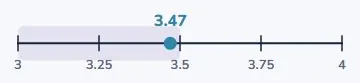
- Round 3.47 to the nearest whole number.
- It sits between 3 and 4, and halfway is 3.5.
- 3.47 is just left of halfway.
- So 3.47 rounds to 3.
The same number, to the nearest tenth
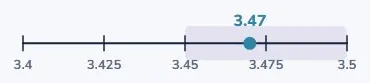
- Now the tenths either side are 3.4 and 3.5.
- Halfway is 3.45, and 3.47 is past it.
- So to the nearest tenth, 3.47 rounds to 3.5.
- Down to a whole number, up to a tenth. Both correct.
Numbers you can build by multiplying
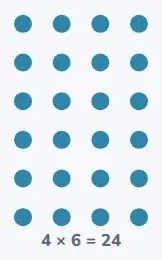
- 24 dots make a neat rectangle 4 across and 6 down.
- 4 × 6 = 24, so 4 and 6 are a factor pair of 24.
- A factor pair is two numbers that multiply to give yours.
Finding every factor pair of 24
- Start at 1 and work up. 1 × 24.
- 2 × 12. Then 3 × 8. Then 4 × 6.
- 5 does not divide 24, so it is skipped.
- Past 4 the pairs repeat backwards, so you are done.
| First | Second |
|---|---|
| 1 | 24 |
| 2 | 12 |
| 3 | 8 |
| 4 | 6 |
When both halves of a pair are the same
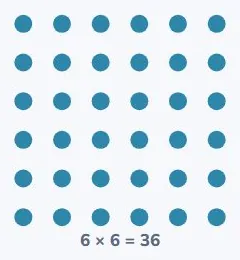
- 36 has a pair where both numbers are 6.
- 6 × 6 = 36, and the dots make an actual square.
- A number multiplied by itself gives a square number.
- 1, 4, 9, 16, 25, 36: every one of them is a square.
Multiply by itself twice and you get a cube
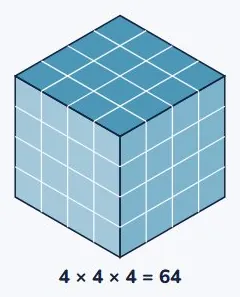
- 4 × 4 = 16 makes a square, 4 across and 4 down.
- Stack 4 of those squares and you have a cube.
- 4 × 4 × 4 = 64, so 64 is a cube number.
- It is called a cube because it makes one.
Rounding to check an answer
- 5,283,471 ÷ 5. Round it first: about 5 million.
- 5 million ÷ 5 is about 1 million.
- So the real answer should be near a million.
- If your calculator says 105,669, you mistyped something.
| Step | Value |
|---|---|
| Round first | 5,000,000 |
| Divide by 5 | 1,000,000 |
| Real answer | 1,056,694.2 |
Four to try
- 1. Read 4,060,900 out loud.
- 2. Round 62,851 to the nearest thousand.
- 3. Find all the factor pairs of 36.
- 4. Round 7.28 to the nearest tenth.
Show answer
Answers: 1. four million, sixty thousand, nine hundred; watch for the empty thousands digit being skipped rather than read as "sixty". 2. 63,000 (the hundreds digit is 8, so up). 3. 1×36, 2×18, 3×12, 4×9, 6×6: five pairs, and 6×6 makes it a square number. 4. 7.3 (the hundredths digit is 8, so up). Ask which digit they looked at, not just what the answer was.
One number, six roundings
- The same 5,283,471 every time.
- Say what you are rounding to, or the answer means nothing.
| Nearest | 5,283,471 becomes |
|---|---|
| million | 5,000,000 |
| hundred thousand | 5,300,000 |
| ten thousand | 5,280,000 |
| thousand | 5,283,000 |
| hundred | 5,283,500 |
| ten | 5,283,470 |
Is your child on track?
Take the free placement test