Negative numbers, squares and cubes
What this lesson covers
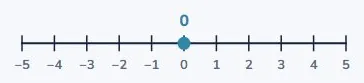
- Negative numbers are to the left of 0 on a horizontal number line and below 0 on a vertical number line.
- Negative numbers are represented symbolically with a negative sign (−) and named 'negative' along with the numeral (e.g. −4 is named negative four).
- Zero is neither positive nor negative.
- Negative numbers arise in a range of situations (e.g. debt, temperature).
There is a negative number in your kitchen
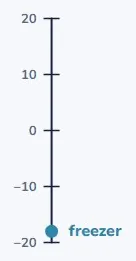
- A freezer sits at about 18 degrees below zero.
- That is not "no temperature". It is a real amount of cold.
- Numbers carry on past zero, and we need names for them.
To the left of zero
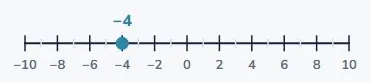
- On a horizontal number line, zero is not the end.
- The numbers keep going to the left.
- Those ones are the negative numbers.
It is called negative four
- −4 is read "negative four".
- Not "minus four": minus is something you do.
- 7 minus 4 is a subtraction. −4 is a number.
- Saying it properly keeps those two apart.
| You see | You say |
|---|---|
| −4 | negative four |
| 7 − 4 | seven minus four |
The sign belongs to the number
- The little dash in front is part of the number itself.
- It travels with it, like a surname.
- Drop it and you have written a completely different number.
Zero is neither
- Zero is not positive and it is not negative.
- It is the mark the other two are measured from.
- There is no such thing as −0.
Stand the line up and you have a thermometer
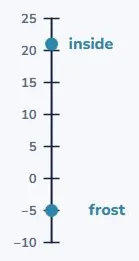
- Turn the number line vertical. Zero stays where it is.
- Positive numbers go up. Negative numbers go down.
- A frosty Central Otago morning reads below zero.
- Lower on the thermometer means colder, and smaller.
Where you actually meet them
- Anywhere there is a natural zero to go under.
- Temperature has one. So does a bank account.
- So does sea level, and the ground floor of a building.
| Where | Looks like |
|---|---|
| Temperature | −5 °C on a frosty morning |
| A freezer | −18 °C inside |
| Money owed | −$20 in your account |
| Below sea level | −3 m under the surface |
Counting backwards in twos from −6
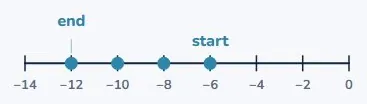
- Start at −6 and count back in twos.
- −6, then −8, then −10, then −12.
- Counting back means moving left, the same as always.
- The numerals grow, and the numbers get smaller.
Counting forwards through zero
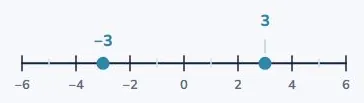
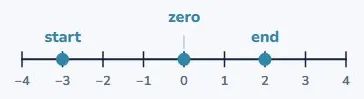
- Start at −3 and count up in ones.
- −3, −2, −1, then zero.
- Keep going and you are into the positives: 1, 2.
- Zero is a step on the way, not a wall.
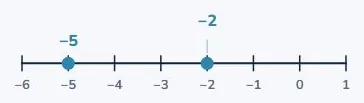
Which is bigger: −2 or −5?
- 5 is bigger than 2, so −5 must be bigger than −2.
- Wrong, and it is worth seeing why.
- On the line, −5 is further left. Further left is smaller.
- A colder day is a smaller temperature, not a bigger one.
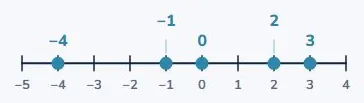
Putting a mixed set in order
- Order these: 3, −4, 0, −1, 2.
- Find each one on the line, then read left to right.
- −4, −1, 0, 2, 3.
- The line does the ordering. You just read it off.
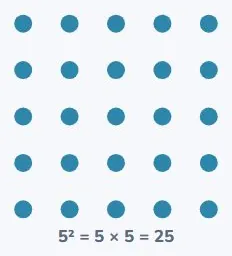
A small raised 2 means squared
- 5² is a short way of writing 5 × 5.
- It is read "five squared", and it equals 25.
- The dots make a square, 5 by 5, hence the name.
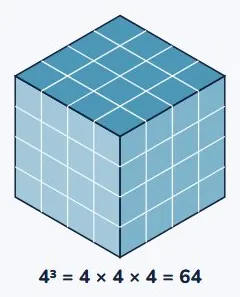
A small raised 3 means cubed
- 4³ is short for 4 × 4 × 4.
- It is read "four cubed", and it equals 64.
- Three of them multiplied, and it builds a cube.
The mistake everyone makes once
- 5² is not 5 × 2.
- The raised 2 says how many fives to multiply, not what by.
- 5 × 2 = 10. But 5² = 25. Nowhere near each other.
| Written | Means | Equals |
|---|---|---|
| 5² | 5 × 5 | 25 |
| 5 × 2 | 5 + 5 | 10 |
The square numbers to 144
- These twelve are worth knowing without working them out.
- Each one is a number multiplied by itself.
- 12² = 144 is the last one you need for Year 6.
| Number | Squared | Number | Squared |
|---|---|---|---|
| 1 | 1 | 7 | 49 |
| 2 | 4 | 8 | 64 |
| 3 | 9 | 9 | 81 |
| 4 | 16 | 10 | 100 |
| 5 | 25 | 11 | 121 |
| 6 | 36 | 12 | 144 |
The cube numbers to 125
- There are only five to learn, so learn them.
- 1, 8, 27, 64, 125.
- They grow much faster than the squares do.
| Number | Cubed | Equals |
|---|---|---|
| 1 | 1 × 1 × 1 | 1 |
| 2 | 2 × 2 × 2 | 8 |
| 3 | 3 × 3 × 3 | 27 |
| 4 | 4 × 4 × 4 | 64 |
| 5 | 5 × 5 × 5 | 125 |
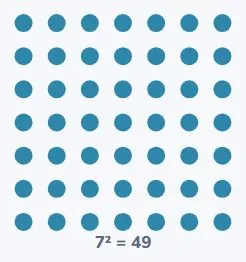
Is 49 a square number?
- Ask whether some number times itself makes 49.
- 7 × 7 = 49, so yes: 49 is 7².
- Now try 30. Nothing times itself makes 30.
- 5² is 25 and 6² is 36, so 30 falls in the gap.
Squared and cubed are not close
- Take the number 5.
- 5² = 25. Add one more five to multiply by.
- 5³ = 125: five times as big again.
- One extra step in the notation, a huge step in the answer.
| Written | Means | Equals |
|---|---|---|
| 5² | 5 × 5 | 25 |
| 5³ | 5 × 5 × 5 | 125 |
Four to try
- 1. Start at −5 and count backwards in threes, three times.
- 2. Which is smaller, −8 or −3?
- 3. What is 9²?
- 4. Is 27 a square number, a cube number, or neither?
Show answer
Answers: 1. −8, −11, −14; watch for them counting forwards because the numerals get bigger. 2. −8, because it is further left. 3. 81. 4. A cube number, 3³, and not a square, since 5² is 25 and 6² is 36. Ask for the reasoning on 2 and 4; the answers alone do not show whether the sign or the gap between squares was understood.
Squared and cubed, side by side
- Squares to 144, cubes to 125.
- And on a number line, further left always means smaller.
| Number | Squared | Cubed |
|---|---|---|
| 1 | 1 | 1 |
| 2 | 4 | 8 |
| 3 | 9 | 27 |
| 4 | 16 | 64 |
| 5 | 25 | 125 |
Is your child on track?
Take the free placement test