Working out probabilities, and checking them
What this lesson covers
- Likelihood can be visualised using a number line from 0 to 1.
- The sample space is the set of all possible outcomes of an experiment.
- The probability of an event, if events are believed to be equally likely, is the number of ways the event can happen divided by the total number of possible outcomes.
- The sum of the probabilities of all outcomes is equal to 1.
They always add up to 1
- Last lesson every set of probabilities came to exactly 1.
- That is a rule, not a coincidence.
- And it is the most useful thing in this topic.
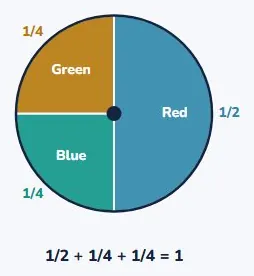
Why it has to be 1
- Spin it and something happens.
- One of the outcomes is certain to occur.
- And certain is 1. So the whole lot must come to 1.
| Question | Answer |
|---|---|
| Will you get a colour? | certainly |
| What is certain, as a number? | 1 |
| So all the colours together? | 1 |
Job one: it catches mistakes
- Work out every probability, then add them.
- If you do not get 1, something is wrong.
- Usually an outcome you forgot to list.
| Your answers add to | Verdict |
|---|---|
| 1 | consistent |
| 7/8 | an outcome is missing |
| 1.2 | something counted twice |
Job two: it gives you answers
- If you know all but one, you know that one.
- It is 1 take away the rest.
- No counting needed.
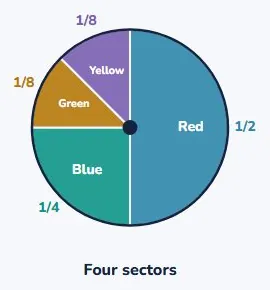
Finding the missing one
- Red 1/2, blue 1/4, green 1/8. Yellow unknown.
- 1/2 + 1/4 + 1/8 = 4/8 + 2/8 + 1/8 = 7/8.
- So yellow is 1 − 7/8 = 1/8.
- And the sector really is an eighth. It checks out.
| Colour | Probability | How |
|---|---|---|
| Red | 1/2 | given |
| Blue | 1/4 | given |
| Green | 1/8 | given |
| Yellow | 1/8 | 1 − 7/8 |
Which needs the whole sample space
- The sample space is every possible outcome of an experiment.
- All of them. That is what makes the total 1.
- Leave one out and the rule stops working.
| Experiment | Sample space |
|---|---|
| Rolling a die | 1, 2, 3, 4, 5, 6 |
| Spinning spinner A | red, blue, green |
| Flipping a coin | heads, tails |
The counting rule
- When the outcomes are equally likely:
- ways the event can happen, over total outcomes.
- A fraction, top over bottom.
| Part | Where it goes | For "even" on a die |
|---|---|---|
| Number of ways the event can happen | the top | 3 even faces |
| Total number of possible outcomes | the bottom | 6 faces |
| Divide | the probability | 3/6 = 1/2 |
The rule on a die
- An even number: 2, 4, 6 (three ways out of six).
- 3/6, which simplifies to 1/2.
- More than 4: 5 and 6 (two ways). 2/6 = 1/3.
| Event | Ways | Probability |
|---|---|---|
| Rolling a 4 | 1 way | 1/6 |
| An even number | 3 ways | 3/6 = 1/2 |
| More than 4 | 2 ways | 2/6 = 1/3 |
| Less than 7 | 6 ways | 6/6 = 1 |
The rule has a condition
- "If the outcomes are equally likely."
- A fair die: yes. Six faces, same chance each.
- A spinner with different-sized sectors: no.
- Use the rule there and you will be wrong.
| Situation | Equally likely? | Count sectors? |
|---|---|---|
| Fair die | yes | yes |
| Coin | yes | yes |
| Spinner A | no | no, use the fractions |
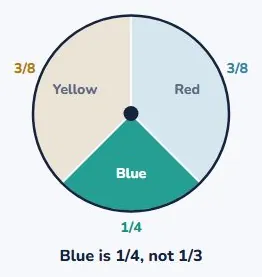
A spinner in eighths
- Red takes three eighths of the turn.
- Blue takes two eighths, which is a quarter.
- Yellow takes three eighths.
- 3/8 + 1/4 + 3/8 = 1.
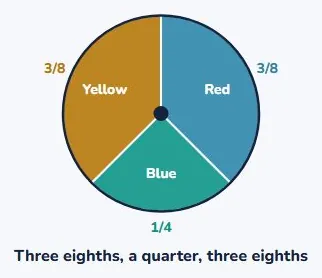
Read it off the sectors
- Not "one of three colours".
- How much of the whole turn each colour takes.
- That is the probability, and it is already a fraction.
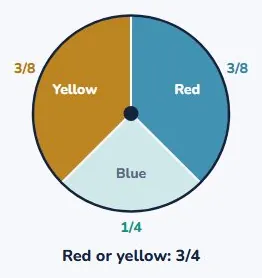
Red or yellow
- Either one will do, so add the two probabilities.
- 3/8 + 3/8 = 6/8.
- Which simplifies to 3/4.
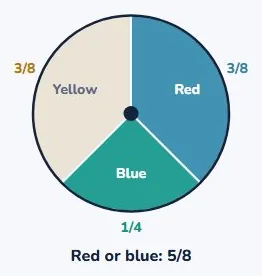
Or ask it the other way
- "Not blue" is the same event.
- Blue is 1/4, so not blue is 1 − 1/4.
- = 3/4. The same answer, one step.
- Two routes, and they agree.
| Event | Working | Answer |
|---|---|---|
| Red or yellow | 3/8 + 3/8 | 3/4 |
| Not blue | 1 − 1/4 | 3/4 |
| Red or blue | 3/8 + 1/4 | 5/8 |
| Any colour | 3/8 + 1/4 + 3/8 | 1 |
When to subtract instead
- If the event is "not something", subtract.
- If it lists a few things, add.
- On a die, "not a 6" is 1 − 1/6 = 5/6.
| Asked | Do this | Example |
|---|---|---|
| Not a 6 | 1 − 1/6 | 5/6 |
| A 2 or a 5 | 1/6 + 1/6 | 2/6 = 1/3 |
| Not an even number | 1 − 1/2 | 1/2 |
Adding unlike fractions
- Red or blue: 3/8 + 1/4.
- Different bottoms, so make them the same.
- 1/4 is 2/8, so 3/8 + 2/8 = 5/8.
All of them on the line
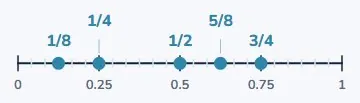
- Likelihood always fits on a line from 0 to 1.
- 1/8 is 0.125. 5/8 is 0.625.
- Which lets you compare two fractions at a glance.
The check, in full
- A die: six outcomes, each 1/6.
- Add all six: 6/6.
- Which is 1. The sample space is complete.
- Do this and you will catch a missed outcome every time.
| Step | Working | Result |
|---|---|---|
| 1, 2, 3, 4, 5, 6 | six outcomes | each 1/6 |
| Add them | 6 lots of 1/6 | 6/6 |
| Which is | 1 |
Your turn
- 1. A spinner is half red, half blue. P(red)?
- 2. On a die, what is the probability of not rolling a 1?
- 3. Three outcomes are 1/3, 1/4 and 1/4. What is the fourth?
- 4. On spinner B, what is P(red or yellow)?
Show answer
1. 1/2. 2. 1 − 1/6 = 5/6. 3. 1/3 + 1/4 + 1/4 = 4/12 + 3/12 + 3/12 = 10/12 = 5/6, so the fourth is 1 − 5/6 = 1/6. 4. 3/8 + 3/8 = 6/8 = 3/4, and you can check it as 1 − 1/4 for "not blue", which gives 3/4 too.
What to take away
- All the probabilities add to 1. Always.
- Equally likely outcomes: ways over total.
- Unequal sectors: read the fraction off the spinner.
- "Not this" is 1 take away this.
Is your child on track?
Take the free placement test