Chance, sample space and the 0-to-1 scale
What this lesson covers
- Situations that involve chance, uncertainty, and randomness are called chance-based situations. Probability can be used to describe such situations.
- A trial is a single run of a chance-based situation that results in one of a set of possible outcomes.
- The possible outcomes for a chance-based situation can be arranged into events.
- The probability of an outcome is the chance of it occurring.
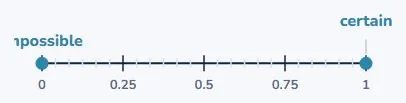
- Probabilities are associated with values between 0 and 1, where: 0 is impossible between 0 and 0.5 or 1/2 ranges from very unlikely to unlikely 0.5 or 1/2 is equally likely between 0.5 or 1/2 and 1 range from likely to very likely 1 is certain.
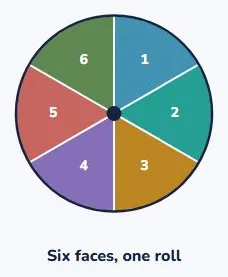
Two true things about one die
- Nobody can tell you what this roll will show.
- Everybody can tell you the chance of a six.
- Both true at once. That is what probability is for.
Chance-based situations
- Chance, uncertainty, randomness: all the same family.
- You cannot know the result before it happens.
- 7 × 8 is not one of these. It is 56, always.
| Situation | Chance-based? | Why |
|---|---|---|
| Rolling a die | yes | you cannot know which face |
| Tomorrow’s weather | yes | uncertain until it happens |
| 7 × 8 | no | it is 56, always |
| Your age next birthday | no | already decided |
Four words that get muddled
- Trial, outcome, sample space, event.
- They mean four different things.
- Worth ten seconds now to save an hour later.
| Word | Means | For a die |
|---|---|---|
| Trial | one single run | rolling the die once |
| Outcome | what that run gave | a 4 |
| Sample space | every outcome possible | 1, 2, 3, 4, 5, 6 |
| Event | outcomes grouped together | "even" means 2, 4 or 6 |
A trial is one single run
- Roll the die once: that is one trial.
- It gives exactly one outcome.
- Roll it thirty times and you have thirty trials.
| You do | That is |
|---|---|
| Roll once | 1 trial, 1 outcome |
| Roll 30 times | 30 trials |
| Flip a coin twice | 2 trials |
The sample space
- Every outcome that is possible. Each one listed once.
- For a die: 1, 2, 3, 4, 5, 6.
- Not 7. Not 0. Those are not possible.
| Situation | How many | Sample space |
|---|---|---|
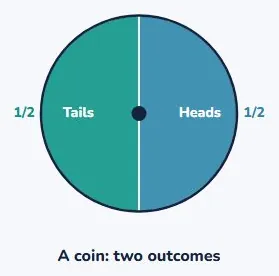
| A coin | 2 | heads, tails |
| A die | 6 | 1, 2, 3, 4, 5, 6 |
| A four-colour spinner | 4 | red, blue, green, yellow |
| Days of the week | 7 | Monday … Sunday |
Listing one properly
- Be systematic: go in order, do not skip.
- A coin: heads, tails. Two outcomes.
- A die: 1 to 6. Six outcomes.
- Miss one and every probability after it is wrong.
Outcomes group into events
- "An even number" is not one outcome.
- It is three of them: 2, 4 and 6.
- A group of outcomes like that is called an event.
| Event | Which outcomes | How many |
|---|---|---|
| Even | 2, 4, 6 | 3 |
| More than 4 | 5, 6 | 2 |
| A six | 6 | 1 |
| A seven | none | 0 |
A chance is a number
- "Probably" cannot be compared with "probably".
- The probability of an outcome is the chance of it happening.
- Written as a number between 0 and 1.

The two ends
- 0 means impossible. It cannot happen.
- 1 means certain. It must happen.
- Nothing sits outside those. There is no 1.5.
And the middle
- One half (0.5) means equally likely.
- As likely to happen as not.
- A fair coin landing heads sits exactly there.
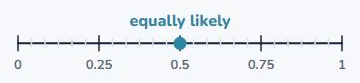
The words for the in-between
- Below a half: unlikely, and below that very unlikely.
- Above a half: likely, and further up very likely.
- The words describe the number. The number comes first.
| Value | What we call it |
|---|---|
| 0 | impossible |
| between 0 and 1/2 | very unlikely, then unlikely |
| 1/2 | equally likely |
| between 1/2 and 1 | likely, then very likely |
| 1 | certain |
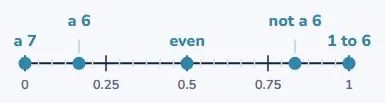
Real events on the line
- A 7: impossible, so 0.
- A 6: 1/6, which is about 0.17 (unlikely).
- Not a 6: 5/6, about 0.83 (likely).
- Any of 1 to 6: certain, so 1.
When outcomes are equally likely
- A fair die: no face is favoured.
- Six outcomes, all with the same chance.
- Which is what lets you just count them.
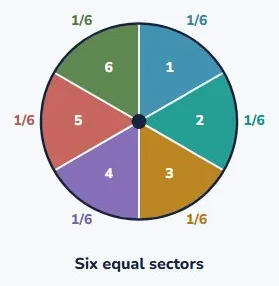
The probability of one outcome
- Six equally likely outcomes.
- A six is one of them.
- So the probability is 1 out of 6: the fraction 1/6.
| Event | Count | Probability | As a decimal |
|---|---|---|---|
| Rolling a 6 | 1 of 6 | 1/6 | about 0.17 |
| Rolling an even number | 3 of 6 | 1/2 | 0.5 exactly |
| Rolling less than 6 | 5 of 6 | 5/6 | about 0.83 |
| Rolling a 7 | 0 of 6 | 0 | impossible |
Keep it as a fraction
- 1/6 is exact. 0.17 is rounded.
- Give the fraction unless you are asked otherwise.
- The decimal is for putting it on the line.
| Fraction | Decimal | Exact? |
|---|---|---|
| 1/2 | 0.5 | yes |
| 1/4 | 0.25 | yes |
| 1/6 | 0.1666… | no, rounds to 0.17 |
| 5/6 | 0.8333… | no, rounds to 0.83 |
When they are not equally likely
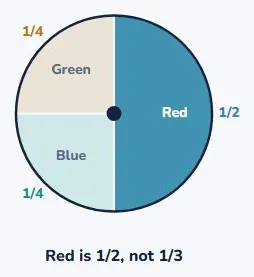
- Red takes half the spinner.
- Blue and green take a quarter each.
- So counting the colours would give the wrong answer.
- It is the size of each sector that decides.
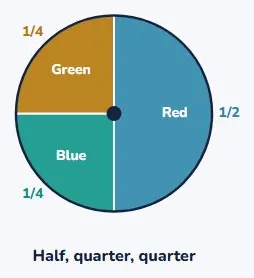
Three colours, not one in three
- Three colours might suggest 1/3 each.
- It is 1/2, 1/4 and 1/4.
- "How many kinds" is not "how likely".
One thing to notice
- On the die: six lots of 1/6.
- On the spinner: 1/2 + 1/4 + 1/4.
- Both come to exactly 1.
- That is not a coincidence (next lesson).
| Situation | All the probabilities | Total |
|---|---|---|
| A coin | 1/2 + 1/2 | 1 |
| A die | six lots of 1/6 | 1 |
| The spinner | 1/2 + 1/4 + 1/4 | 1 |
Your turn
- 1. List the sample space for spinning a three-colour spinner.
- 2. What is the probability of rolling a 3 on a fair die?
- 3. Which outcomes make up the event "more than 4"?
- 4. Where on the 0-to-1 line does "impossible" sit?
Show answer
1. The three colours, each listed once: that is the sample space; how likely each is depends on the sector sizes. 2. 1/6, because a fair die has six equally likely outcomes and a 3 is one of them. 3. 5 and 6, two outcomes, so 2/6, which is 1/3. 4. At 0, the very left-hand end.
What to take away
- A trial is one run; the sample space is every possible outcome.
- An event is a group of outcomes.
- A probability is a number from 0 to 1. 0.5 is equally likely.
- Equally likely outcomes let you count. Otherwise, measure.
Is your child on track?
Take the free placement test