Tenths, hundredths and thousandths
What this lesson covers
- Thousandths can be created by dividing whole numbers by 1,000 and can be expressed as fractions or decimals.
- Equivalent fractions can be generated and simplified using common factors.
There is a thousandth in your pencil case
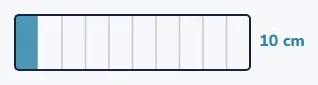
- Take a metre. Cut it into ten equal pieces.
- Each piece is 10 cm: one tenth of a metre.
- Keep cutting and you reach the smallest mark on your ruler.
One whole, ten equal parts
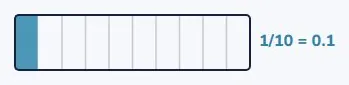
- Ten equal parts means each one is a tenth.
- As a fraction that is 1/10. As a decimal, 0.1.
- Same amount. Two ways of writing it.
Cut each tenth into ten again
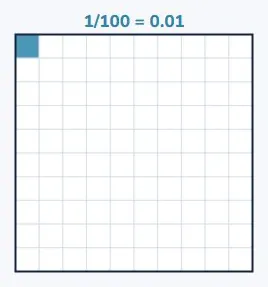
- Ten tenths, each split into ten, gives one hundred parts.
- One of them is 1/100, or 0.01.
- On a metre, that is one centimetre.
Once more, and you have thousandths
- Split each hundredth into ten. Now there are a thousand.
- One of them is 1/1000, or 0.001.
- On a metre, that is one millimetre. A thousand of them fit.
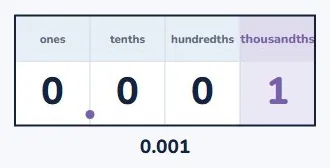
Every column has a name
- To the right of the point: tenths, then hundredths, then thousandths.
- Each column is worth ten times less than the one before it.
- The column a digit sits in tells you what it is worth.
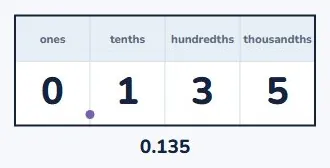
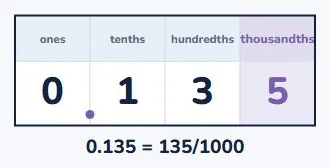
Reading 0.135
- The 1 is in the tenths column: one tenth.
- The 3 is in the hundredths column: three hundredths.
- The 5 is in the thousandths column: five thousandths.
- Altogether, 135 thousandths.
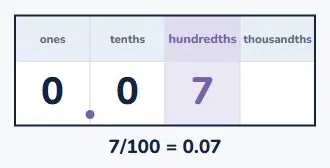
Writing seven hundredths
- Seven hundredths means a 7 in the hundredths column.
- The tenths column has nothing in it, so it gets a zero.
- That zero is doing a job: it holds the 7 in place.
- Seven hundredths is 0.07, not 0.7.
The same amount, fewer pieces
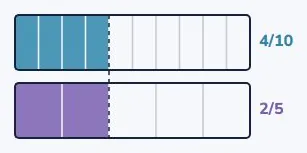
- 4/10 of the bar is shaded.
- 4 and 10 share a common factor of 2.
- Divide both by 2 and you get 2/5.
- The shading has not moved. Only the names changed.
Simplifying 6/10
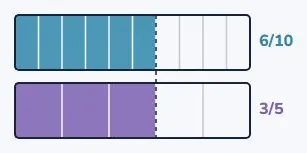
- What goes into both 6 and 10? Two does.
- 6 ÷ 2 = 3, and 10 ÷ 2 = 5.
- So 6/10 is 3/5.
- Nothing goes into 3 and 5 now, so that is as simple as it gets.
Per cent means per hundred
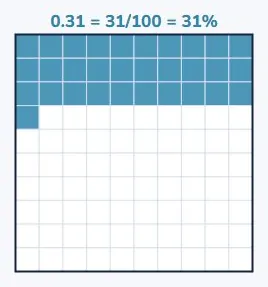
- This grid has one hundred squares. 31 are shaded.
- As a fraction, 31/100. As a decimal, 0.31.
- As a percentage, 31%.
- Three names for one amount.
Worth knowing by heart: one half
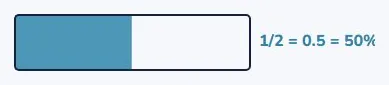
- Half of the bar is shaded.
- 1/2 is 0.5, which is 50%.
- You should not have to work this one out.
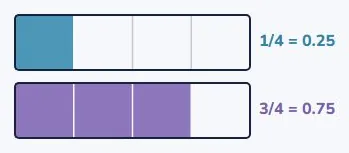
Quarters
- 1/4 is 0.25, or 25%.
- 3/4 is 0.75, or 75%.
- Two quarters is a half, so 0.5 sits between them.
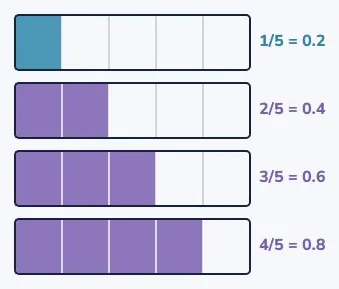
Fifths go up in twos
- 1/5 is 0.2. 2/5 is 0.4.
- 3/5 is 0.6. 4/5 is 0.8.
- Every fifth adds another two tenths. That is the whole pattern.
Which is bigger: 0.38 or 0.4?
- Thirty-eight is a bigger number than four.
- So 0.38 must be bigger than 0.4.
- That argument is wrong, and it is worth knowing exactly why.
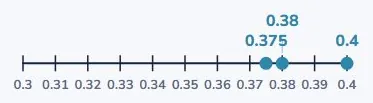
Put them on a number line
- The digits after the point are not a whole number.
- 0.4 is four tenths. 0.38 is not even four tenths yet.
- 0.375 is smaller still, however many digits it has.
- Further right means bigger. The line does not care how long a number looks.
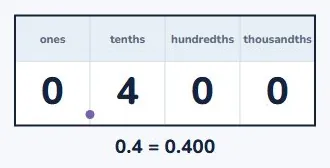
Give them the same number of places
- Writing 0.4 as 0.400 does not change it.
- The extra zeros add no tenths, hundredths or thousandths.
- Now compare 0.400, 0.380 and 0.375 (all thousandths).
- 400, 380, 375. Now the digits can be trusted.
Multiplying by ten
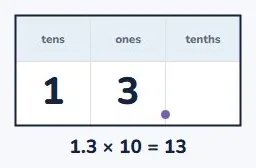
- 1.3 × 10. Every digit becomes worth ten times more.
- The 1 was ones and becomes tens. The 3 was tenths and becomes ones.
- So 1.3 × 10 = 13.
- The digits did not change. They moved up a column.
Dividing by a hundred
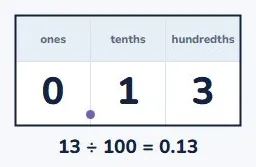
- 13 ÷ 100. Now every digit is worth a hundred times less.
- The 1 drops from tens to tenths, and the 3 from ones to hundredths.
- So 13 ÷ 100 = 0.13.
- Two columns down, because a hundred is two tens.
Four to try
- 1. Write 9/100 as a decimal.
- 2. Simplify 8/10.
- 3. Put these in order, smallest first: 0.6, 0.58, 0.605.
- 4. What is 2.4 ÷ 10?
Show answer
Answers: 1. 0.09; watch for 0.9, which is the placeholder-zero mistake from the "writing seven hundredths" beat. 2. 4/5 (divide both by 2). 3. 0.58, 0.6, 0.605. This is the trap beat again; ask for the same number of places first (0.580, 0.600, 0.605). 4. 0.24. Ask which column each digit moved to rather than accepting "move the point".
Fraction, decimal, percentage
- The seven worth knowing without thinking.
- Same amount, three names each.
Is your child on track?
Take the free placement test