Fractions and percentages of amounts
What this lesson covers
- Multiplication, division, fractions, decimals, and percentages can be used to solve problems involving relative quantities and measures.
240 students, and 2/3 walk or bike
- How many students is that?
- You cannot multiply 240 by 2/3 in your head easily.
- But you can do it in two easy steps.
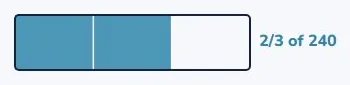
Find one third first
- Thirds means three equal groups.
- So divide: 240 ÷ 3 = 80.
- One third of the school is 80 students.
| Step | Working | Answer |
|---|---|---|
| Find 1/3 | 240 ÷ 3 | 80 |
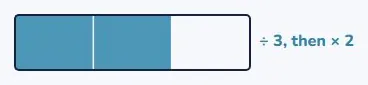
Then take two of them
- We want two thirds, and one third is 80.
- So 80 × 2 = 160.
- 160 students walk or bike.
- A division, then a multiplication. Both easy.
| Step | Working | Answer |
|---|---|---|
| Find 1/3 | 240 ÷ 3 | 80 |
| Then take 2 of them | 80 × 2 | 160 |
Divide by the bottom, multiply by the top
- The bottom number says how many groups.
- The top number says how many of them you want.
- So: divide by the bottom, then multiply by the top.
- Always in that order: it keeps the numbers small.
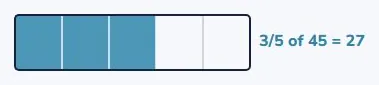
Three fifths of 45
- Divide by the bottom: 45 ÷ 5 = 9.
- Multiply by the top: 9 × 3 = 27.
- So 3/5 of 45 is 27.
- Two steps, and neither of them is hard.
Why divide first
- You could multiply first: 45 × 3 = 135, then ÷ 5 = 27.
- Same answer. But 135 is a harder number to hold.
- Dividing first keeps everything small.
| Order | Working | Answer |
|---|---|---|
| ÷ then × | 45 ÷ 5 = 9, × 3 | 27 |
| × then ÷ | 45 × 3 = 135, ÷ 5 | 27 |
Percentages are just fractions of 100
- 50% means 50 out of every 100.
- So a percentage of an amount is the same kind of job.
- But six of them are worth doing by shortcut, not by division.
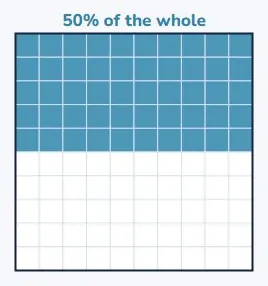
50% is just half
- Half of 240 is 120.
- No division by 100 needed.
- If you ever divide by 100 to find 50%, stop.
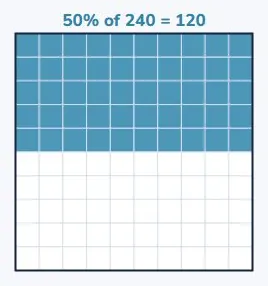
10% is dividing by 10
- 240 ÷ 10 = 24.
- Every digit moves down one column.
- 10% is the most useful one to know, by a long way.
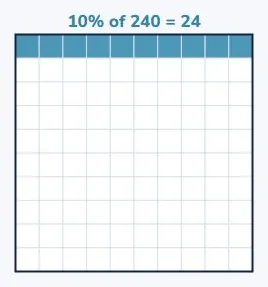
25% is half of a half
- Half of 240 is 120. Half again is 60.
- So 25% of 240 is 60.
- Two halvings beat any division by four.
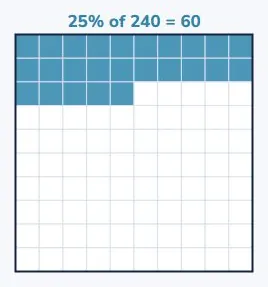
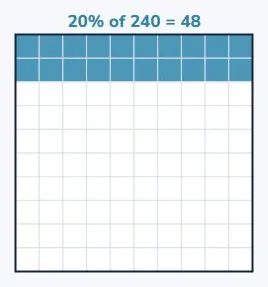
20% is 10% doubled
- 10% of 240 is 24, so double it: 48.
- 20% of 240 is 48.
- Once you have 10%, most others are one step away.
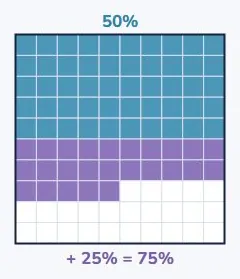
75% is 50% plus 25%
- 50% is 120 and 25% is 60.
- Add them: 180.
- So 75% of 240 is 180. Three quarters of the school.
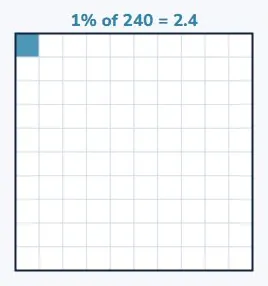
1% is dividing by 100
- 240 ÷ 100 = 2.4.
- Not a whole number, and that is perfectly fine.
- Money does this constantly.
- 1% is the one you build unusual percentages from.
Six shortcuts, and you can build the rest
- None of these needs a written calculation.
- 30%? That is 10% three times: 3 × 24 = 72.
- 15%? 10% plus half of 10%.
- Learn the six and you can reach almost anything.
| Percent | How | Of 240 |
|---|---|---|
| 1% | 240 ÷ 100 | 2.4 |
| 10% | 240 ÷ 10 | 24 |
| 20% | double 10% | 48 |
| 25% | half of half | 60 |
| 50% | half of 240 | 120 |
| 75% | 50% + 25% | 180 |
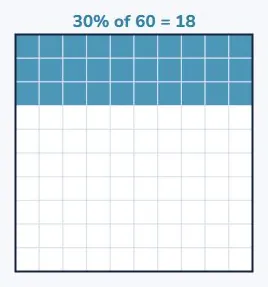
30% of 60
- Start with 10%: 60 ÷ 10 = 6.
- 30% is three lots of 10%.
- So 6 × 3 = 18.
- 30% of 60 is 18, worked out entirely in your head.
Now the other direction
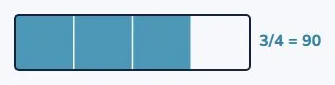
- A netball club: 3/4 of the members are 90 players.
- How many members are there altogether?
- This is the reverse of everything so far.
- And it is where nearly every mark gets lost.
Same two steps, swapped over
- Forwards you divide by the bottom. Backwards, divide by the top.
- 3/4 is 90, so one quarter is 90 ÷ 3 = 30.
- Then multiply by the bottom: 30 × 4 = 120.
- The club has 120 members.
| Step | Working | Answer |
|---|---|---|
| 3/4 of the set is 90 | ||
| Find 1/4 | 90 ÷ 3 | 30 |
| Then take 4 of them | 30 × 4 | 120 |
The same with a percentage: 75% is 24
- 75% is three lots of 25%, so 25% is 24 ÷ 3 = 8.
- 100% is four lots of 25%.
- So 8 × 4 = 32.
- The whole amount is 32.
| Step | Working | Answer |
|---|---|---|
| 75% is 24 | ||
| Find 25% | 24 ÷ 3 | 8 |
| Then 100% | 8 × 4 | 32 |
The trap, and the check that catches it
- Told "3/4 of the set is 90", many people work out 3/4 of 90.
- That gives 67.5: the right method, the wrong direction.
- The check: the whole must be BIGGER than the part.
- 67.5 is smaller than 90, so it was never going to be right.
| Answer | Bigger than 90? | Possible? |
|---|---|---|
| 67.5 | no | no |
| 120 | yes | yes |
Four to try
- 1. What is 3/8 of 64?
- 2. What is 20% of 350?
- 3. 2/5 of a class is 12 students. How big is the class?
- 4. 50% of a number is 17. What is the number?
Show answer
Answers: 1. 64 ÷ 8 = 8, × 3 = 24. 2. 10% is 35, so 20% is 70. 3. 12 ÷ 2 = 6 is one fifth, × 5 = 30 students. 4. 34. Questions 3 and 4 are the reverse direction; if the answer to 3 comes out smaller than 12 (4.8, say), they have gone forwards, and the check in beat 18 is the one to revisit.
Both directions, side by side
- Forwards: divide by the bottom, multiply by the top.
- Backwards: divide by the top, multiply by the bottom.
- And check the whole came out bigger than the part.
| Question | Divide by | Multiply by |
|---|---|---|
| 2/3 of 240 | the bottom (3) | the top (2) |
| 3/4 of it is 90 | the top (3) | the bottom (4) |
Is your child on track?
Take the free placement test