Powers of 10 and expanded form
What this lesson covers
- In our number system each place value is a power of 10, and this continues infinitely.
- Repeated multiplication can be expressed using exponent notation with positive exponents.
- An exponent means 'raising to the power of' (e.g. 5² is 5 raised to the power of 2 or 5 to the second power).
- Expanded form uses powers of 10 to indicate place value.
Ten to the power of four is not forty
- It is a very easy mistake to make.
- The little 4 is not something to multiply by.
- It is a count.
| Written | Means |
|---|---|
| 10⁴ | 10 × 10 × 10 × 10 |
| not | 10 × 4 |
What the exponent counts
- The big number is the base: the one being multiplied.
- The small raised number is the exponent.
- It says how many of the base to multiply together.
| Short | Long | Value |
|---|---|---|
| 2³ | 2 × 2 × 2 | 8 |
How to say it out loud
- 2³ is "two to the power of three", or "two cubed".
- 5² is "five squared": the power of two.
- Those words come from area and volume.
| Short | Long | Value |
|---|---|---|
| 2³ | 2 × 2 × 2 | 8 |
| 5² | 5 × 5 | 25 |
Any base at all
- The base does not have to be small.
- 3⁴ is four threes multiplied: 81.
- Not 3 × 4 = 12. Nowhere near it.
| Short | Long | Value |
|---|---|---|
| 2³ | 2 × 2 × 2 | 8 |
| 5² | 5 × 5 | 25 |
| 3⁴ | 3 × 3 × 3 × 3 | 81 |
| 10³ | 10 × 10 × 10 | 1000 |
Ten is the useful one
- Multiply tens together and something tidy happens.
- 10 × 10 × 10 is 1000.
- Three tens multiplied. Three zeros. Count them.
| Short | Long | Value |
|---|---|---|
| 10³ | 10 × 10 × 10 | 1000 |
The powers of ten
- The exponent and the number of zeros are the same.
- That is only true for base ten.
- 3⁴ is 81; no zeros anywhere.
| Power | Value | Column |
|---|---|---|
| 10¹ | 10 | tens |
| 10² | 100 | hundreds |
| 10³ | 1000 | thousands |
| 10⁴ | 10,000 | ten thousands |
| 10⁵ | 100,000 | hundred thousands |
| 10⁶ | 1,000,000 | millions |
Every column is a power of ten
- Look at the third column of that table.
- Ones, tens, hundreds, thousands: the place value chart.
- It was powers of ten the whole time.
| Power | Value | Column |
|---|---|---|
| 10¹ | 10 | tens |
| 10² | 100 | hundreds |
| 10³ | 1000 | thousands |
| 10⁴ | 10,000 | ten thousands |
| 10⁵ | 100,000 | hundred thousands |
| 10⁶ | 1,000,000 | millions |
So what is the ones column?
- Come down the table: 1000, then 100, then 10.
- Each step divides by ten, and the exponent drops by one.
- One more step: 10⁰ is 1.
| Power | Value | Column |
|---|---|---|
| 10⁰ | 1 | ones |
| 10¹ | 10 | tens |
| 10² | 100 | hundreds |
| 10³ | 1000 | thousands |
| 10⁴ | 10,000 | ten thousands |
| 10⁵ | 100,000 | hundred thousands |
| 10⁶ | 1,000,000 | millions |
And it never stops
- Millions is 10⁶. Billions is 10⁹.
- There is no biggest column.
- Every one of them is ten times the one before.
| Power | Value | Column |
|---|---|---|
| 10⁴ | 10,000 | ten thousands |
| 10⁵ | 100,000 | hundred thousands |
| 10⁶ | 1,000,000 | millions |
A number in its columns
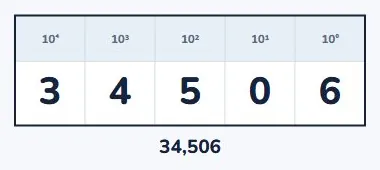
- Thirty-four thousand, five hundred and six.
- Each digit sits in a column.
- Nothing changed except what we call the columns.
You already know expanded form
- Saying the number aloud names the columns.
- "Thirty-four thousand" is 3 ten-thousands and 4 thousands.
- Expanded form writes exactly that down.
| Way of writing it | 34,506 |
|---|---|
| In words | thirty-four thousand, five hundred and six |
| Plain sum | 30,000 + 4,000 + 500 + 0 + 6 |
| With powers | 3 × 10⁴ + 4 × 10³ + 5 × 10² + 0 × 10¹ + 6 × 10⁰ |
The column with nothing in it
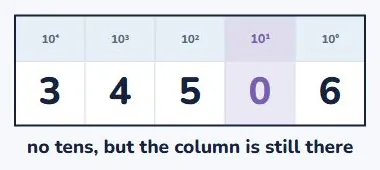
- 34,506 has no tens.
- It still has a tens column.
- Write 0 × 10¹, or the columns after it shift.
Write 60,208 in expanded form
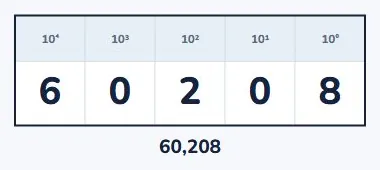
- Sixty thousand, two hundred and eight.
- Ten-thousands 6, thousands 0, hundreds 2, tens 0, ones 8.
- 6 × 10⁴ + 0 × 10³ + 2 × 10² + 0 × 10¹ + 8 × 10⁰.
Check it by adding up
- 6 × 10,000 is 60,000.
- 2 × 100 is 200. 8 × 1 is 8.
- 60,000 + 200 + 8 = 60,208. It matches.
| Term | Value |
|---|---|
| 6 × 10⁴ | 60,000 |
| 0 × 10³ | 0 |
| 2 × 10² | 200 |
| 0 × 10¹ | 0 |
| 8 × 10⁰ | 8 |
| Total | 60,208 |
Comparing with powers
- 9,999 has four digits. 10⁴ has five.
- More columns means bigger, always.
- So 9,999 is less than 10⁴, by one.
| Number | Digits | Which |
|---|---|---|
| 9,999 | four digits | smaller |
| 10⁴ = 10,000 | five digits | bigger |
Put these in order
- 10³, 998, 10⁴, 9,999.
- Turn the powers into numbers first: 1000 and 10,000.
- 998, then 10³, then 9,999, then 10⁴.
| In order | Value |
|---|---|
| 998 | 998 |
| 10³ | 1,000 |
| 9,999 | 9,999 |
| 10⁴ | 10,000 |
The mistake to watch for
- 5² is not 10. It is 5 × 5, which is 25.
- 10⁴ is not 40. It is 10,000.
- The exponent counts. It never multiplies.
| Looks like | Actually |
|---|---|
| 5² = 10 | 5² = 25 |
| 10⁴ = 40 | 10⁴ = 10,000 |
Your turn: four questions
- Pause here and try all four.
- Question 4 runs the process backwards.
- Watch the columns on that one.
| Question | |
|---|---|
| 1 | Write 2⁵ as a multiplication, then work it out. |
| 2 | Which is bigger: 9,999 or 10⁴? |
| 3 | Write 40,703 in expanded form using powers of 10. |
| 4 | What number is 5 × 10³ + 2 × 10¹ + 9 × 10⁰? |
Show answer
1. 2 × 2 × 2 × 2 × 2 = 32. 2. 10⁴ = 10,000, which is bigger than 9,999 by one. 3. 4 × 10⁴ + 0 × 10³ + 7 × 10² + 0 × 10¹ + 3 × 10⁰. 4. 5000 + 20 + 9 = 5029. Note the empty hundreds column.
The answers
- 2⁵ = 32. And 10⁴ is bigger than 9,999.
- 40,703 is 4 × 10⁴ + 0 × 10³ + 7 × 10² + 0 × 10¹ + 3 × 10⁰.
- The last one is 5029: no hundreds column.
| Answer | |
|---|---|
| 1 | 2 × 2 × 2 × 2 × 2 = 32 |
| 2 | 10⁴ = 10,000, bigger by one |
| 3 | 4 × 10⁴ + 0 × 10³ + 7 × 10² + 0 × 10¹ + 3 × 10⁰ |
| 4 | 5000 + 20 + 9 = 5029 |
What to take away
- An exponent counts factors; it does not multiply.
- Every place value column is a power of ten.
- Expanded form is the number said aloud, written in symbols.
| Remember | |
|---|---|
| An exponent | counts how many are multiplied |
| 10⁴ | 10 × 10 × 10 × 10 = 10,000 |
| Every column | is a power of 10 |
| 10⁰ | is 1: the ones column |
| Expanded form | is the number said aloud, in symbols |
Is your child on track?
Take the free placement test