Primes, factors, HCF and LCM
What this lesson covers
- Whole numbers greater than zero are either prime, composite, or the number 1. A prime number has exactly two distinct factors: 1 and the number itself. A composite number has more than two distinct factors. 1 is neither prime nor composite.
- The highest common factor (HCF) of two numbers is the greatest number that is a factor of both the numbers.
- The least common multiple (LCM) of two numbers is the smallest number that they are both factors of.
Is 1 a prime number?
- Almost everyone says yes.
- It is not. It is not composite either.
- And the reason is worth two minutes.
| Number | Its factors | Which |
|---|---|---|
| 13 | exactly 2 factors: 1, 13 | prime |
| 12 | 6 factors: 1, 2, 3, 4, 6, 12 | composite |
| 1 | only 1 factor: itself | neither |
A prime will not make a rectangle
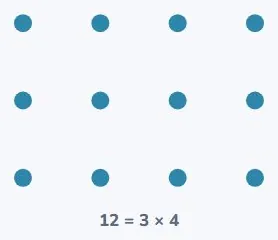
- 12 dots go into a 3 by 4 rectangle.
- Or 2 by 6. Or 1 by 12.
- Three different ways, so 12 is composite.
Now try 13
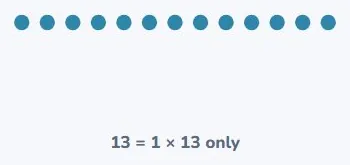
- One row of 13. That is the only rectangle.
- Its only factors are 1 and 13.
- Exactly two. That is what prime means.
So why is 1 neither?
- 1 has only one factor: itself.
- Prime needs exactly two. Composite needs more than two.
- 1 has one. It fits neither box.
| Number | Its factors | Which |
|---|---|---|
| 13 | exactly 2 factors: 1, 13 | prime |
| 12 | 6 factors: 1, 2, 3, 4, 6, 12 | composite |
| 1 | only 1 factor: itself | neither |
Quick tests for factors
- You do not have to divide to find out.
- These rules answer most of it at a glance.
- Notice there is no rule here for 7.
| Divides by | If |
|---|---|
| 2 | ends in an even digit |
| 3 | digits add to a multiple of 3 |
| 4 | last two digits make a multiple of 4 |
| 5 | ends in 0 or 5 |
| 6 | passes the 2 test and the 3 test |
| 8 | last three digits make a multiple of 8 |
| 9 | digits add to a multiple of 9 |
| 10 | ends in 0 |
Is 342 divisible by 6?
- By 2? It ends in 2, so yes.
- By 3? 3 + 4 + 2 = 9, a multiple of 3. Yes.
- Both, so it is divisible by 6. 342 ÷ 6 = 57.
| Test | Working | Result |
|---|---|---|
| 2? | ends in 2 | yes |
| 3? | 3 + 4 + 2 = 9 | yes |
| 6? | both passed | yes |
The number that fools every rule
- 91 is odd, digits total 10, does not end in 0 or 5.
- Every rule you have says no.
- But 7 × 13 = 91. It is not prime.
| Test | Working | Divides? |
|---|---|---|
| 2? | 91 is odd | no |
| 3? | 9 + 1 = 10 | no |
| 5? | ends in 1 | no |
| 9? | 9 + 1 = 10 | no |
| 7? | 7 × 13 = 91 | YES |
The rules rule things out
- Passing every rule does not prove prime.
- To be sure, try each prime: 2, 3, 5, 7, 11...
- You can stop once the prime squared passes the number.
| For 91, try | Because |
|---|---|
| 2, 3, 5, 7 | 7 × 7 = 49, still under 91 |
| then 11 | 11 × 11 = 121, past 91; stop |
| Found | 7 divides it, so 91 is composite |
Breaking a number into primes
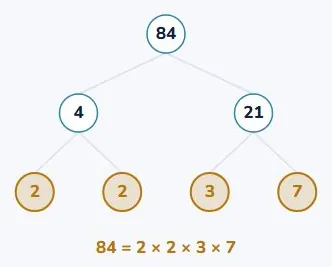
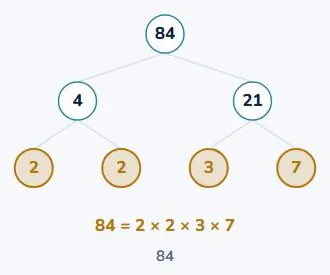
- Split 84 into any factor pair. Say 4 and 21.
- Keep splitting until everything is prime.
- 84 = 2 × 2 × 3 × 7.
The starting split does not matter
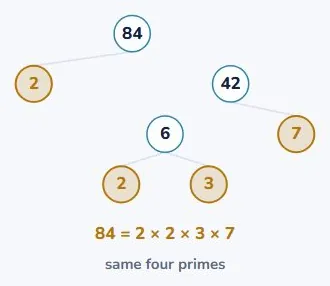
- Start with 2 and 42 instead.
- Different tree, same primes at the bottom.
- Every number has exactly one set of primes.
Square numbers
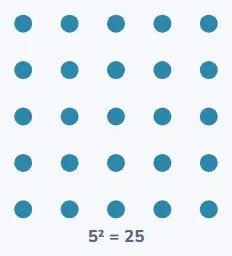
- A square number is one you can make into a square.
- 5 rows of 5 is 25, which is 5².
- Squares go 1, 4, 9, 16, 25, all the way to 144.
Going backwards: the square root
- The square root asks: what was squared to get this?
- The sign is a radical: √.
- √144 = 12, because 12 × 12 = 144.
| Squaring | Rooting |
|---|---|
| 1² = 1 | √1 = 1 |
| 5² = 25 | √25 = 5 |
| 9² = 81 | √81 = 9 |
| 11² = 121 | √121 = 11 |
| 12² = 144 | √144 = 12 |
Highest common factor
- A factor of both numbers is a common factor.
- The biggest one is the highest common factor.
- And the primes show you it straight away.
HCF of 84 and 36
- 84 is 2 × 2 × 3 × 7. 36 is 2 × 2 × 3 × 3.
- What do they share? Two 2s and one 3.
- 2 × 2 × 3 = 12. That is the HCF.
| Number | As primes |
|---|---|
| 84 | 2 × 2 × 3 × 7 |
| 36 | 2 × 2 × 3 × 3 |
| Shared | 2 × 2 × 3 = 12 |
Check it
- 84 ÷ 12 = 7. 36 ÷ 12 = 3.
- 7 and 3 share no factors at all.
- So nothing bigger than 12 could work.
| Working | Result |
|---|---|
| 84 ÷ 12 | 7 |
| 36 ÷ 12 | 3 |
| 7 and 3 share | nothing, so 12 is highest |
Lowest common multiple
- A number both go into is a common multiple.
- The smallest one is the lowest common multiple.
- Same two factor trees, read the other way.
| Number | As primes |
|---|---|
| 6 | 2 × 3 |
| 8 | 2 × 2 × 2 |
| Needs all | 2 × 2 × 2 × 3 = 24 |
LCM of 6 and 8
- 6 needs a 2 and a 3. 8 needs three 2s.
- Take everything either one needs: three 2s and a 3.
- 2 × 2 × 2 × 3 = 24.
| Counting up | Values |
|---|---|
| 6s | 6, 12, 18, 24, 30 |
| 8s | 8, 16, 24, 32, 40 |
| First shared | 24 |
Your turn: four questions
- Pause here and work through all four.
- For question 1, name which test settles it.
- For 3 and 4, break both numbers into primes first.
| Question | |
|---|---|
| 1 | Is 51 prime? Show which test settles it. |
| 2 | What is √64? |
| 3 | Find the HCF of 24 and 60. |
| 4 | Find the LCM of 4 and 6. |
Show answer
1. Not prime. 5 + 1 = 6, a multiple of 3, so 3 divides it: 51 = 3 × 17. 2. 8, because 8 × 8 = 64. 3. 24 = 2 × 2 × 2 × 3 and 60 = 2 × 2 × 3 × 5. Shared: 2 × 2 × 3 = 12. 4. 4 = 2 × 2 and 6 = 2 × 3, so the LCM is 2 × 2 × 3 = 12. Both answers are 12 by coincidence; the questions are unrelated.
The answers
- 51 is not prime: digits total 6, so 3 divides it.
- √64 is 8. HCF of 24 and 60 is 12.
- LCM of 4 and 6 is also 12, a coincidence, not a rule.
| Answer | |
|---|---|
| 1 | 51 = 3 × 17, so not prime |
| 2 | √64 = 8 |
| 3 | HCF(24, 60) = 2 × 2 × 3 = 12 |
| 4 | LCM(4, 6) = 2 × 2 × 3 = 12 |
What to take away
- Prime means exactly two factors. 1 has one, so it is neither.
- Divisibility rules rule numbers out. They never prove prime.
- HCF is what two numbers share; LCM is everything either needs.
| Remember | |
|---|---|
| Prime | exactly two factors |
| 1 | is neither prime nor composite |
| Divisibility rules | rule numbers OUT; they never prove prime |
| HCF | the primes both numbers share |
| LCM | every prime either one needs |
Is your child on track?
Take the free placement test