Listing outcomes, probability and complements
What this lesson covers
- Lists, tables, and tree diagrams are useful systematic methods for generating all possible outcomes.
- If all possible outcomes are assumed to be equally likely, the probability of an event is number of ways the event can happen / total number of possible outcomes.
- Probabilities can be expressed as a fraction or decimal between 0 and 1, or as a percentage between 0% and 100%.
- An event is a subset of the sample space and thus can be a single outcome or a combination of outcomes.
- The probability of an event and its complement add to 1.
Flip two coins. How many outcomes?
- Most people say three.
- Two heads, two tails, or one of each.
- There are four.
| First coin | Second coin | Outcome |
|---|---|---|
| Heads | Heads | HH |
| Heads | Tails | HT |
| Tails | Heads | TH |
| Tails | Tails | TT |
The problem with thinking of them
- Thinking of outcomes is how you miss one.
- You need a method that cannot skip anything.
- The curriculum calls that being systematic.
| First coin | Second coin | Outcome |
|---|---|---|
| Heads | Heads | HH |
| Heads | Tails | HT |
| Tails | Heads | TH |
| Tails | Tails | TT |
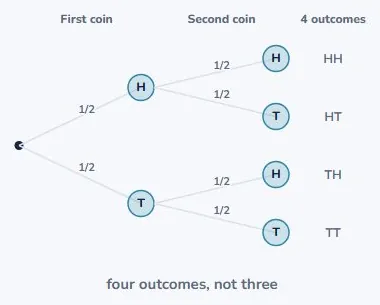
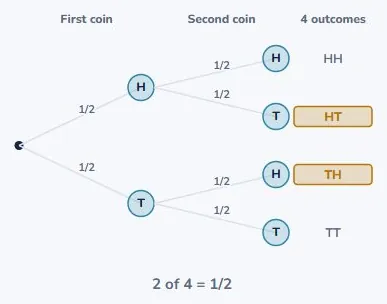
A tree diagram cannot miss one
- Every branch of the second coin, from every branch of the first.
- Follow each path from left to right.
- Four paths. Four outcomes.
Why "one of each" is two outcomes
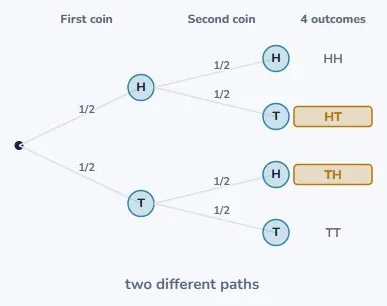
- Head then tail is a different result from tail then head.
- They are separate paths through the tree.
- Which is why one of each is twice as likely as two heads.
Turning a list into a probability
- Count the outcomes you want.
- Divide by the total number of outcomes.
- That works when every outcome is equally likely.
P(two heads)
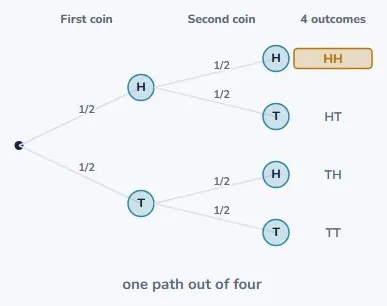
- Only HH gives two heads. That is one outcome.
- There are four altogether.
- So the probability is one quarter.
| Event | Outcomes | Chance |
|---|---|---|
| Two heads | HH | 1 of 4 |
| One of each | HT, TH | 2 of 4 |
| At least one head | HH, HT, TH | 3 of 4 |
| No heads | TT | 1 of 4 |
An event can be more than one outcome
- "Two heads" is a single outcome.
- "One of each" is two of them, HT and TH.
- Count all the ones that qualify.
| Event | Outcomes | Chance |
|---|---|---|
| Two heads | HH | 1 of 4 |
| One of each | HT, TH | 2 of 4 |
| At least one head | HH, HT, TH | 3 of 4 |
| No heads | TT | 1 of 4 |
P(one of each)
- Two outcomes qualify: HT and TH.
- Two out of four.
- Which simplifies to one half.
Three ways to write the same chance
- A quarter. Or 0.25. Or 25 percent.
- All the same number, exactly as in fractions.
- Use whichever the question uses.
| Fraction | Decimal | Percentage |
|---|---|---|
| 1/4 | 0.25 | 25% |
| 1/2 | 0.5 | 50% |
| 3/4 | 0.75 | 75% |
| 1/8 | 0.125 | 12.5% |
| 7/8 | 0.875 | 87.5% |
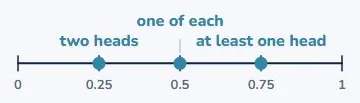
Always between 0 and 1
- 0 means it cannot happen. 1 means it must.
- Everything else sits between them.
- A probability above 1 is a mistake, every time.
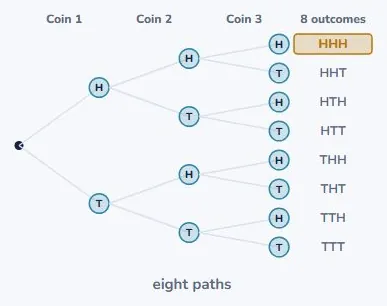
Three coins
- Add a third stage to the tree.
- Every path from before splits in two again.
- Eight outcomes.
Counting without drawing
- Two choices, then two, then two: 2 × 2 × 2 = 8.
- A coin and a three-colour spinner: 2 × 3 = 6.
- Two dice: 6 × 6 = 36.
| Experiment | Working | Outcomes |
|---|---|---|
| 2 coins | 2 × 2 | 4 outcomes |
| 3 coins | 2 × 2 × 2 | 8 outcomes |
| Coin and 3-spinner | 2 × 3 | 6 outcomes |
| 2 dice | 6 × 6 | 36 outcomes |
The opposite of an event
- Every event has an opposite: it does not happen.
- That opposite is called its complement.
- Together they cover every outcome, so they total 1.
| Event | P | Complement | P |
|---|---|---|---|
| Two heads | 1/4 | not two heads | 3/4 |
| At least one head | 7/8 | no heads | 1/8 |
| Rolling a six | 1/6 | not a six | 5/6 |
Why they have to add to 1
- Something has to happen.
- Either the event does, or it does not.
- So between them they account for everything.
| Event | P | Complement | P |
|---|---|---|---|
| Two heads | 1/4 | not two heads | 3/4 |
| At least one head | 7/8 | no heads | 1/8 |
| Rolling a six | 1/6 | not a six | 5/6 |
Where that saves you work
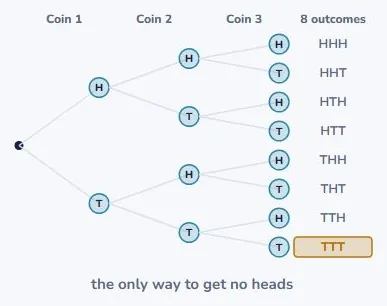
- Three coins. What is P(at least one head)?
- The long way is counting seven outcomes.
- The short way: the only failure is TTT.
| Method | What you do | Working |
|---|---|---|
| The long way | count 7 outcomes | HHH HHT HTH HTT THH THT TTH |
| The short way | the only failure is TTT | 1 − 1/8 |
| Both give | 7/8 |
1 minus one eighth
- P(no heads) is TTT, which is one out of eight.
- So P(at least one head) is 1 − 1/8.
- Seven eighths, or 0.875, or 87.5 percent.
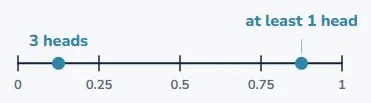
Comparing two events
- Put both on the 0-to-1 scale.
- Whichever is further right is more likely.
- Convert to the same form first if you need to.
Your turn: four questions
- Pause here and try all four.
- Do question 1 as a tree, not from memory.
- Then use it for the rest.
| Question | |
|---|---|
| 1 | Two coins are flipped. List every possible outcome. |
| 2 | What is the probability of at least one head? |
| 3 | Write that answer as a decimal and a percentage. |
| 4 | What is the probability of no heads? Check it against question 2. |
Show answer
1. HH, HT, TH, TT: four of them. 2. 3/4. Three of the four outcomes contain at least one head. 3. 0.75 and 75%. 4. 1/4, only TT. And 3/4 + 1/4 = 1, which is the complement check.
The answers
- HH, HT, TH and TT: four outcomes.
- Three contain a head, so 3/4, which is 0.75 or 75%.
- No heads is 1/4, and 3/4 + 1/4 = 1.
| Answer | |
|---|---|
| 1 | HH, HT, TH, TT |
| 2 | 3/4 |
| 3 | 0.75 and 75% |
| 4 | 1/4, and the pair totals 1 |
What to take away
- List outcomes with a tree, not from memory.
- Probability is ways it happens over total outcomes.
- And P(not A) is 1 − P(A), which is often far quicker.
| Remember | |
|---|---|
| List systematically | a tree cannot miss an outcome |
| Probability | ways it happens ÷ total outcomes |
| An event | can be one outcome or several |
| Fraction, decimal, percentage | the same number three ways |
| P(not A) | is 1 − P(A), often much quicker |
Is your child on track?
Take the free placement test