Chance experiments and the Law of Large Numbers
What this lesson covers
- Some chance-based situations, such as rolling a weighted die, can only be explored through probability experiments.
- Results from sets of repeated trials for the same experiment may vary.
- The Law of Large Numbers states that as the number of trials in a chance experiment increases, the experimental probability will approach the theoretical probability.
- The estimated probability of an event from an experiment is the number of times the event happens divided by the total number of trials.
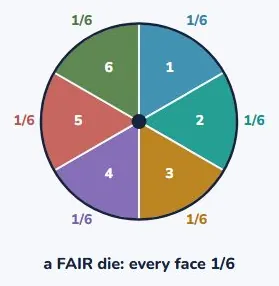
What is the chance of a six on this die?
- It has six faces, so you would say one sixth.
- But this one has a weight hidden inside it.
- Now no amount of looking will tell you.
Some probabilities cannot be worked out
- Counting faces only works if they are equally likely.
- A weighted die breaks that assumption.
- So there is nothing to count.
| Situation | Can you calculate it? |
|---|---|
| A fair coin | yes, two equal outcomes |
| A fair die | yes, six equal outcomes |
| A weighted die | no |
| A drawing pin landing point up | no |
So you roll it. A lot.
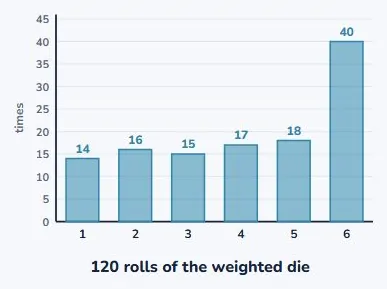
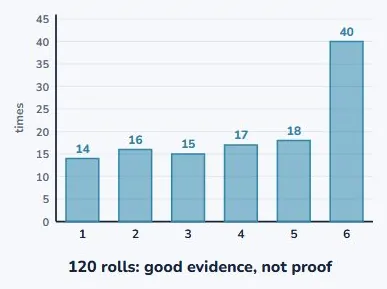
- 120 rolls, and count how often each face came up.
- Five faces landed between 14 and 18 times.
- The six landed 40 times.
Experimental probability
- How many times it happened, divided by how many trials.
- 40 sixes out of 120 rolls.
- 40 ÷ 120 = one third.
| Face | Working | Probability |
|---|---|---|
| 1 | 14 / 120 | 0.12 |
| 2 | 16 / 120 | 0.13 |
| 3 | 15 / 120 | 0.13 |
| 4 | 17 / 120 | 0.14 |
| 5 | 18 / 120 | 0.15 |
| 6 | 40 / 120 | 0.33 |
Against a fair die
- A fair die gives one sixth, about 0.17.
- This one gives 0.33 for a six.
- Twice as often. It is definitely weighted.
| Die | Working | P(six) |
|---|---|---|
| Fair die, any face | 1 / 6 | 0.17 |
| This die, a six | 40 / 120 | 0.33 |
| So a six comes up | about twice as often |
They still add to 1
- Every roll produced exactly one face.
- So the counts total 120, and the probabilities total 1.
- That is true whether the die is fair or not.
| Face | Working | Probability |
|---|---|---|
| 1 | 14 / 120 | 0.12 |
| 2 | 16 / 120 | 0.13 |
| 3 | 15 / 120 | 0.13 |
| 4 | 17 / 120 | 0.14 |
| 5 | 18 / 120 | 0.15 |
| 6 | 40 / 120 | 0.33 |
What a fair die would have looked like
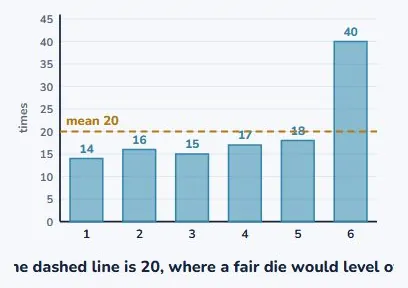
- Twenty of each, all six bars the same height.
- The dashed line is where they would all sit.
- One bar is a long way above it.
Now something about fair coins
- Flip a fair coin 30 times and count the heads.
- Then do it again. And again.
- You will get three different answers.
| Run | Result | P(heads) |
|---|---|---|
| First 30 flips | 18 heads | 0.60 |
| Second 30 flips | 13 heads | 0.43 |
| Third 30 flips | 16 heads | 0.53 |
And that is completely normal
- 0.60, then 0.43, then 0.53: all from a fair coin.
- None of those runs was wrong.
- Repeated sets of trials just do vary.
| Run | Result | P(heads) |
|---|---|---|
| First 30 flips | 18 heads | 0.60 |
| Second 30 flips | 13 heads | 0.43 |
| Third 30 flips | 16 heads | 0.53 |
So 18 heads out of 30 proves nothing
- It is not evidence the coin is rigged.
- 30 trials is simply not many.
- To find out, you need more of them.
| Run | Result | P(heads) |
|---|---|---|
| First 30 flips | 18 heads | 0.60 |
| Second 30 flips | 13 heads | 0.43 |
| Third 30 flips | 16 heads | 0.53 |
Watch what more trials do
- 10 flips gave 0.70. 30 gave 0.60.
- 100 gave 0.54. 500 gave 0.506.
- Closing in on a half, and not by accident.
| Trials | Heads | P(heads) |
|---|---|---|
| 10 flips | 7 heads | 0.70 |
| 30 flips | 18 heads | 0.60 |
| 100 flips | 54 heads | 0.54 |
| 500 flips | 253 heads | 0.506 |
The Law of Large Numbers
- As the number of trials goes up...
- ...the experimental probability gets closer to the true one.
- Which is why 100 trials beats 30, and 1000 beats 100.
| Trials | Heads | P(heads) |
|---|---|---|
| 10 flips | 7 heads | 0.70 |
| 30 flips | 18 heads | 0.60 |
| 100 flips | 54 heads | 0.54 |
| 500 flips | 253 heads | 0.506 |
What it does not promise
- You will not land exactly on 0.5. Almost never.
- And a run of heads does not have to be paid back.
- The coin has no memory of what it just did.
| The Law | Says | |
|---|---|---|
| It does say | more trials get you closer | |
| It does not say | you will land exactly on it | |
| It does not say | a run of heads must be balanced out |
Five heads in a row. What next?
- People say tails is "due". It is not.
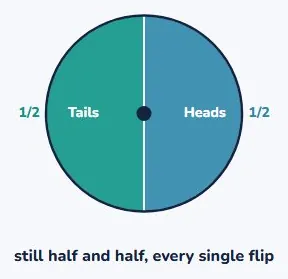
- The next flip is still exactly 0.5.
- The coin does not know about the last five.
Back to the weighted die
- The same warning applies there.
- 120 rolls is decent, but not proof.
- 600 rolls would make the case much stronger.
How many is enough?
- At least 30 for a rough answer.
- At least 100 before you compare each outcome.
- More whenever you can be bothered.
| Trials | Good enough for |
|---|---|
| under 10 | nothing much |
| 30 | a rough estimate |
| 100 | comparing each outcome |
| 500+ | being fairly confident |
Your turn: four questions
- Pause here and try all four.
- Question 3 wants a judgement and a reason.
- Think about how much 30 flips varied earlier.
| Question | |
|---|---|
| 1 | In 40 spins, red comes up 14 times. Experimental probability of red? |
| 2 | A coin is flipped 50 times and lands heads 31 times. Give P(heads). |
| 3 | Is that strong evidence the coin is unfair? Say why. |
| 4 | Flipped 5000 times, what should the experimental probability be near? |
Show answer
1. 14 ÷ 40 = 0.35, or 7/20. 2. 31 ÷ 50 = 0.62. 3. Not strong evidence. Fifty trials is a small number and this much variation is ordinary: the sets of thirty in this lesson ranged from 0.43 to 0.60 on a fair coin. 4. Near 0.5. With that many trials the experimental probability should be very close to the theoretical one, though almost certainly not exactly 0.5.
The answers
- 14 ÷ 40 = 0.35. And 31 ÷ 50 = 0.62.
- No, 50 flips is not strong evidence; 30 gave 0.43 to 0.60.
- At 5000 flips, expect very close to 0.5.
| Answer | |
|---|---|
| 1 | 0.35 |
| 2 | 0.62 |
| 3 | no, 50 trials is too few |
| 4 | near 0.5 |
What to take away
- Experimental probability: how often ÷ how many trials.
- Some situations can only be measured, never calculated.
- More trials get closer, but never promise exactness.
| Remember | |
|---|---|
| Experimental probability | times it happened ÷ total trials |
| Some situations | can only be measured, not calculated |
| Repeated sets | give different answers; that is normal |
| More trials | get you closer to the truth |
| All the outcomes | still total 1 |
Is your child on track?
Take the free placement test