Division and what to do with the remainder
What this lesson covers
- Standard written algorithms (e.g. column addition, column subtraction) rely on place value, regrouping, and renaming.
- Remainders from division can be represented as whole numbers, fractions, or decimals, depending on the context.
Thirty-one children, vans that hold six
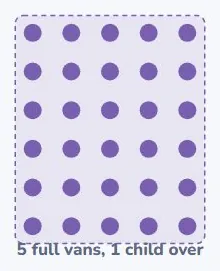
- How many vans do you need to book?
- 31 ÷ 6 is 5, with 1 left over.
- But five vans leaves a child standing on the footpath.
The division itself is the easy part
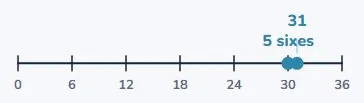
- How many sixes fit into 31? Five of them make 30.
- That uses up 30 and leaves 1 behind.
- So 31 ÷ 6 = 5 remainder 1.
One remainder, three ways to write it
- As a whole number with a remainder: 5 remainder 1.
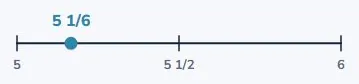
- As a mixed number: 5 1/6.
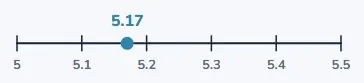
- As a rounded decimal: 5.17.
- All three are correct. They are not interchangeable.
| Written as | Answer |
|---|---|
| Whole number and remainder | 5 remainder 1 |
| Mixed number | 5 1/6 |
| Rounded decimal | 5.17 |
For the vans, the answer is six
- You cannot book 5.17 vans. There is no such thing.
- Five vans means one child does not go.
- So you round up: six vans, and the last one is nearly empty.
- Six is the answer, and the division never printed it.
| Option | What happens |
|---|---|
| 5 vans | 1 child left behind |
| 5.17 vans | does not exist |
| 6 vans | everyone goes |
Sharing sweets: keep the remainder
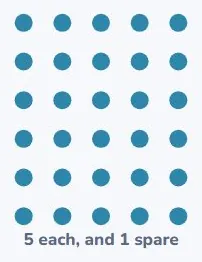
- 31 sweets shared between 6 children.
- Five each, and one sweet left in the bag.
- You cannot cut a sweet, so the remainder stays a remainder.
- 5 each, 1 over. That is the useful answer here.
Sharing cake: split the remainder
- 31 slices of cake between 6 people.
- Cake can be cut, so the leftover slice gets shared too.
- That last slice splits six ways: one sixth each.
- So each person gets 5 1/6 slices.
Measuring rope: use a decimal
- 31 metres of rope cut into 6 equal lengths.
- A tape measure shows decimals, not sixths.
- 31 ÷ 6 is 5.1666… so round it: 5.17 metres.
- Same sum. A decimal is the useful shape this time.
The sum never changed
- Four situations. One division. Four different right answers.
- The arithmetic cannot tell you which one to give.
- You have to look at what the leftover 1 actually is.
| Situation | Answer | Because |
|---|---|---|
| Vans that hold 6 | 6 vans | round up: nobody is left behind |
| Sweets shared out | 5 each, 1 over | a whole number and a remainder |
| Cake shared out | 5 1/6 each | the leftover gets split |
| Metres of rope | 5.17 m | a decimal, to two places |
Bigger numbers, same idea
- Now 1283 ÷ 5, which is too big to do in your head.
- Short division works one digit at a time, left to right.
- Each step carries what is left over into the next digit.
Working through 1283 ÷ 5
- 1 ÷ 5 is 0, and 1 carries over to make 12.
- 12 ÷ 5 is 2, and 2 carries over to make 28.
- 28 ÷ 5 is 5, and 3 carries over to make 33.
- 33 ÷ 5 is 6, with 3 genuinely left over.
| Step | Result | So far |
|---|---|---|
| 1 ÷ 5 | 0, carry 1 | 0 |
| 12 ÷ 5 | 2, carry 2 | 02 |
| 28 ÷ 5 | 5, carry 3 | 025 |
| 33 ÷ 5 | 6, remainder 3 | 256 r 3 |
1283 ÷ 5 = 256 remainder 3
- Reading the digits off the top: 256.
- And 3 that would not divide.
- Check it: 256 × 5 is 1280, plus 3 is 1283.
| Check | Value |
|---|---|
| 256 × 5 | 1,280 |
| plus the remainder | 1,283 |
And that remainder, three ways
- As a remainder: 256 remainder 3.
- As a mixed number: 256 3/5, because 3 of 5 parts are left.
- 3/5 is 0.6, so as a decimal it is 256.6 exactly.
- No rounding needed this time: fifths land on decimals neatly.
| Written as | Answer |
|---|---|
| Remainder | 256 r 3 |
| Mixed number | 256 3/5 |
| Decimal | 256.6 |
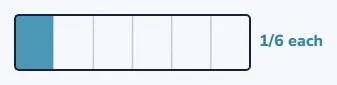
A sixth of something IS dividing by six
- Finding 1/6 of 31 and working out 31 ÷ 6 are the same job.
- Not similar. The same.
- Sharing into 6 equal parts is what both of them mean.
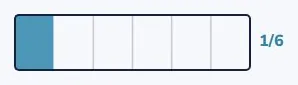
- So 1/6 of 31 is 5 1/6.
Which is why the answer can be a fraction
- One sixth of 31 obviously is not a whole number.
- 31 does not split into 6 whole parts.
- The mixed number is the honest answer, not a rounded one.
A quarter of 90
- 1/4 of 90 means 90 ÷ 4.
- 4 twenty-twos make 88, so 22 with 2 left over.
- Those 2 split four ways: 2/4, which is 1/2.
- So a quarter of 90 is 22 1/2, or 22.5.
| Step | Value |
|---|---|
| 90 ÷ 4 | 22 remainder 2 |
| Remainder as a fraction | 2/4 = 1/2 |
| Answer | 22 1/2 = 22.5 |
Estimating first, as always
- 1283 ÷ 5. Round 1283 to 1300.
- 1300 ÷ 5 is 260, because 13 ÷ 5 is 2.6.
- Our answer, 256.6, sits just under 260.
- If the answer had come out 51 or 2,566, you would know.
| Step | Value |
|---|---|
| Estimate | 1,300 ÷ 5 = 260 |
| Actual | 256.6 |
Four to try
- 1. Work out 947 ÷ 4, with a remainder.
- 2. Write that remainder as a fraction, then as a decimal.
- 3. What is 1/8 of 60?
- 4. 50 people, minibuses that hold 8. How many buses?
Show answer
Answers: 1. 236 remainder 3. 2. 236 3/4, and 3/4 is 0.75, so 236.75 exactly. 3. 60 ÷ 8 = 7 remainder 4, and 4/8 is 1/2, so 7 1/2 or 7.5. 4. 7 buses: 50 ÷ 8 is 6 remainder 2, and those 2 people still need a bus. Question 4 is the van problem again; if they answer 6, or 6.25, that is the beat to go back to.
The remainder is a decision
- Three ways to write one, and the situation picks.
- Ask what the leftover actually is before you answer.
| Written as | Use it when |
|---|---|
| 5 remainder 1 | the leftover cannot be split |
| 5 1/6 | the leftover can be split |
| 5.17 | you are measuring |
| 6 | everyone has to fit |
Is your child on track?
Take the free placement test