Equations, and what the letter is doing
What this lesson covers
- A variable can be used to represent: an unknown number, often in formulae; a quantity that can vary or change; a specific unknown value to be solved.
- The solution to an equation satisfies that equation.
- Equations can be rearranged using inverse operations (e.g. addition and subtraction, multiplication and division).
- Solutions to equations can be checked using substitution.
- Equations can be solved through trial and error, but this can be an inefficient method.
A letter does three different jobs
- In 3a = 18, the a is one unknown number. Find it.
- In A = bh, the letters are a formula. Put numbers in.
- In y = 3x + 4, they are a relationship. Neither is fixed.
| Looks like | The letter is | So you |
|---|---|---|
| 3a = 18 | one unknown value | solve for it |
| A = bh | a formula | substitute into it |
| y = 3x + 4 | a relationship | explore it |
Why that distinction matters
- Asked to "solve" A = bh, students go looking for b.
- There is nothing to find. It is a formula, not a puzzle.
- Read which job the letter is doing before you start.
| Looks like | The letter is | So you |
|---|---|---|
| 3a = 18 | one unknown value | solve for it |
| A = bh | a formula | substitute into it |
| y = 3x + 4 | a relationship | explore it |
What solving actually means
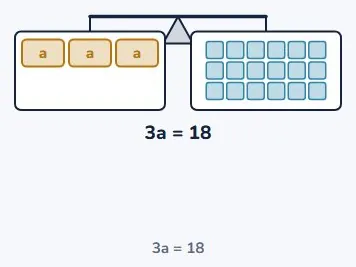
- 3a = 18. The solution is the value that makes it true.
- a = 6, because 3 × 6 really is 18.
- Any other number makes the statement false.
Think of it as a balance
- The two sides weigh the same. That is what = means.
- Take 5 off one pan and it tips, unless you take 5 off both.
- Every legal move is one you do to both sides.
Undo with the opposite operation
- Something added is undone by subtracting.
- Something multiplied is undone by dividing.
- These pairs are called inverse operations.
| If it was | Do this | |
|---|---|---|
| Added 7 | undo by | subtracting 7 |
| Subtracted 3 | undo by | adding 3 |
| Multiplied by 5 | undo by | dividing by 5 |
| Divided by 2 | undo by | multiplying by 2 |
Solving 2x + 5 = 17
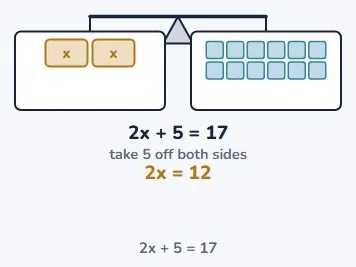
- The 5 was added last, so take it off both sides first.
- That leaves 2x = 12.
- The x was doubled, so halve both sides. x = 6.
| Line | Move | Gives |
|---|---|---|
| 2x + 5 = 17 | take 5 off both pans | 2x = 12 |
| 2x = 12 | halve both pans | x = 6 |
| Check | 2 × 6 + 5 | 17 |
Could you just guess instead?
- Try 5s + 9 = −18 by trial. s = −5 gives −16. Close.
- s = −6 gives −21. Too far. s = −5.5 gives −18.5.
- Three goes, still not there. And the answer is not tidy.
| Guess | Working | Gives |
|---|---|---|
| s = −5 | 5(−5) + 9 | −16 |
| s = −6 | 5(−6) + 9 | −21 |
| s = −5.5 | 5(−5.5) + 9 | −18.5 |
| Target | −18 |
In fairness, guessing is sometimes fine
- For 3a = 18 you saw the answer instantly. No method needed.
- Guessing is quick when the answer is small and whole.
- It collapses when it is negative, or a decimal, or both.
| Equation | Guessing | Verdict |
|---|---|---|
| 3a = 18 | instant | fine |
| 5s + 9 = −18 | no | undo it instead |
So undo it instead
- 5s + 9 = −18. Subtract 9 from both sides: 5s = −27.
- Divide both sides by 5: s = −5.4.
- One pass, no guessing, and it works for any numbers.
| Line | Move | Gives |
|---|---|---|
| 5s + 9 = −18 | subtract 9 from both | 5s = −27 |
| 5s = −27 | divide both by 5 | s = −5.4 |
Notice the scales have gone
- A pan cannot hold −27 kilograms. The picture has run out.
- The algebra has not. It handles negatives without blinking.
- The balance explained why the method is allowed. It is done now.
| Balance | Algebra | |
|---|---|---|
| 2x + 5 = 17 | yes | yes |
| 5s + 9 = −18 | no | yes |
| t + 7 = 6.5 | no | yes |
One more the scales cannot hold
- t + 7 = 6.5. Something plus 7 gives less than 7.
- So t must be negative. Subtract 7 from both sides.
- t = −0.5. Predicted before we calculated it.
| Line | Move | Gives |
|---|---|---|
| t + 7 = 6.5 | subtract 7 from both | t = −0.5 |
| Check | −0.5 + 7 | 6.5 |
| Note | the answer was smaller than 7 |
You can always check your own answer
- Put your answer back into the original equation.
- 5 × −5.4 is −27, and −27 + 9 is −18. It works.
- No answer key needed. Algebra marks itself.
| Line | Move | Gives |
|---|---|---|
| 5s + 9 = −18 | subtract 9 from both | 5s = −27 |
| 5s = −27 | divide both by 5 | s = −5.4 |
| Check | 5(−5.4) + 9 | −18 |
Substituting, which is not solving
- Find w + 12 when w = 4. Nothing to solve. Put 4 in.
- 16. Same for y = 3x + 4 at x = 2, which gives 10.
- And A = bh with b = 5 and h = 4 gives 20.
| Given | Working | Answer |
|---|---|---|
| w + 12, w = 4 | 4 + 12 | 16 |
| y = 3x + 4, x = 2 | 3(2) + 4 | 10 |
| A = bh, b = 5, h = 4 | 5 × 4 | 20 |
Now: when it is not equal, but at least
- Some questions ask for a range, not a single value.
- "At least 5" is not one number, it is all of them from 5 up.
- We write that with an inequality sign.
| Sign | Means | End point |
|---|---|---|
| > | greater than | not including it |
| ≥ | greater than or equal to | including it |
| < | less than | not including it |
| ≤ | less than or equal to | including it |
Solving one works the same way
- t − 3 ≥ −5. Add 3 to both sides, exactly as before.
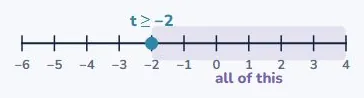
- t ≥ −2.
- So t can be −2, or anything above it.
| Line | Move | Gives |
|---|---|---|
| t − 3 ≥ −5 | add 3 to both sides | t ≥ −2 |
| So t can be | −2, −1, 0, 1, ... | |
| And −2 is | included |
And the circle tells you about the end
- t ≥ −2 includes −2, so the circle is filled in.
- If it were t > −2, the circle would be hollow.
- One stroke in the notation. Very visible on a line.
Your turn: four questions
- Pause here and try all four.
- Question 3 is a substitution, not an equation. Do not solve it.
- Check every answer by putting it back in.
| Question | |
|---|---|
| 1 | Solve x + 8 = 3. |
| 2 | Solve 4m − 3 = 9. |
| 3 | Find 2p + 7 when p = 5. |
| 4 | Solve y − 4 ≤ 1, and say whether 5 is included. |
Show answer
1. x = −5. Subtract 8 from both sides. The answer is negative, which is fine. 2. m = 3. Add 3 to both sides to get 4m = 12, then divide by 4. 3. 17. Substitute, do not solve: 2(5) + 7. 4. y ≤ 5, and yes, 5 is included, because the symbol has the line under it. On a number line that is a filled circle.
The answers
- x = −5, from subtracting 8. A negative answer is fine.
- m = 3, and 2p + 7 at p = 5 is 17.
- y ≤ 5, and 5 is included, so the circle is filled.
| Answer | |
|---|---|
| 1 | x = −5 |
| 2 | m = 3 |
| 3 | 17 |
| 4 | y ≤ 5, and 5 counts |
What to take away
- Read what the letter is doing before you do anything to it.
- Undo the operations in reverse, doing the same to both sides.
- Then substitute your answer back, every single time.
| Remember | |
|---|---|
| A letter | does three jobs; read which one |
| Solving | undo the operations, in reverse |
| Both sides | always do the same to each |
| Checking | substitute your answer back in |
| ≥ and > | differ over whether the end point counts |
Is your child on track?
Take the free placement test