Expanding, factorising and the laws behind them
What this lesson covers
- The distributive, commutative, and associative laws are true for all real numbers.
- Algebraic expressions can be presented in many different ways including fully factorised, partially factorised, and fully expanded forms.
Three laws, and each one is a permission
- Commutative: you may swap the order.
- Associative: you may regroup which pair goes first.
- Distributive: you may multiply across a bracket.
| Law | Lets you | Example |
|---|---|---|
| Commutative | you may swap the order | 3 + 5 = 5 + 3 |
| Associative | you may regroup them | (2 + 3) + 4 = 2 + (3 + 4) |
| Distributive | you may multiply across | 3(4 + 5) = 3 × 4 + 3 × 5 |
Why bother with the names
- Every move in algebra is allowed by one of these.
- Knowing which one tells you when a move is not allowed.
- That second half is where the marks are.
| Law | Lets you | Example |
|---|---|---|
| Commutative | you may swap the order | 3 + 5 = 5 + 3 |
| Associative | you may regroup them | (2 + 3) + 4 = 2 + (3 + 4) |
| Distributive | you may multiply across | 3(4 + 5) = 3 × 4 + 3 × 5 |
Two operations that do not swap
- 5 − 3 is 2. But 3 − 5 is −2. Not the same.
- 6 ÷ 2 is 3. But 2 ÷ 6 is a third.
- Adding and multiplying swap freely. These two never do.
| Expression | Value | |
|---|---|---|
| 5 − 3 | is 2 | |
| 3 − 5 | is −2 | not the same |
| 6 ÷ 2 | is 3 | |
| 2 ÷ 6 | is a third | not the same |
The distributive law, as a rectangle
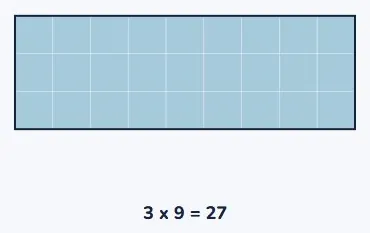
- 3 rows of 9 is 27.
- Split the 9 into 4 and 5, and you have 3 fours and 3 fives.
- 12 and 15, which is 27. The same rectangle, cut in two.
So both routes are legal
- Add inside the bracket first, then multiply. 3 × 9 = 27.
- Or multiply across first. 12 + 15 = 27.
- Which means you may do the same with letters inside.
| Route | Order | Answer |
|---|---|---|
| 3(4 + 5) | add first | 3 × 9 = 27 |
| 3 × 4 + 3 × 5 | multiply first | 12 + 15 = 27 |
| Same answer | so both routes are legal |
First, collecting like terms
- 3x and 5x are the same kind of thing. They combine to 8x.
- 3x and 2y are not. Leave them alone.
- Nor are 4a and 4a². Same letter, different power.
| Terms | Why | Do |
|---|---|---|
| 3x and 5x | same letter | collect: 8x |
| 2y and 7y | same letter | collect: 9y |
| 3x and 2y | different letters | leave them |
| 4a and 4a² | different powers | leave them |
Gathering them up
- 3x + 2y + 5x. The commutative law lets you reorder.
- So put the x terms together: 3x + 5x is 8x.
- The 2y has no partner. Answer: 8x + 2y.
| Expression | Step | Gives |
|---|---|---|
| 3x + 2y + 5x | gather the x terms | 3x + 5x = 8x |
| the y term is alone | 2y | |
| So | 8x + 2y |
And the sign belongs to the term after it
- In 4a + 7b − a, the minus belongs to that a.
- So the a terms are 4a and −a, leaving 3a.
- Because subtraction does not swap, the sign cannot wander.
| Expression | The a terms | Leaves |
|---|---|---|
| 4a + 7b − a + 2b | 4a and −a | 3a |
| 7b and 2b | 9b | |
| So | 3a + 9b |
Expanding a bracket
- 2(x + 3) + 1. The 2 multiplies everything inside.
- Both terms: 2x and 6. So 2x + 6 + 1.
- Then collect the numbers. 2x + 7.
| Expression | Step | Gives |
|---|---|---|
| 2(x + 3) + 1 | multiply across | 2x + 6 + 1 |
| 2x + 6 + 1 | collect the numbers | 2x + 7 |
| Note | the 2 hits both terms |
Everything inside, not just the first
- The commonest slip is 2(x + 3) becoming 2x + 3.
- The 3 was inside the bracket. It gets multiplied too.
- Draw an arrow to each term if it helps. 4(2x + 3) is 8x + 12.
| Written | Verdict | Why |
|---|---|---|
| 2(x + 3) = 2x + 3 | wrong | the 3 was missed |
| 2(x + 3) = 2x + 6 | right | both terms doubled |
With a subtraction inside
- 3(x − 2) + 2x. The 3 multiplies the x and the 2.
- And the minus stays with the 2. So 3x − 6 + 2x.
- Collect the x terms: 5x − 6.
| Expression | Step | Gives |
|---|---|---|
| 3(x − 2) + 2x | multiply across | 3x − 6 + 2x |
| 3x − 6 + 2x | collect the x terms | 5x − 6 |
| The sign | travels with the 2 |
Now run the arrow backwards
- 5x − 35. What number divides both terms? 5.
- Take it outside: 5(x − 7).
- Note the order: x minus 7, not 7 minus x. The sign stayed.
| Expression | Step | Gives |
|---|---|---|
| 5x − 35 | what divides both? | 5 |
| Take it out | 5(? − ?) | 5(x − 7) |
And check it by expanding again
- Expand 5(x − 7) and you should get back to 5x − 35.
- 5 times x is 5x. 5 times −7 is −35. It works.
- Factorising is expanding read backwards. Always check.
| Expression | Step | Gives |
|---|---|---|
| 5x − 35 | what divides both? | 5 |
| Take it out | 5(? − ?) | 5(x − 7) |
| Check | expand it again | 5x − 35 |
The word "fully" costs marks
- 12x − 18 = 2(6x − 9) is a correct factorisation.
- But 6x − 9 still divides by 3, so it is only partial.
- 6(2x − 3) is fully factorised. Nothing left inside.
| Written | Test | Verdict |
|---|---|---|
| 12x − 18 = 2(6x − 9) | 6x − 9 still divides by 3 | partial |
| 12x − 18 = 6(2x − 3) | 2x − 3 shares nothing | fully |
| The test | can the inside be factorised again? |
Rearranging is not a new skill
- A = bh, and you want b on its own.
- The b is multiplied by h, so divide both sides by h.
- b = A ÷ h. That is last lesson, with letters on the other side.
| Formula | Move | Gives |
|---|---|---|
| A = bh | divide both sides by h | b = A ÷ h |
Two steps, same idea
- P = 2(l + w), and you want l.
- Divide both sides by 2 first: P ÷ 2 = l + w.
- Then subtract w. l = P ÷ 2 − w.
| Formula | Move | Gives |
|---|---|---|
| A = bh | divide both sides by h | b = A ÷ h |
| P = 2(l + w) | divide both sides by 2 | P ÷ 2 = l + w |
| subtract w from both | l = P ÷ 2 − w |
Your turn: four questions
- Pause here and try all four.
- Question 3 says fully. Check the inside when you think you are done.
- Check question 1 and 3 by expanding them back out.
| Question | |
|---|---|
| 1 | Expand and simplify 3(x + 4) + 2. |
| 2 | Simplify 4a + 7b − a + 2b. |
| 3 | Factorise 8x + 12 fully. |
| 4 | Rearrange A = lw to make w the subject. |
Show answer
1. 3x + 14. Expanding gives 3x + 12 + 2, then collect the numbers. 2. 3a + 9b. The a terms are 4a and −a, which leave 3a. 3. 4(2x + 3). Taking out 2 gives 2(4x + 6), which is only partial, because 4x + 6 still divides by 2. 4. w = A ÷ l. Divide both sides by l, exactly as with an equation.
The answers
- 3(x + 4) + 2 expands to 3x + 12 + 2, which is 3x + 14.
- 4a + 7b − a + 2b collects to 3a + 9b.
- 8x + 12 is 4(2x + 3). And w = A ÷ l.
| Answer | |
|---|---|
| 1 | 3x + 14 |
| 2 | 3a + 9b |
| 3 | 4(2x + 3) |
| 4 | w = A ÷ l |
What to take away
- The three laws are permissions, and two operations lack them.
- Expanding hits every term inside the bracket, signs included.
- Factorising is the same arrow backwards, so check by expanding.
| Remember | |
|---|---|
| The three laws | each one is a permission |
| Subtraction | is not commutative, so signs stay put |
| Expanding | the outside term hits every term inside |
| Factorising | is expanding read backwards; check by expanding |
| Fully factorised | means the inside shares nothing left |
Is your child on track?
Take the free placement test