Powers of ten, in both directions
What this lesson covers
- In our number system, each place value is a power of 10, and this continues infinitely to the left and right.
- Repeated division can be expressed using exponent notation with negative exponents.
- Decimals can be represented using negative exponents (i.e. negative powers of ten).
The pattern does not stop at the point
- You have met place value twice: whole numbers, then decimals.
- They are taught as if the decimal point is a border.
- It is not. There is one ladder, and it runs both ways.
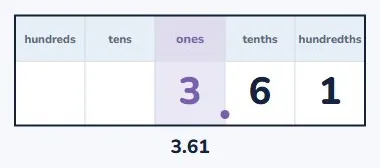
Every column is a power of ten
- A thousand is 10 × 10 × 10, which we write as 10³.
- A hundred is 10², and ten is 10¹.
- The exponent counts how many tens are multiplied together.
| Power | Value | Step |
|---|---|---|
| 10³ | 1000 | |
| 10² | 100 | ÷ 10 |
| 10¹ | 10 | ÷ 10 |
Going down a rung means dividing by ten
- 1000 ÷ 10 is 100. 100 ÷ 10 is 10.
- Every step to the right divides by ten.
- So what comes after 10¹?
| Power | Value | Step |
|---|---|---|
| 10³ | 1000 | |
| 10² | 100 | ÷ 10 |
| 10¹ | 10 | ÷ 10 |
| 10⁰ | 1 | ÷ 10 |
Which is why 10⁰ is 1
- 10 ÷ 10 is 1. The pattern gives us no choice.
- The next rung down from 10¹ is 10⁰, and it is worth 1.
- Not a rule to memorise. Just the pattern, carried on.
| Power | Value | Step |
|---|---|---|
| 10³ | 1000 | |
| 10² | 100 | ÷ 10 |
| 10¹ | 10 | ÷ 10 |
| 10⁰ | 1 | ÷ 10 |
And nothing stops us carrying on
- 1 ÷ 10 is 0.1. That is the next rung.
- The exponent has to keep dropping too, so it goes negative.
- 0.1 is 10⁻¹. Then 0.01 is 10⁻², and so on for ever.
| Power | Value | Step |
|---|---|---|
| 10⁰ | 1 | |
| 10⁻¹ | 0.1 | ÷ 10 |
| 10⁻² | 0.01 | ÷ 10 |
| 10⁻³ | 0.001 | ÷ 10 |
What a negative exponent actually means
- It does not mean a negative number. 10⁻² is not below zero.
- It counts divisions instead of multiplications.
- 10⁻³ means 1 divided by ten, three times over.
| Exponent | Counts | So |
|---|---|---|
| Positive | how many tens multiplied | 10³ = 10 × 10 × 10 |
| Zero | no tens at all | 10⁰ = 1 |
| Negative | how many tens divided by | 10⁻³ = 1 ÷ 10 ÷ 10 ÷ 10 |
Three ways to write the same rung
- 10⁻² is one hundredth.
- One hundredth is the fraction 1/100.
- And 1/100 is the decimal 0.01. Three names, one number.
| Power | Fraction | Decimal |
|---|---|---|
| 10⁻¹ | 1/10 | 0.1 |
| 10⁻² | 1/100 | 0.01 |
| 10⁻³ | 1/1000 | 0.001 |
So the columns have proper names
- The ones column is the 10⁰ column.
- First past the point is tenths, which is 10⁻¹.
- Then hundredths, 10⁻². The point marks where the ones are.
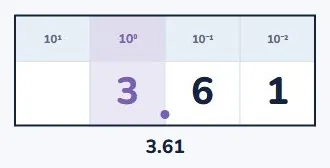
Writing 3.61 the long way
- Take each digit with the column it sits in.
- 3 ones, 6 tenths, 1 hundredth.
- So 3.61 = 3 × 10⁰ + 6 × 10⁻¹ + 1 × 10⁻².
| Digit | Column | Written | Worth |
|---|---|---|---|
| 3 | ones | 3 × 10⁰ | 3 |
| 6 | tenths | 6 × 10⁻¹ | 0.6 |
| 1 | hundredths | 1 × 10⁻² | 0.01 |
Check it by adding it back up
- 3 + 0.6 + 0.01.
- That is 3.61, which is what we started with.
- Expanded form is never a guess. It always adds back.
| Digit | Column | Written | Worth |
|---|---|---|---|
| 3 | ones | 3 × 10⁰ | 3 |
| 6 | tenths | 6 × 10⁻¹ | 0.6 |
| 1 | hundredths | 1 × 10⁻² | 0.01 |
A longer one: 2405.07
- Start at the left. 2 is in the thousands, so 2 × 10³.
- Work right one column at a time, dropping the exponent by one.
- Past the point the exponents go negative. 7 is 7 × 10⁻².
| Digit | Written | Worth |
|---|---|---|
| 2 | 2 × 10³ | 2000 |
| 4 | 4 × 10² | 400 |
| 0 | 0 × 10¹ | 0 |
| 5 | 5 × 10⁰ | 5 |
| 0 | 0 × 10⁻¹ | 0 |
| 7 | 7 × 10⁻² | 0.07 |
The zeros are not optional
- Two columns here hold a zero, and contribute nothing.
- But they hold the other digits in their places.
- Drop them and 2405.07 becomes 245.7, a different number.
| Digit | Written | Worth |
|---|---|---|
| 2 | 2 × 10³ | 2000 |
| 4 | 4 × 10² | 400 |
| 0 | 0 × 10¹ | 0 |
| 5 | 5 × 10⁰ | 5 |
| 0 | 0 × 10⁻¹ | 0 |
| 7 | 7 × 10⁻² | 0.07 |
Now: which is bigger, 0.4 or 0.35?
- Plenty of people say 0.35, because 35 is bigger than 4.
- Put them on a line and you can see it is not.
- 0.4 sits to the right of 0.35.
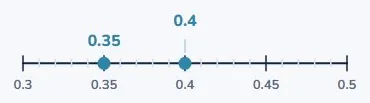
Why more digits does not mean bigger
- After the point, the digits are not a whole number.
- The first one is tenths, and tenths outrank everything after.
- 4 tenths beats 3 tenths. The hundredths never get a say.
| Number | Tenths | Hundredths |
|---|---|---|
| 0.4 | 4 tenths | 0 hundredths |
| 0.35 | 3 tenths | 5 hundredths |
| Bigger? | 4 beats 3 | 0.4 |
Ordering four of them
- Compare the tenths first. Only if they tie, move right.
- 0.405 and 0.45 both have 4 tenths, so go to the hundredths.
- 0 beats nothing, 5 beats 0. Smallest to largest, left to right.
| Number | Reading it | |
|---|---|---|
| 0.405 | 4 tenths, 0 hundredths | smallest |
| 0.45 | 4 tenths, 5 hundredths | |
| 0.5 | 5 tenths | |
| 0.54 | 5 tenths, 4 hundredths | largest |
Your turn: four questions
- Pause here and try all four.
- Question 2 wants powers of ten, not just 4 + 0.5 + 0.02.
- Question 3 is the one to slow down on.
| Question | |
|---|---|
| 1 | Write 0.001 as a power of ten. |
| 2 | Write 4.52 in expanded form using powers of ten. |
| 3 | Which is bigger, 0.7 or 0.65? |
| 4 | Write 10⁻¹ as a fraction and as a decimal. |
Show answer
1. 10⁻³. Three divisions by ten below the ones. 2. 4 × 10⁰ + 5 × 10⁻¹ + 2 × 10⁻². 3. 0.7. It has 7 tenths against 6 tenths, and the comparison is settled there. The extra digit in 0.65 never gets a say. 4. 1/10 and 0.1.
The answers
- 0.001 is three divisions below the ones, so 10⁻³.
- 4.52 is 4 × 10⁰ + 5 × 10⁻¹ + 2 × 10⁻².
- 0.7 is bigger. And 10⁻¹ is 1/10, which is 0.1.
| Answer | |
|---|---|
| 1 | 10⁻³ |
| 2 | 4 × 10⁰ + 5 × 10⁻¹ + 2 × 10⁻² |
| 3 | 0.7 |
| 4 | 1/10 and 0.1 |
What to take away
- One ladder of powers of ten, running both ways for ever.
- A negative exponent counts divisions, not subtractions.
- To compare, start at the left and stop at the first difference.
| Remember | |
|---|---|
| One ladder | each rung is ten times the one below |
| 10⁰ | is 1, because the pattern says so |
| Negative exponent | counts divisions, not subtractions |
| 10⁻² | is 1/100, which is 0.01 |
| Comparing | start at the left and stop at the first difference |
Is your child on track?
Take the free placement test