Powers, roots and prime factors
What this lesson covers
- Each composite number can be represented as a unique product of prime factors and summarised with exponent notation.
Break 36 apart, any way you like
- You could start with 6 × 6. Or with 4 × 9.
- Those are completely different first moves.
- Keep going and they end in exactly the same place. Every time.
First, the two words
- A prime has exactly two factors: itself and 1.
- 2, 3, 5, 7, 11, 13 and on for ever.
- Anything else with factors is composite. 36 is composite.
| Number | Factors | So |
|---|---|---|
| 7 | 1 and 7 | prime |
| 9 | 1, 3, 9 | composite |
| 13 | 1 and 13 | prime |
| 36 | nine of them | composite |
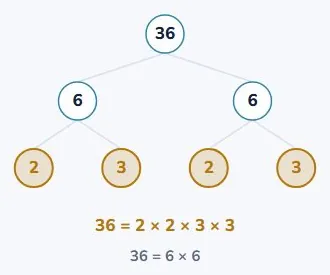
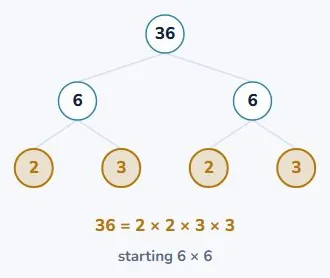
First tree: start with 6 × 6
- 36 splits into 6 and 6.
- Neither 6 is prime, so split again. 6 is 2 × 3.
- Now everything at the bottom is prime. Stop. 2, 2, 3, 3.
Second tree: start with 4 × 9
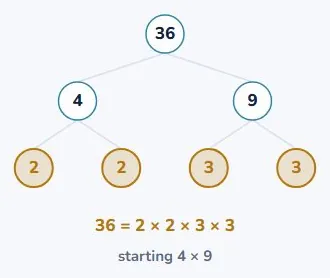
- A completely different first split.
- 4 is 2 × 2, and 9 is 3 × 3.
- Bottom row: 2, 2, 3, 3. The same four numbers.
That is not a coincidence
- Every route down gives the same primes.
- Not usually. Always, for every composite number there is.
- A number has one set of prime factors and no other.
| First split | Then | Leaves |
|---|---|---|
| Split as 6 × 6 | 6 = 2 × 3, twice | 2, 2, 3, 3 |
| Split as 4 × 9 | 4 = 2 × 2, 9 = 3 × 3 | 2, 2, 3, 3 |
| Same leaves | every time | 2² × 3² |
Tidying it with exponents
- 2 × 2 × 3 × 3 is correct but clumsy.
- Two 2s is 2². Two 3s is 3².
- So 36 = 2² × 3². Same fact, less writing.
| Number | Primes | Tidied |
|---|---|---|
| 36 | 2 × 2 × 3 × 3 | 2² × 3² |
Three more, same method
- 72 gives three 2s and two 3s: 2³ × 3².
- 60 gives two 2s, a 3 and a 5: 2² × 3 × 5.
- A prime appearing once needs no exponent at all.
| Number | Primes | Tidied |
|---|---|---|
| 36 | 2 × 2 × 3 × 3 | 2² × 3² |
| 72 | 2 × 2 × 2 × 3 × 3 | 2³ × 3² |
| 60 | 2 × 2 × 3 × 5 | 2² × 3 × 5 |
| 100 | 2 × 2 × 5 × 5 | 2² × 5² |
Why anyone does this
- The primes are a fingerprint for the number.
- Two numbers written this way show their shared factors at a glance.
- That is what makes simplifying fractions quick, next year.
| Number | Primes | Shared |
|---|---|---|
| 36 | 2² × 3² | |
| 60 | 2² × 3 × 5 | 2² and a 3 |
| So | both divide by 12 |
Now the other half: squares
- A square number is a number times itself.
- 5² is 25. 8² is 64. 12² is 144.
- Worth knowing on sight up to at least 12².
| Power | Meaning | Value |
|---|---|---|
| 5² | 5 × 5 | 25 |
| 8² | 8 × 8 | 64 |
| 11² | 11 × 11 | 121 |
| 12² | 12 × 12 | 144 |
The square root asks it backwards
- √49 does not mean "do something to 49".
- It asks: what number, times itself, gives 49?
- 7. So √49 = 7.
| Radical | The question | Answer |
|---|---|---|
| √49 | what times itself gives 49? | 7 |
Cubes: three of the same, multiplied
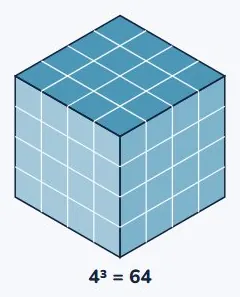
- 2³ is 2 × 2 × 2, which is 8.
- 3³ is 27, 4³ is 64, 5³ is 125.
- Called cubes because that many unit cubes build a cube.
And the cube root asks that backwards
- ³√27 asks: what number, cubed, gives 27?
- 3, because 3 × 3 × 3 = 27.
- The small 3 on the sign is what makes it a cube root.
| Radical | The question | Answer |
|---|---|---|
| √49 | what times itself gives 49? | 7 |
| ³√27 | what cubed gives 27? | 3 |
| √144 | what times itself gives 144? | 12 |
| ³√125 | what cubed gives 125? | 5 |
64 answers both, differently
- √64 is 8, because 8 × 8 = 64.
- ³√64 is 4, because 4 × 4 × 4 = 64.
- Same number in, different question asked, different answer out.
| Radical | Because | Answer |
|---|---|---|
| √64 | because 8 × 8 = 64 | 8 |
| ³√64 | because 4 × 4 × 4 = 64 | 4 |
| Same number | different question | different answer |
When the root is not a whole number
- √50. Nothing times itself gives exactly 50.
- But 7² is 49 and 8² is 64, so it is between 7 and 8.
- 50 is barely past 49, so it is only just past 7.
| Known | Compared to 50 | Tells us |
|---|---|---|
| 7² = 49 | just under 50 | √50 is above 7 |
| 8² = 64 | well over 50 | √50 is below 8 |
| So | between 7 and 8 | and close to 7 |
Then let the calculator confirm it
- It says 7.0710 and onwards. About 7.07.
- Which is what we predicted: just above 7.
- Bracket first, key in second. Otherwise a slip goes unnoticed.
| Known | Compared to 50 | Tells us |
|---|---|---|
| 7² = 49 | just under 50 | √50 is above 7 |
| 8² = 64 | well over 50 | √50 is below 8 |
| So | between 7 and 8 | and close to 7 |
| Calculator | 7.0710... | 7.07 |
Your turn: four questions
- Pause here and try all four.
- For question 1, start the tree wherever you like.
- Question 4 wants no calculator. Use the squares you know.
| Question | |
|---|---|
| 1 | Write 48 as a product of prime factors, using exponents. |
| 2 | What is ³√125? |
| 3 | What is √81? |
| 4 | Without a calculator, which two whole numbers is √20 between? |
Show answer
1. 2⁴ × 3. Split it any way you like: 6 × 8 and 4 × 12 both end at four twos and a three. 2. 5, because 5 × 5 × 5 = 125. 3. 9. 4. Between 4 and 5, because 4² is 16 and 5² is 25, and 20 sits between those. It is nearer 4.
The answers
- 48 is 2⁴ × 3, whichever split you started from.
- ³√125 is 5, and √81 is 9.
- √20 is between 4 and 5, because 16 and 25 sit either side of 20.
| Answer | |
|---|---|
| 1 | 2⁴ × 3 |
| 2 | 5 |
| 3 | 9 |
| 4 | between 4 and 5 |
What to take away
- One number, one set of prime factors, however you split it.
- Exponents only tidy the writing. They add nothing new.
- Square root and cube root are different questions.
| Remember | |
|---|---|
| Prime factors | one set per number, no exceptions |
| Any first split | gives the same leaves |
| Exponents | tidy repeated factors, nothing more |
| √ and ³√ | two different questions |
| A root that is not whole | trap it between two you know |
Is your child on track?
Take the free placement test