Ratios, and finding the whole from a part
What this lesson covers
- Ratios, fractions, and percentages can all represent proportional relationships between two quantities.
Try both of these
- 45% of 20. That is 9.
- Now 20% of 45. That is also 9.
- Same answer, and not because of these particular numbers.
| Calculation | Working | Answer |
|---|---|---|
| 45% of 20 | 0.45 × 20 | 9 |
| 20% of 45 | 0.2 × 45 | 9 |
Why the swap always works
- 45% of 20 means 45 × 20, then divide by 100.
- 20% of 45 means 20 × 45, then divide by 100.
- Identical. So a% of b is always b% of a.
| Calculation | Working | Answer |
|---|---|---|
| 45% of 20 | 0.45 × 20 | 9 |
| 20% of 45 | 0.2 × 45 | 9 |
| Both are | 45 × 20 ÷ 100 | 9 |
Which lets you pick the easier one
- 4% of 75 is unpleasant to work out.
- But 75% of 4 is three quarters of 4, which is 3.
- Same question. Always check whether the flip is kinder.
| Version | How it feels | Answer |
|---|---|---|
| 4% of 75 | awkward | |
| 75% of 4 | three quarters of 4 | 3 |
| Same question | much easier version | 3 |
Now the other direction
- Every percentage question so far gave you the whole.
- This time you are given a slice and asked for the whole.
- 20% of a number is 60. What is the number?
| Given | Asked for |
|---|---|
| the whole, and a percentage | the part |
| a part, and its percentage | the whole |
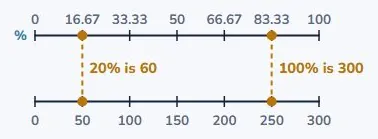
Two scales, side by side
- Percentages on one scale, the actual amount on the other.
- 20% lines up with 60.
- So 100% lines up with 300. Read it straight off.
The method behind that picture
- Get down to 1% first, then scale up to 100.
- 3% is 27, so 1% is 27 ÷ 3, which is 9.
- Then 100% is 9 × 100, which is 900.
| Step | Working | Gives |
|---|---|---|
| 3% is | 27 | |
| So 1% is | 27 ÷ 3 | 9 |
| So 100% is | 9 × 100 | 900 |
Check it, and do one more
- 3% of 900 is 27, so 900 is right.
- Another: 15% is 45. So 1% is 45 ÷ 15, which is 3.
- 100% is 300. The whole is always bigger than the part.
| Step | Working | Gives |
|---|---|---|
| 15% is | 45 | |
| 1% is | 45 ÷ 15 | 3 |
| 100% is | 3 × 100 | 300 |
Ratios: an unequal split
- A ratio says how a whole is shared out unevenly.
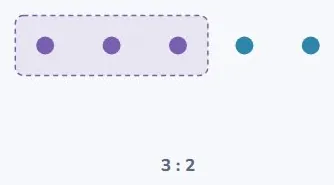
- 3 : 2 means three for every two.
- Read it aloud as "three to two".
Count the parts first. Always
- 3 : 2 is three parts and two parts.
- Which is five parts altogether.
- Not three. Not two. Five. This is the whole trick.
| Step | Working | Gives |
|---|---|---|
| Ratio 3 : 2 | 3 parts and 2 parts | 5 parts in total |
Splitting 60 in the ratio 3 : 2
- Five parts, and 60 to share, so 60 ÷ 5 = 12 per part.
- One share gets three parts: 3 × 12 = 36.
- The other gets two: 2 × 12 = 24.
| Step | Working | Gives |
|---|---|---|
| Ratio 3 : 2 | 3 parts and 2 parts | 5 parts in total |
| 60 ÷ 5 | what one part is worth | 12 |
| 3 parts | 3 × 12 | 36 |
| 2 parts | 2 × 12 | 24 |
Two checks, and you need both
- Do they add to 60? 36 + 24 does. Good.
- But 30 and 30 also add to 60, and that is wrong.
- So also check the shape: 36 : 24 divides down to 3 : 2.
| Check | Working | Result |
|---|---|---|
| Do they add up? | 36 + 24 | 60 |
| Is it the right shape? | 36 : 24, both ÷ 12 | 3 : 2 |
| Both pass | so the split is right |
When the ratio is given against the whole
- "3 out of 8 of the 32" is not a part-to-part ratio.
- It is a fraction. 3/8 of 32 is 12.
- The rest is 20, and as a ratio that split is 3 : 5.
| Step | Working | Gives |
|---|---|---|
| 3 out of 8 of 32 | that is 3/8 | 12 |
| The rest | 32 − 12 | 20 |
| As a ratio | 12 : 20, both ÷ 4 | 3 : 5 |
Telling the two kinds apart
- 3 : 2 compares one part with the other part.
- 3 out of 5 compares one part with the whole.
- Same split. Read which comparison you were given.
| Written | Compares | Total |
|---|---|---|
| 3 : 2 | part with part | 5 parts |
| 3 out of 5 | part with whole | 5 parts |
| 3/5 | the same thing again | 5 parts |
Writing a split as a ratio
- Two people got 36 and 24. What is the ratio?
- Write 36 : 24, then divide both by anything you can.
- Both by 12 gives 3 : 2. Simplify, same as a fraction.
| Step | Working | Gives |
|---|---|---|
| Start with | 36 : 24 | |
| Both ÷ 4 | 9 : 6 | |
| Both ÷ 3 | 3 : 2 | |
| Or ÷ 12 at once | 3 : 2 |
One split, every notation you know
- That 3 : 2 split is also 3/5 and 2/5.
- Which is 0.6 and 0.4.
- Which is 60% and 40%. Four notations, one relationship.
| Notation | Compares | The split |
|---|---|---|
| Ratio | part to part | 3 : 2 |
| Fractions | part to whole | 3/5 and 2/5 |
| Decimals | 0.6 and 0.4 | |
| Percentages | 60% and 40% |
Your turn: four questions
- Pause here and try all four.
- Question 2 wants the swap. Do not multiply anything hard.
- For question 3, count the parts before you divide.
| Question | |
|---|---|
| 1 | If 5% of a number is 35, what is the number? |
| 2 | Work out 8% of 25 the easy way. |
| 3 | Divide 72 in the ratio 5 : 3. |
| 4 | Write 40 : 16 in its simplest form. |
Show answer
1. 700. 1% is 35 ÷ 5 = 7, and 100% is 700. 2. 2. Swap it to 25% of 8, which is a quarter of 8. 3. 45 and 27. That is 8 parts, 72 ÷ 8 = 9 per part, then 5 × 9 and 3 × 9. Check: 45 + 27 = 72. 4. 5 : 2. Both numbers divide by 8.
The answers
- 1% is 7, so the number is 700.
- 8% of 25 is 25% of 8, a quarter of 8, which is 2.
- 72 in 5 : 3 is 45 and 27. And 40 : 16 is 5 : 2.
| Answer | |
|---|---|
| 1 | 700 |
| 2 | 2 |
| 3 | 45 and 27 |
| 4 | 5 : 2 |
What to take away
- a% of b is always b% of a. Pick whichever is easier.
- To get back to the whole, find 1% and multiply by 100.
- And with a ratio, count the parts before dividing anything.
| Remember | |
|---|---|
| a% of b | equals b% of a, always |
| Back to 100% | find 1% first, then times 100 |
| A ratio | count the parts before you divide |
| 3 : 2 | is 5 parts, not 3 and not 2 |
| Check | the two parts must add to the whole |
Is your child on track?
Take the free placement test