Decimals, fractions of amounts, and working backwards
What this lesson covers
- Ratios can be used to describe proportional relationships and unequal division of a whole.
Before you multiply, trap it
- 2.3 × 45. Do not reach for the method yet.
- 2 × 45 is 90. 3 × 45 is 135.
- 2.3 sits between 2 and 3, so the answer sits between those.
| Benchmark | Compared | Value |
|---|---|---|
| 2 × 45 | too small | 90 |
| 3 × 45 | too big | 135 |
| So 2.3 × 45 | lands between | 90 to 135 |
Now the actual multiplication
- 2.3 is just 23 divided by 10.
- So do 23 × 45 first, which is 1035.
- Then divide by 10, giving 103.5. Inside our bracket.
| Step | Working | Gives |
|---|---|---|
| 2.3 is | 23 ÷ 10 | |
| So 2.3 × 45 is | 23 × 45, then ÷ 10 | |
| 23 × 45 | 1035 | |
| ÷ 10 | 103.5 |
Which is where the shortcut comes from
- Count the decimal places in the question.
- Put the same number into the answer.
- It is not a separate rule. It is that division, tidied up.
| Calculation | Places | Answer |
|---|---|---|
| 2.3 × 45 | 1 decimal place in the question | 103.5 |
| 1.5 × 2.4 | 2 decimal places | 3.6 |
The one that looks wrong
- 0.4 × 0.2. The digits give 4 × 2 = 8.
- Two decimal places in the question, so two in the answer.
- 0.08, not 0.8. Two numbers under 1 multiply to something smaller.
| Calculation | Places | Answer |
|---|---|---|
| 2.3 × 45 | 1 decimal place in the question | 103.5 |
| 1.5 × 2.4 | 2 decimal places | 3.6 |
| 0.4 × 0.2 | 2 decimal places | 0.08 |
A fraction of a whole number
- 2/5 of 42. Write the 42 as 42/1 and multiply.
- 2 × 42 over 5 gives 84/5.
- That is an improper fraction, and it is a correct answer.
| Step | Working | Gives |
|---|---|---|
| 2/5 of 42 | write 42 as 42/1 | 2/5 × 42/1 |
| Multiply | 2 × 42 over 5 | 84/5 |
Tidying it into a mixed number
- 84/5 means 84 divided by 5.
- 5 goes into 84 sixteen times, with 4 left over.
- So 16 4/5. Or 16.8, if the question wants a decimal.
| Step | Working | Gives |
|---|---|---|
| 2/5 of 42 | write 42 as 42/1 | 2/5 × 42/1 |
| Multiply | 2 × 42 over 5 | 84/5 |
| As a mixed number | 84 ÷ 5 is 16, r 4 | 16 4/5 |
Percentages, built from ten percent
- 35% of 180. Start with 10%, which is 18.
- Three lots gives 30%, which is 54.
- 5% is half of 10%, so 9. Together, 63.
| Step | Working | Gives |
|---|---|---|
| 10% of 180 | 180 ÷ 10 | 18 |
| 30% is | three lots | 54 |
| 5% is | half of 10% | 9 |
| 35% is | 54 + 9 | 63 |
Or in a single multiplication
- 35% is 0.35 as a decimal.
- 180 × 0.35 is 63. Same answer, one step.
- Use this with a calculator. Use the other to check it.
| Step | Working | Gives |
|---|---|---|
| 35% as a decimal | 35 ÷ 100 | 0.35 |
| 180 × 0.35 | 63 | |
| Same answer | one step instead of three |
A quick one, no calculator
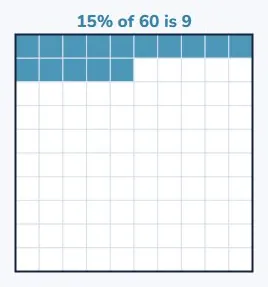
- 15% of 60. A tenth of 60 is 6.
- Half of that is 3, which is the 5%.
- 6 + 3 = 9. Faster than typing it.
Everything so far went one way
- You were given the whole and asked for a part.
- 2/5 of 42. 35% of 180. 15% of 60.
- Now we turn it round, and this is the hard bit.
| Given | Asked for | Direction |
|---|---|---|
| the whole | a part of it | forwards |
| a part | the whole | backwards |
One question before any method
- 8 is three fifths of a set. How big is the set?
- Do not work it out. Just answer this: bigger or smaller than 8?
- Bigger. Three fifths is not the whole thing.

Multiply by the fraction, upside down
- Going forwards you multiply by 3/5.
- Going backwards you multiply by 5/3.
- 8 × 5/3 is 40/3, which is 13 1/3.
| Step | Working | Gives |
|---|---|---|
| 8 is 3/5 of it | so multiply by the flip | 8 × 5/3 |
| Multiply | 8 × 5 over 3 | 40/3 |
| As a mixed number | 40 ÷ 3 is 13, r 1 | 13 1/3 |
And check it, in one line
- 13 1/3 is bigger than 8, as we said it had to be.
- Take three fifths of 40/3 and you get 8 back.
- Reverse problems always check themselves. Always do it.
| Step | Working | Gives |
|---|---|---|
| 8 is 3/5 of it | so multiply by the flip | 8 × 5/3 |
| Multiply | 8 × 5 over 3 | 40/3 |
| As a mixed number | 40 ÷ 3 is 13, r 1 | 13 1/3 |
| Check | 3/5 of 40/3 | 8 |
Why turning it over works
- 8 is three fifths, so one fifth is 8 ÷ 3.
- The whole is five of those: 8 ÷ 3 × 5.
- Which is exactly 8 × 5/3. Same thing, written shorter.
| Step | Working | Gives |
|---|---|---|
| Three fifths is | 8 | |
| So one fifth is | 8 ÷ 3 | 8/3 |
| Five fifths is | 8/3 × 5 | 40/3 |
And a word you will need next
- A ratio describes a split that is not equal.
- 3 : 2 means three for every two. Part against part.
- 3 out of 5 is the same split as a fraction. Part against whole.
| Written | Compares | Means |
|---|---|---|
| 3 : 2 | part to part | 3 for every 2 |
| 3 out of 5 | part to whole | a fraction |
| Same split | described two ways |
Your turn: four questions
- Pause here and try all four.
- Question 4 is the backwards one. Decide the direction first.
- Then check your answer by going forwards again.
| Question | |
|---|---|
| 1 | Work out 1.4 × 25. |
| 2 | What is 3/8 of 20? |
| 3 | What is 20% of 85? |
| 4 | If 9 is 3/4 of a number, what is the number? |
Show answer
1. 35. 14 × 25 = 350, and one decimal place in the question puts it at 35.0. 2. 7 1/2. 3/8 × 20/1 = 60/8, which is 7.5, or 7 1/2. 3. 17. A tenth of 85 is 8.5, so two tenths is 17. 4. 12. Multiply by the flip: 9 × 4/3 = 36/3 = 12. Check it, three quarters of 12 is 9. And 12 is bigger than 9, which it had to be.
The answers
- 1.4 × 25 is 35. And 3/8 of 20 is 60/8, which is 7 1/2.
- 20% of 85 is 17, since a tenth is 8.5.
- 9 × 4/3 is 12. And three quarters of 12 is 9, so it checks.
| Answer | |
|---|---|
| 1 | 35 |
| 2 | 7 1/2 |
| 3 | 17 |
| 4 | 12 |
What to take away
- Estimate a decimal product before you place the point.
- Going backwards, multiply by the fraction turned over.
- And always ask whether the answer should grow or shrink.
| Remember | |
|---|---|
| Decimal products | estimate first, then count the places |
| Fraction of an amount | multiply, then tidy to a mixed number |
| Percentages | build from 10%, or multiply once |
| Going backwards | multiply by the fraction turned upside down |
| Always ask | should the answer be bigger or smaller? |
Is your child on track?
Take the free placement test