Probability as a fraction, a decimal and a percentage
What this lesson covers
- Lists, tables, and tree diagrams are useful systematic methods for generating all possible outcomes.
- If all possible outcomes are assumed to be equally likely, the probability of an event is number of ways the event can happen/total number of possible outcomes.
- Probabilities can be expressed as a fraction or decimal between 0 and 1, or as a percentage between 0% and 100%.
- An event is a subset of the sample space and thus can be a single outcome or a combination of outcomes.
- The probability of an event and its complement add to 1.
Which is more likely: 3/8 or 40%?
- You cannot tell while they are written differently.
- 3/8 is 0.375. And 40% is 0.4. So the 40% is bigger.
- That was a conversion problem, not a probability one.
| Written | As a decimal | |
|---|---|---|
| 3/8 | 0.375 | |
| 40% | 0.4 | larger |
Where a probability comes from
- Count the ways the thing you want can happen.
- Divide by how many outcomes there are altogether.
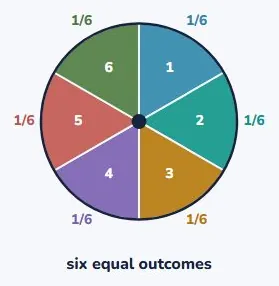
- One face is a 6, out of six faces. So P(6) is 1/6.
| Step | Working | Gives |
|---|---|---|
| Ways it can happen | one face is a 6 | 1 |
| Total outcomes | six faces | 6 |
| Probability | 1 ÷ 6 | 1/6 |
But only if the outcomes are equally likely
- That formula assumes no face is favoured over another.
- For the weighted die from last lesson, it is simply wrong.
- Check the assumption before you use the formula.
Every probability sits between 0 and 1
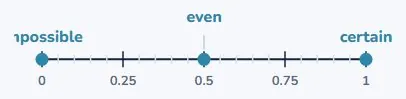
- 0 means impossible. 1 means certain.
- Everything real sits somewhere between them.
- As a percentage that is 0% to 100%. Never more.
And can be written three ways
- P(6) is 1/6, which is 0.167, which is 16.7%.
- One probability. Three notations. Same number.
- Exactly as fractions, decimals and percentages always were.
| Event | Fraction | Decimal or percentage |
|---|---|---|
| P(6) | 1/6 | 0.167 or 16.7% |
| P(even) | 1/2 | 0.5 or 50% |
| P(more than 4) | 1/3 | 0.333 or 33.3% |
| P(not 6) | 5/6 | 0.833 or 83.3% |
Which is not a formality
- A fraction is exact. 1/3 beats 0.333 every time.
- A percentage is easiest to say out loud and to compare.
- Pick whichever the question needs, and convert freely.
| Notation | Best for | |
|---|---|---|
| Fraction | being exact | 1/3 |
| Decimal | comparing and calculating | 0.333 |
| Percentage | saying it to somebody | 33.3% |
An event can be more than one outcome
- Rolling a 6 is one outcome. That is an event.
- Rolling an even number is three outcomes. Also one event.
- An event is just the set of outcomes that count as a win.
| Event | Outcomes in it | Probability |
|---|---|---|
| Rolling a 6 | one outcome | 1/6 |
| Rolling an even number | 2, 4 or 6 | 3/6 |
| Rolling more than 4 | 5 or 6 | 2/6 |
| All of these | are single events |
So count the ways, not the questions
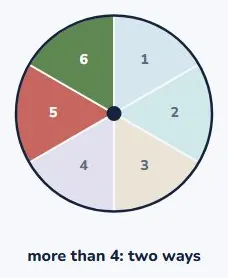
- "More than 4" on a die. Which faces count? 5 and 6.
- Two ways out of six. So 2/6, which is 1/3.
- Careful: more than 4 does not include the 4.
A bag of ten counters
- 5 red, 3 blue, 2 green. Ten altogether.
- P(red) is 5/10, which is a half, or 50%.
- P(blue) is 30%, P(green) 20%. They total 100%.
| Colour | Count | Probability |
|---|---|---|
| Red | 5 of 10 | 1/2 or 50% |
| Blue | 3 of 10 | 0.3 or 30% |
| Green | 2 of 10 | 1/5 or 20% |
| Together | 100% |
And they always total 1
- Every draw produces exactly one of the three colours.
- So the three probabilities have to account for everything.
- 50 plus 30 plus 20 is 100%. It is a useful check.
| Colour | Count | Probability |
|---|---|---|
| Red | 5 of 10 | 1/2 or 50% |
| Blue | 3 of 10 | 0.3 or 30% |
| Green | 2 of 10 | 1/5 or 20% |
| Together | 100% |
Comparing two events
- Is red more likely than blue? Put them in one notation.
- 1/2 is 0.5. 3/10 is 0.3.
- So red is more likely. That is why converting matters.
| Event | Converted | Value |
|---|---|---|
| P(red) = 1/2 | as a decimal | 0.5 |
| P(blue) = 3/10 | as a decimal | 0.3 |
| So red | is more likely |
Everything else is the complement
- P(6) is 1/6. So P(not 6) must be the other 5/6.
- Together they account for every outcome, so they total 1.
- P(not A) = 1 − P(A). Always.
| Event | Working | Probability |
|---|---|---|
| P(6) | 1/6 | |
| P(not 6) | 5/6 | |
| Together | 1/6 + 5/6 | 1 |
| So P(not A) | 1 − P(A) |
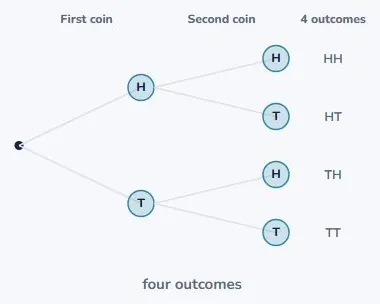
Two coins, and all four outcomes
- A tree lists them without missing any.
- Two branches, then two more from each: four outcomes.
- HH, HT, TH, TT. Not three, which is the usual guess.
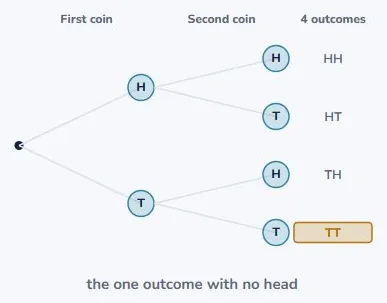
Now: at least one head
- Count them directly: HH, HT and TH. Three out of four.
- Or notice that the only failure is TT, which is 1/4.
- So it is 1 − 1/4, which is 3/4. One subtraction.
"At least" is the signal
- Whenever a question says at least, try the complement first.
- Counting the successes is usually the longer job.
- And the longer job is where the miscounts happen.
| Route | Work | Answer |
|---|---|---|
| P(at least one head) | count HH, HT, TH | 3/4 |
| Or: P(no heads) | only TT | 1/4 |
| So P(at least one) | 1 − 1/4 | 3/4 |
| "At least" | means try the complement |
Your turn: four questions
- The bag holds 4 red and 6 blue. Pause here.
- Question 1 wants all three notations.
- Question 4: read whether the 4 itself is included.
| Question | |
|---|---|
| A bag holds 4 red and 6 blue counters. | |
| 1 | Find P(red) as a fraction, a decimal and a percentage. |
| 2 | Find P(not red). |
| 3 | Flip two coins. Find P(two tails). |
| 4 | Roll a die. Find P(more than 4). |
Show answer
1. 4/10, which is 2/5, or 0.4, or 40%. 2. 0.6, or 60%, or 3/5. Either count the 6 blue out of 10, or take 1 − 0.4. 3. 1/4. The four outcomes are HH, HT, TH and TT, and only one is two tails. 4. 2/6, which is 1/3. More than 4 means 5 or 6, so two outcomes out of six. Note it does not include the 4 itself.
The answers
- P(red) is 4/10, which is 2/5, or 0.4, or 40%.
- P(not red) is 0.6, either by counting or by 1 − 0.4.
- Two tails is 1/4. And more than 4 is 2/6, which is 1/3.
| Answer | |
|---|---|
| 1 | 2/5, 0.4, 40% |
| 2 | 0.6 |
| 3 | 1/4 |
| 4 | 1/3 |
What to take away
- Ways it can happen, over total outcomes, if they are equally likely.
- One probability, three notations. Convert before you compare.
- And when a question says at least, reach for the complement.
| Remember | |
|---|---|
| P(event) | ways it happens over total outcomes |
| Only when | the outcomes are equally likely |
| One probability | three notations; convert to compare |
| An event | can be several outcomes at once |
| "At least" | is the signal to use the complement |
Is your child on track?
Take the free placement test