Experimental probability and the Law of Large Numbers
What this lesson covers
- Some chance-based situations, such as rolling a weighted die, can only be explored through probability experiments.
- Results from sets of repeated trials for the same experiment may vary.
- The Law of Large Numbers states that as the number of trials in a chance experiment increases, the experimental probability will approach the experiment's theoretical probability.
- The estimated probability of an event from an experiment is the number of times the event happens divided by the total number of trials in the experiment (i.e. the relative frequency for that event).
Some things you cannot work out in advance
- A fair coin has two identical sides, so heads is a half.
- You did not have to flip anything to know that.
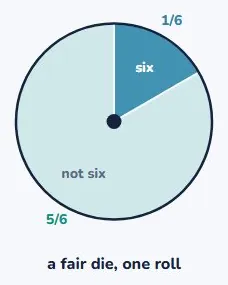
- Now weight one side of a die. What is the chance of a six?
| Situation | Why | How to find out |
|---|---|---|
| A fair coin | two identical sides | reason it out |
| A fair die | six identical faces | reason it out |
You genuinely cannot calculate that
- The argument for a fair die is that the faces are identical.
- Weight it, and that argument is gone. There is nothing left.
- The only way to find out is to roll it and count.
| Situation | Why | How to find out |
|---|---|---|
| A fair coin | two identical sides | reason it out |
| A fair die | six identical faces | reason it out |
| A weighted die | the symmetry is broken | you must experiment |
| A drawing pin | no symmetry at all | you must experiment |
So: count, and divide
- Count how many times the thing happened.
- Divide by how many trials you did altogether.
- 13 heads in 20 flips gives 13 ÷ 20, which is 0.65.
| Step | Working | Gives |
|---|---|---|
| Count the event | heads came up | 13 times |
| Count the trials | we flipped | 20 times |
| Divide | 13 ÷ 20 | 0.65 |
That fraction has a name
- It is the relative frequency of the event.
- Relative, because it is measured against the total.
- And it is an estimate of the probability, not the probability.
| Term | Means | |
|---|---|---|
| Frequency | how many times it happened | 13 |
| Relative frequency | out of how many trials | 13/20 |
| As a probability | an estimate | 0.65 |
Two people, same experiment, different answers
- Both roll the same die 30 times and count sixes.
- One gets 11, so 0.367. The other gets 4, so 0.133.
- Nobody made a mistake. This is normal.
| Run | Result | Estimate |
|---|---|---|
| Run 1 | 11 sixes in 30 rolls | 0.367 |
| Run 2 | 4 sixes in 30 rolls | 0.133 |
| Same die, same method | different answers |
Because each trial is its own event
- The die has no memory and no quota to fill.
- Any 30 rolls could come out almost any way.
- So an estimate from 30 trials is a rough one.
So do more of them
- Take a fair coin, where we know the answer is 0.5.
- Flip it 20 times, then 100, then 1000.
- Watch what the estimate does.
| Trials | Heads | Estimate |
|---|---|---|
| 20 flips | 13 heads | 0.65 |
It closes in on the truth
- 20 flips: 13 heads, so 0.65. A long way out.
- 100 flips: 54 heads, so 0.54. Closer.
- 1000 flips: 508 heads, so 0.508. Very close indeed.
| Trials | Heads | Estimate |
|---|---|---|
| 20 flips | 13 heads | 0.65 |
| 100 flips | 54 heads | 0.54 |
| 1000 flips | 508 heads | 0.508 |
| Theoretical | 0.5 |
The errors make it obvious
- Out by 0.15. Then by 0.04. Then by 0.008.
- Each time you do a lot more trials, the error shrinks.
- That is the Law of Large Numbers, and that is all it is.
| Trials | Compared | Error |
|---|---|---|
| 20 flips | 0.65 vs 0.5 | out by 0.15 |
| 100 flips | 0.54 vs 0.5 | out by 0.04 |
| 1000 flips | 0.508 vs 0.5 | out by 0.008 |
But not what most people think it says
- It does not say the counts even out. Look at them.
- 13 against 7 is a gap of 6. 508 against 492 is a gap of 16.
- The counts drifted further apart. The proportion closed in.
| Trials | Split | Raw gap |
|---|---|---|
| 20 flips | 13 heads, 7 tails | gap of 6 |
| 100 flips | 54 and 46 | gap of 8 |
| 1000 flips | 508 and 492 | gap of 16 |
| So the counts | drift further apart |
Which is why "it is due" is wrong
- Five heads in a row does not make tails more likely next.
- The coin cannot remember, and it has nothing to make up.
- The proportion settles by adding trials, not by correcting.
| Belief | Verdict | |
|---|---|---|
| Tails is due after five heads | wrong | the coin has no memory |
| The next flip is still 0.5 | right |
How many trials is enough?
- Thirty is a sensible minimum for a rough estimate.
- A hundred or more before you trust a second decimal place.
- And there is no number that makes it exact.
| Trials | Good for | |
|---|---|---|
| Under 30 | almost nothing | |
| 30 or so | a rough estimate | |
| 100 or more | seeing the law work | |
| Any number | never exact |
Back to the weighted die
- Roll it 60 times. Six comes up 15 times.
- Experimental probability: 15 ÷ 60, which is 0.25.
- A fair die would give about 0.167. This one favours six.
| Step | Working | Gives |
|---|---|---|
| Rolled 60 times | six came up | 15 times |
| Experimental | 15 ÷ 60 | 0.25 |
| A fair die would be | 1 ÷ 6 | 0.167 |
| So this die | favours six |
And what that does and does not tell us
- It tells us this die is probably not fair.
- It does not tell us 0.25 is the exact chance.
- For that, roll it a thousand times instead of sixty.
| Claim | Supported? | |
|---|---|---|
| This die is not fair | yes, well supported | |
| P(six) is exactly 0.25 | no, 60 trials is too few | |
| P(six) is well above 1/6 | yes |
Your turn: four questions
- Pause here and try all four.
- Question 2 wants a reason, not a calculation.
- Question 3 asks why, so say what more trials actually do.
| Question | |
|---|---|
| 1 | A coin is flipped 40 times and lands heads 18. Find the experimental probability. |
| 2 | Why can you not calculate the probability a drawing pin lands point up? |
| 3 | Which estimates better, 30 trials or 200? Why? |
| 4 | A bag is drawn from 20 times, red 7 times. Find P(red) from the experiment. |
Show answer
1. 0.45, from 18 ÷ 40. 2. It has no symmetry to reason from. Nothing about its shape tells you how often it lands point up, so the only way to find out is to drop it a few hundred times and count. 3. 200. More trials brings the proportion closer to the true value. Note it does not guarantee it, it just makes a large error much less likely. 4. 0.35, from 7 ÷ 20. And with only 20 trials that is a rough estimate.
The answers
- 18 ÷ 40 is 0.45.
- A drawing pin has no symmetry to reason from, so you must drop it.
- 200 trials, because the proportion settles. And 7 ÷ 20 is 0.35.
| Answer | |
|---|---|
| 1 | 0.45 |
| 2 | no symmetry to reason from |
| 3 | 200 trials |
| 4 | 0.35 |
What to take away
- Experimental probability is a count divided by the trials.
- More trials brings the proportion in, not the counts.
- And some situations can only ever be explored by experiment.
| Remember | |
|---|---|
| Experimental probability | times it happened, over trials |
| Two runs | of the same experiment will disagree |
| More trials | brings the proportion closer |
| The counts | drift further apart, and that is fine |
| A weighted die | can only be explored by rolling it |
Is your child on track?
Take the free placement test