Volume, capacity and converting units
What this lesson covers
- Liquids can be measured by capacity and by volume; there are standard conversions between measurements, in particular 1 mL = 1 cm³, 1L = 1000 cm³, and 1 m³ = 1000 L.
Two words that sound like one thing
- Volume is how much space something takes up.
- Capacity is how much a container can hold.
- Related, and measured in different units. Usually.
| Word | Means | Measured in |
|---|---|---|
| Volume | space a thing takes up | cm³, m³ |
| Capacity | what a container holds | mL, L |
And the bridge between them
- One millilitre is exactly one cubic centimetre.
- Not roughly. Exactly, by definition.
- So capacity and volume are the same quantity, relabelled.
| Word | Means | Measured in |
|---|---|---|
| Volume | space a thing takes up | cm³, m³ |
| Capacity | what a container holds | mL, L |
| Bridge | 1 mL is exactly 1 cm³ |
Start with lengths, which you know
- A centimetre is 10 millimetres.
- A metre is 100 centimetres.
- A kilometre is 1000 metres. Nothing new yet.
| Unit | Equals | |
|---|---|---|
| 1 cm | 10 mm | |
| 1 m | 100 cm | |
| 1 km | 1000 m |
So is a square centimetre 10 square millimetres?
- It is the obvious guess, and it is wrong.
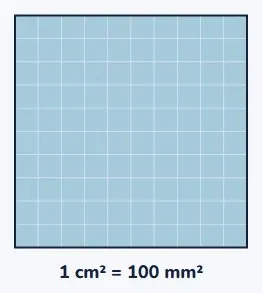
- Draw the square centimetre and cut it into millimetre squares.
- Count them. There are a hundred.
Because a square has two directions
- It is 10 millimetres across and 10 millimetres down.
- 10 times 10 is 100.
- The factor got used twice, because area has two dimensions.
| Question | Working | Answer |
|---|---|---|
| 1 cm is 10 mm | so is 1 cm² = 10 mm²? | no |
| Count the grid | 10 rows of 10 | 100 |
| 1 cm² | 100 mm² |
One rule for everything that follows
- For lengths, use the factor once.
- For areas, twice. For volumes, three times.
- The little 2 or 3 in the unit tells you how many.
| Measuring | Then | Factor |
|---|---|---|
| Length | use the factor once | × 10 |
| Area | use it twice | × 10 × 10 = 100 |
| Volume | use it three times | × 10 × 10 × 10 = 1000 |
Which gives you every area conversion
- cm² to mm²: 10 squared, so times 100.
- m² to cm²: 100 squared, so times 10 000.
- km² to m²: 1000 squared, so times a million.
| Going from | Because | Multiply by |
|---|---|---|
| cm² to mm² | 10² | × 100 |
| m² to cm² | 100² | × 10 000 |
| km² to m² | 1000² | × 1 000 000 |
And every volume one
- cm³ to mm³: 10 cubed, so times 1000.
- m³ to cm³: 100 cubed, which is a million.
- Nothing memorised. All of it rebuilt from 10, 100 and 1000.
| Going from | Because | Multiply by |
|---|---|---|
| cm³ to mm³ | 10³ | × 1000 |
| m³ to cm³ | 100³ | × 1 000 000 |
Going back, you divide by the same number
- mm² to cm² is dividing by 100, not by 10.
- The factor does not change direction. Only the operation does.
- 300 mm² is 3 cm². Not 30.
| Conversion | Do | Example |
|---|---|---|
| cm² to mm² | × 100 | 3 cm² = 300 mm² |
| mm² to cm² | ÷ 100 | 300 mm² = 3 cm² |
Now build a cube
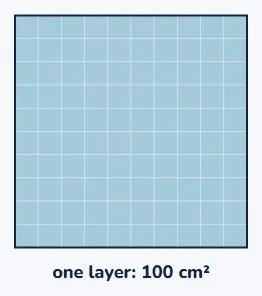
- Start with a square 10 centimetres each way.
- That face is 100 square centimetres.
- Now stack ten of those layers on top of each other.
That cube holds exactly one litre
- 10 × 10 × 10 is 1000 cubic centimetres.
- And a cubic centimetre is a millilitre, so 1000 millilitres.
- Which is one litre. Check it against a milk bottle.
| Step | Working | Gives |
|---|---|---|
| A cube 10 cm each way | 10 × 10 × 10 | 1000 cm³ |
| And 1 cm³ is 1 mL | so that is | 1000 mL |
| Which is | 1 litre |
And a cubic metre holds a thousand
- A metre is 100 centimetres, so 100 cubed is a million cm³.
- A million cubic centimetres is a million millilitres.
- Divide by 1000 and that is 1000 litres.
| Step | Working | Gives |
|---|---|---|
| 1 m³ | in cubic centimetres | 1 000 000 cm³ |
| That is | in millilitres | 1 000 000 mL |
| So 1 m³ | 1000 L |
Three conversions, start to finish
- 5 m² to cm²: the factor is 100 squared, so 50 000.
- 2.5 litres to cm³: times 1000, so 2500.
- 3 m³ to litres: times 1000, so 3000.
| Convert | Working | Answer |
|---|---|---|
| 5 m² to cm² | 5 × 10 000 | 50 000 cm² |
| 2.5 L to cm³ | 2.5 × 1000 | 2500 cm³ |
| 3 m³ to L | 3 × 1000 | 3000 L |
One going the other way
- 250 cubic centimetres. That is 250 millilitres.
- To get litres, divide by 1000.
- 0.25 litres. A small glass of something.
| Step | Working | Gives |
|---|---|---|
| 250 cm³ | same as | 250 mL |
| 250 mL | ÷ 1000 | 0.25 L |
Picking a unit that fits
- A swimming pool in millilitres is a silly number.
- A dose of medicine in litres is worse.
- Choose the unit that gives a number you can say out loud.
| Measuring | Not | Use |
|---|---|---|
| A swimming pool | not litres | m³ |
| A dose of medicine | not litres | mL |
| A farm | not m² | hectares or km² |
| A pencil lead | not cm | mm |
And having something to compare against
- A litre is that ten centimetre cube. A milk bottle.
- A square metre is about a small table top.
- If your answer is wildly off those, check the factor.
| Unit | Roughly | |
|---|---|---|
| 1 litre | a milk bottle | |
| 1 m² | a small table top | |
| 1 m³ | a large fridge |
Your turn: four questions
- Pause here and try all four.
- For each one, ask whether it is area or volume first.
- Question 4 goes backwards, so you will be dividing.
| Question | |
|---|---|
| 1 | Convert 4 m² into cm². |
| 2 | Convert 1.5 L into cm³. |
| 3 | Convert 2 m³ into litres. |
| 4 | Convert 300 mm² into cm². |
Show answer
1. 40 000 cm². The factor is 100 squared, which is 10 000. 2. 1500 cm³. A litre is 1000 cm³. 3. 2000 L. A cubic metre is 1000 litres. 4. 3 cm². Going the other way you divide, and the factor is still 100, not 10. The commonest wrong answer is 30.
The answers
- 4 m² is 40 000 cm². And 1.5 litres is 1500 cm³.
- 2 m³ is 2000 litres.
- 300 mm² is 3 cm². Dividing by 100, not by 10.
| Answer | |
|---|---|
| 1 | 40 000 cm² |
| 2 | 1500 cm³ |
| 3 | 2000 L |
| 4 | 3 cm² |
What to take away
- Square the length factor for area, cube it for volume.
- A millilitre is exactly a cubic centimetre.
- And a ten centimetre cube holds exactly one litre.
| Remember | |
|---|---|
| Area | square the length factor |
| Volume | cube it |
| 1 mL | is exactly 1 cm³ |
| A 10 cm cube | holds exactly 1 litre |
| 1 m³ | is 1000 litres |
Is your child on track?
Take the free placement test