Straight lines: what m and c actually do
What this lesson covers
- For a specific straight line, the gradient, m, and y-intercept, c, are fixed, and x varies with y according to the rule y = mx + c.
- The y-intercept touches the y-axis and has coordinates (0,c).
- In the equation of a line y = mx + c, m and c represent constants (they are unchanging), y and x can vary, and all the values of x and y that satisfy the equation create an infinite number of points that form the line.
- The gradient is a ratio that can be interpreted as the ‘steepness’ of a linear graph. A positive gradient slopes upwards when the graph is read from left to right. A negative gradient slopes downwards when the graph is read from left to right. A horizontal line has a gradient equal to zero. Its equation will be y = c.
One line, four different-looking things
- A rule, a table of numbers, a graph, and a growing pattern.
- Those can all be the same straight line.
- And two numbers control all four of them.
Four letters, and only two of them move
- In y = mx + c, m and c are fixed once you pick a line.
- x and y are the ones that vary.
- Sorting that out first makes everything else readable.
| Letter | What it is | Fixed or varying |
|---|---|---|
| m | the gradient | fixed for a given line |
| c | the y-intercept | fixed for a given line |
| x | the input | varies |
| y | the output | varies with x |
Build a table by substituting
- Take y = 2x + 1 and feed it x values, negatives included.
- At x = −2, that is minus four plus one, so y is −3.
- Nothing here is new. It is substitution from last lesson.
| x | Working | y |
|---|---|---|
| −2 | 2(−2) + 1 | −3 |
| −1 | 2(−1) + 1 | −1 |
| 0 | 2(0) + 1 | 1 |
| 1 | 2(1) + 1 | 3 |
| 2 | 2(2) + 1 | 5 |
| 3 | 2(3) + 1 | 7 |
Plot them, and they line up
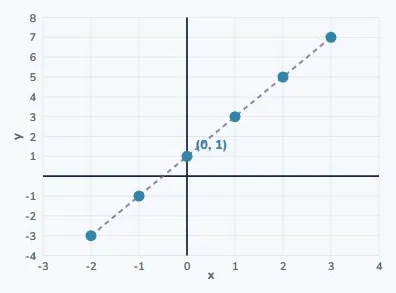
- Each row of the table is a point on the plane.
- Six points, and every one lands on the same straight line.
- And there are infinitely many more between them.
Both numbers are visible in the table
- The y values go up by 2 every time. That step is m.
- When x is 0, y is 1. That value is c.
- So you can write the rule without seeing the graph at all.
| What to look at | What you see | What it tells you |
|---|---|---|
| The y values | −3, −1, 1, 3, 5, 7 | |
| Step between them | always up 2 | so m = 2 |
| Value when x is 0 | 1 | so c = 1 |
| The rule | y = 2x + 1 |
The gradient is a ratio, not a mood
- Pick two points on the line. Go across, then up.
- From (1, 3) to (3, 7): across 2, up 4.
- Four over two is two. Rise over run.
| Step | Detail | Value |
|---|---|---|
| From (1, 3) to (3, 7) | ||
| Across | 1 to 3 | run of 2 |
| Up | 3 to 7 | rise of 4 |
| Gradient | rise over run | 4/2 = 2 |
What the sign of m looks like
- Positive m goes uphill as you read left to right.
- Negative m goes downhill.
- And m of zero is flat, which makes the rule just y equals c.
| Gradient | On the graph | Example |
|---|---|---|
| m is positive | uphill, left to right | y = 2x + 1 |
| m is negative | downhill, left to right | y = −3x + 5 |
| m is zero | flat | y = 4 |
When the table does not start at zero
- y is 10, 7, 4, 1 for x of 1, 2, 3, 4. The step is down 3.
- So is c ten? No. Ten is y when x is one, not zero.
- Step back one more: add 3. c is 13.
| Step | Reasoning | Note |
|---|---|---|
| x = 1, 2, 3, 4 | y = 10, 7, 4, 1 | |
| Step | down 3 each time | so m = −3 |
| Is c = 10? | no, that is y at x = 1 | |
| Step back to x = 0 | 10 + 3 | c = 13 |
| The rule | y = −3x + 13 | check at x = 4: 1 |
That catches people constantly
- Reading c as the first number in the table usually works.
- It works only because tables often happen to start at zero.
- c is always the value at x equals zero. Nothing else.
The line is every point that fits the rule
- A table gives you six points. The line has infinitely many.
- Any x and y that make the equation true is on it.
- So to test a point, just substitute and see.
Now a pattern, which looks like a different topic
- A shape made of matches: 4, then 7, then 10, then 13.
- Three more each time. Every single step.
- A constant increase. You have seen that before.
| Position | Matches | Change |
|---|---|---|
| Position 1 | 4 matches | |
| Position 2 | 7 matches | up 3 |
| Position 3 | 10 matches | up 3 |
| Position 4 | 13 matches | up 3 |
So find m and c, exactly as before
- The constant increase is 3, so m is 3.
- At position zero it would be 1, so c is 1.
- The rule is 3n + 1. Check position 4: thirteen. Correct.
| Step | Working | Result |
|---|---|---|
| Constant increase | 3 each step | so m = 3 |
| At position 0 | 4 − 3 | so c = 1 |
| The rule | 3n + 1 | |
| Check position 4 | 3(4) + 1 | 13, correct |
| Predict position 10 | 3(10) + 1 | 31 |
And this is what the rule buys you
- Position 10 needs 31 matches. You did not count them.
- Position 100 would need 301. Still no counting.
- That is the entire reason for finding a rule.
The same two numbers, in all four places
- This is the idea the lesson has been building.
- A rule, a table, a graph, a pattern.
- m and c are in every one of them, wearing different clothes.
| Representation | Where m and c are | Example |
|---|---|---|
| In the rule | written down | y = 3n + 1 |
| In a table | m is the step | c is y at 0 |
| On a graph | m is the slope | c is the crossing |
| In a pattern | m is what is added | c is the start |
What to take away
- Six things, and this is the lesson everything later leans on.
| m and c | are fixed for a line. x and y vary |
| c | is where the line crosses the y-axis, at (0, c) |
| m | is rise over run, and its sign is the direction |
| A flat line | has gradient zero and the rule y = c |
| From a table | m is the step, and c is y when x is 0 |
| A growing pattern | is a straight line wearing a disguise |
Your turn
- Pause here and try all four.
- Answers are in the description.
| Question | |
|---|---|
| 1 | For y = 4x − 3, state the gradient and the y-intercept. |
| 2 | y = 5, 8, 11, 14 for x = 0, 1, 2, 3. The rule? |
| 3 | Does the line y = 2x + 1 pass through (4, 9)? |
| 4 | A pattern goes 5, 9, 13, 17. Find a rule for position n. |
Show answer
1. Gradient 4, y-intercept −3. They are simply the two numbers in the rule. 2. y = 3x + 5. The step is 3, so m is 3, and y is 5 when x is 0, so c is 5. 3. Yes. Substituting x = 4 gives 2 times 4 plus 1, which is 9, and that is the y value asked about. 4. 4n + 1. It goes up 4 each time, and at position 0 it would be 1. Check position 3: 4 times 3 plus 1 is 13.
The answers
- They are the two numbers in the rule.
- The step is 3, and y is 5 when x is 0.
- Substitute 4: two fours plus one is nine.
| Answer | |
|---|---|
| 1 | m = 4, c = −3 |
| 2 | y = 3x + 5 |
| 3 | Yes |
| 4 | 4n + 1 |
Is your child on track?
Take the free placement test